Sunday, August 31, 2008

The Olympics, Democtatic Convention ...

and Shakespeare’s first history play.


It’s a sort of weird brace of metaphor for:


‘THE FIRST PART OF THE CONTENTION BETWIXT THE TWO FAMOUS HOUSES OF YORK AND LANCASTER’.


During the Olympics I couldn’t help thinking of the way in which people were investing the participants with a sort of representative nationality – by this I mean they became like the ‘coronated’ king (yes, I know the word should be crowned but I wanted to ‘mark’ the idea); the sporting hero went out as a single champion (even if they were in a team) and fought not so much for a national pride as for that part of ‘me’ I had deposited in the symbol of ‘you’.

A bit abstract maybe ….


It was easy with Thorpe: Henry V if ever there was one. What a hero, what a fund of pride … and strangely, like Shakespeare’s Henry V, his magnificent success transcended any nationalism. By the end, all but the meanest minded wanted him to succeed … even if at the expense of ones own favourite. Bolt was more a Hal than a grown king – his antics not quite mature.


For Henry VI there were a number of contenders … we need a sportsman who shows a lot of early promise but who hasn’t quite lived up to them. The obvious contender is the British diver, young Mr Tom Daley: The build up he got, the press coverage and the general media attention lead a lot of people to expect … and what a flop (except, it wasn’t …) ! No medal, lost hopes, wasted investment.


No blame to the young man himself – it was our over expectation, our unsolicited demands, our unreasonable faith in a maturing boy … sound familiar? Henry VI is expected to perform in the same way … especially in competition with France. He doesn’t … and at the start of this play, we feel that disappointment. The magnificent ceremonial hype of trumpets and hautboys … and the immediate disaster of the loss of France.


But the Henry VI of this play is not Mr Daley - he is older … maybe Tom is the Henry of Henry VI Part 1. (And I want to make it very clear the boy done good – I am talking here of the expectations of others and the disappointment their wrong placed expectations result in.)

We need to look for an older, high expectation, low performance competitor … someone like Andy Murray?


Tennis got a bit of a rough ride from the English sporting press (well it might) for not really being an Olympic sport … there are much more important events for it than the Olympics (bet Mr Nadal and certainly Mr Federer would beg to differ). Murray wasn’t taking the competition seriously, he hadn’t prepared, he was focussed elsewhere. He thought he could swan in and get somewhere reasonable and people would be happy …


Now, that is more like the Henry VI of the ‘First Contention’. Henry is more focused on the Kingdom of Heaven than that of England … his paradise is not of this earth, he is not so interested in an Eden, although he doesn’t mind being there whilst he waits for a more important job of work over in the Flushing Meadows of … perdition.

But we are stuck with Murray – he’s the English number one, but there are obviously much better foreign princes and real monarchs out there … he is never going to perform, not even at home.


But, hold on, he’s not English … he’s really not entitled to the job of representing me … isn’t there someone else with a better right to do that?


Welcome to the American Political Conventions!


In the UK speechifying is about as important as … learning grammar: People nod in the direction but realise it is an outdated and impotent way of getting things done. The press conference and the sound bite are much more important (like genre and texting).


Not so in the quaint old US of A!


The conventions (origin: with talk although I had hoped it was with wind) are back to back speech making getting prime time coverage and swamping a nation already deaf to meaning with more meaningless but impassioned sounds.


And we are back to Shakespeare’s play.


As soon as Henry enters, his warm-up man, Suffolk, gives us a speech. It is one sentence long, lasts for around 15 lines and drops a lot of names. Great start to the convention. Set the ground, pull out all the supporters and place yourself at the centre of attention whilst nodding in the direction of the guy currently in power.


The new Queen throws in a similar but more fawning speech … great to be here, happy with the husband and the land (Mrs Obama or what? – God Bless America!). Then it’s the turn for the heavyweight contenders to way in … old powers first, Gloucester … (read Kennedy) and Cardinal Beaufort (read Clinton – which one I’ll lead you , and the results of this November’s election to decide).

But this is not the convention of today … this is a ‘certain loser’ convention. As soon as the candidate leaves the stage the speeches of descent start – each speaker jockeying for position.


I will watch the Republican convention with interest …

Saturday, August 23, 2008

Playing Tag ...

Strange game for grown people ...


However, seeing as El Geek has set the challenge I will go, so far, with it ... with a difference:

1) My first 'big' role in a school play (apart from doing 'all' the singing in earlier productions) was as Oberon - and Theseus ... and my costume was on hire from the RSC - as worn originally by ...Ian Richardson, I am not sure - but I think it was the one worn in the production Judy Dench played Titania and Helen Miren one of the lovers - so my costume 'big' resonance.

2) My mother, when she was at school, had stared in a performance of 'Midsummer Nights Dream' as Titania ... and was on her way to being a professional until struck down with TB. She always claimed to have been pushed in her pram by a young Charlie Chaplin and his brother Sid - but after she died we discovered it wasn't her but her older sister, Madge, who had that honour ... my grandmother, also invalided off the stage ran a 'guest house' for Music Hall performers in Manchester.

Her 'god father' was George Robey, the Prime Minister of Mirth which sort of compensates for her claiming more of a connection than she really had to greatness ... I of course would never dream of doing such a thing!

3) Willy Russell once described my acting as being, 'like that of Orson Welles' - he described me as a 'King Actor' ... and then added the somewhat deflationary, 'not necessarily good, but certainly big.' That was at a time he was casting his play, 'Blodd Brothers' first productin in Australia ... which eventually included Russel Crowe in the cast.

4) I attended the first ever public performance at the New London Globe - quite by accident. I was on holiday in London and had heard the place was opening ... went along with a friend to see it and they were selling tickets ... so, we bought a couple for the yard and that was it ... i was one of many, my friend, the first Romanian ever to see a production at the Globe!

5) When I was training to be a teacher I did my teaching practice in 'Mirfield', which is in Yorkshire - and many would regard it as the armpit of England. It is a town with two famous inhabitants .. one, the Yorkshire Ripper ... the other Patrick Stewart. He, as you may be aware, has gone on to greater things ... although I did teach at the school he attended, it was some time after he left - and no one knew in the school just what a star they had on their hands.


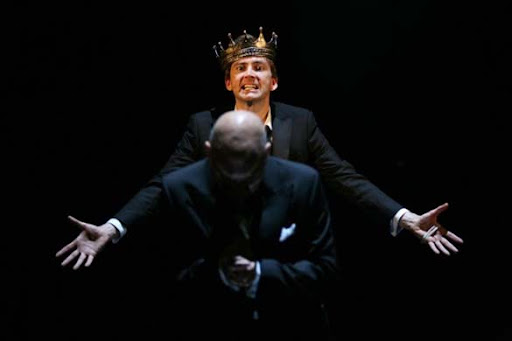
6) And a final Shakespeare (not spectacular) Farrar experience - Hamlet (above) is being played by Doctor Who ... the actor who played the Doctor before, Christopher Eccleston was taught drama by the boy (grown to man) who played Lysander in the production of The Dream I appeared in at school ... he also went on to teach the most recent 'Othello' at the RSC.

Small world isn't it ...


Wiving it at the Globe

It was, to say the least, an interesting day.

National Gallery in the morning – complete with red dressed, blond-haired Virgin; Globe Theatre for the ‘Merry Wives’ in the afternoon; a quick dash to ‘The Sound of Music’ in the evening. We ended squeezed in the last tube to Victoria … tired and somewhat satiated.

Nothing was quite what was expected.

I like Shakespearean comedy – you might have noticed.

What I didn’t know (because you sometimes forget that it is the ‘experts’ that have told you – and you should always be cautious and careful of expert opinion) is how good a play The Merry Wives of Windsor is.

I don't understand why there are not more school productions ... it would make an excellent school play.

After the Globe production I can’t understand why it isn’t better known or better loved. Verdi chose it for his operatic masterpiece and he obviously realized something – it is very funny.

It is also remarkably ‘feminist’ – the only sensible and solid people are the two wives … merry, and virtuous. All the men seem to be missing something – usually restraint.

In this production the women got good solid performances: As with the Romeo and Juliet production which visited Timisoara last month, it is an ensemble production – although with a full cast. There were no star performances – but that is what makes these comedies … they are not vehicles for individuals.

Falstaff was a part – and only a part, but an excellent part. He is balanced in the play with a “bugger”ing French doctor; a jealous, knuckle biting, husband; a language crunching schoolteacher and a small cheeky boy. And the production did just that – balanced.

The Globe experience is partly the stage and staging – the speed of the production (not breakneck like Romeo and Juliet) and the closeness to the audience all contribute to make the play user friendly. However, I was a little uncomfortable with the set – it had been extended into the courtyard with a walkway which seemed one step too far, I also don’t really think there was any necessity to cover the back of the Globe’s stage with a ‘mock-Elizabethan’ house front. This forced a lot of the action forward and made it difficult at times to see (I chose to try standing at the side of the stage and was acutely aware of how little the back area of the stage was used - in a previous visit I’d noticed how well it was used).

Maybe a danger for the modern productions at the globe is the designer … maybe they should just have a costume wo/man and dump the superfluous modern element of design (which was, strangely enough, the big problem of ‘The Sound of Music’ – all very impressive technicals interrupting the music)?

But that was a mere niggle: On a rain-threatening afternoon I stood for a couple of hours and laughed rather a lot … at a witty play with a social conscience delivered by a group of excellent performers giving the audience exactly what they need – an uplifting theatrical experience.

Having travelled across most of Europe for the day to see it … I was not disappointed. In fact, I'm looking at a way of doing it again.

Technorati Tags: , , ,

Saturday, August 16, 2008

Now, I didn't know that ...

When the Globe burnt down in 1613, there was a ballad written (knew that): On the Pitiful Burning of the Globe Play-house (link and link)

What I didn't know was that it mentions in it:

Then with swoll'n eyes, like drunken Flemings,
Distressed stood old stuttering Hemings.
Oh sorrow, pitiful sorrow, and yet all this is true.


Now, cast your mind back to 'Shakespeare in Love' and the character who delivers the prologue at the start of Romeo and Juliet (video).


He stutters ... and I thought it was all a directors or writers idea - in fact it is based on a real actor (although the character in the film is not Hemings).

The real stutterer was' of course, behind the printing of the folio! He also seems to have apprenticed as a grocer, become a freeman of London and died wealthy ... acting was as profitable then as now.

(Sorry about the size of the video - not Geek enough to make it smaller!)

Technorati Tags: , ,

Play Shakespeare off my list

Despite my having deleted all my entries to the play Shakespeare forum, I see they have been re-instated ...

I suggest anyone posting there be aware of the way the board management is willing to ignore the wishes of the people who post.

I, for one, will not be posting anything over on that site again.

Technorati Tags:

Wednesday, August 13, 2008

What the BBC did with it ...

I have to start out by making it clear, it was the BBC production of the three Henry VI Plays which got me hooked on the History plays - yes I knew Henry V and Henry IV Part 1, I'd endured Richard the Second and seen Larry hamming up the Third for all it was worth. But it was the BBC that made me register 'History Play' as something different. And they still keep up the good work: How well did Shakespeare know history?

The BBC though took a path I am not taking - they did the three Henry VI plays in historical chronological order, I am looking at them in a reconstructed order of their writing.

The three plays as a sequence I will leave until later on - possibly when I have finished the three Henry VIs, possibly when I look at the whole of the history plays.

Here I want to take a look at what the opening of 'The First Part of the Contention ...' was like - taking into consideration what I posted last and those rather irritating Olympics which have me glued to the TV even as I write.

I've blogged on the opening ceremony of the Olympics over on Thoughts from the Edge and won't tread the same ground - I will say though that both Shakespeare and the BBC open this exploration of a national history in the same spirit - big loud and colourful.

Which is precisely what the BBC production gave us - well, not so big (as befits a stage play) but certainly loud and colourful.

Trumpets blared, drums rolled, crowds cheered and in marched the key agents to the play which will follow - each preceded by a flag, each marching in and nodding to the king, who we don't see as the camera is peeping over his shoulder, and each taking up his appointed place.

The colours are all there - mainly in the costume but also in the painted wood of the 'bear-pit' the production is placed in, and in all the fluttering flags and shiny clothes.

Then, with all the 'athletes' in place, in comes the 'torch' on the hand of an upstart - rose-petal like discs of coloured paper fluttering around Margaret and Suffolk just as after a wedding - but this is a bride who has not yet married although a 'troth' has been plighted.

This has the essence of an Olympic ceremony and is as much an attempt to claim national identity and significance as any such splendours played out nowadays.

You get a 'feel good factor' - there is pride and there is hope.

Suffolk, speaking as only the politician in front of a national audience can, declares, "... in sight of England and her lordly peers ..." to have fulfilled all that was requested of him.

And you just know, in the original production - that sight of England was accompanied by a gesture to the assembled theatre - already dragged in emotionally by the music and flag waving.

You didn't quite get that from the TV. Although the voice made clear its importance - we are watching you - the world is watching you; Cue camera and roll.

Henry, weak of voice, pale of colour (although with lively eyes) responds.

He thanks Suffolk, then kisses his bride - and, if you are expecting warmth and love, excitement and passion, forget it. In a triumphal theatrical moment, Henry kisses the hand of Margaret. She had moved to kiss cheeks or lips and is visibly surprised.

This is back to the question of the marriage relationship - Henry, as a devout man, as a Catholic King esteems the Platonic above the lustful. Whatever, union is about to be sanctified, it is not going to be carnal. Friendship before equality? And, after the three kisses of 'The Taming of the Shrew' what clearer indication could you have of all not being well?

There is a disappointment - it is as if you were to discover the fireworks opening the Beijing Olympics were a computer trick, or the cute girl singing the Chinese national anthem was miming to someone else's voice.
The difference, of course, being we do not discover 'til after the event, the slight of hand in China - here the BBC give us, in the middle of the ceremony, disappointment and unease.

And they haven't finished with us yet ...


Technorati Tags: , , ,

Wednesday, August 06, 2008

And the trumpet shall sound


The first thing to strike you as the play opens is the noise – as my new ‘Complete Works’ (2nd edition) informs me,

trumpets flourish,

then hautboys

which is a pretty impressive, if loud, way to open.

You do notice it – there is a majesty, and a ceremony about it. A good trumpet ‘flourish’ – none of your wishy-washy blowing – this is a growing vigorously, a grand gesture, a flaunt, a boom! And then the hautboys follow – which is the signal for the stage to be processed (as in procession) on to … for a hautboy is to be processed to.

I like a good hautboy flourish almost as much as I like a good trumpet flourish.

Neither of Shakespeare’s previous plays even thought of opening like this – they both sort of … started: Which fitted their ‘domestic’ themes. Here we are in a different world – and, for the original Theatre audience, a more familiar world.

This is to be a play about England - this is to be a play about Dukes and Kings, about Duchesses and Queens, their lovers and rebellion – above all, rebellion: Overt, physical fighting and secret caterpillar creepings and crawlings; rebellion in the state, in the town, in the countryside and in the family.

And what colours and materials soon fill the stage! The royal velvety reds and rich shimmering blue silks, the sparkling cloth of golds, the lions and unicorns rampant, the full panoply of state laid out for both a royal wedding and a coronation.

For the young Henry VI, King of England is to meet for the first time his espoused bride and straight away lead her into Westminster Abbey for their wedding and her installation as Queen.

Which is when you notice that there is a link to both the previous plays – this is yet another play about marriage. Here the marriage is the actual union of man and woman, complete with all the associated ‘Shrew’ commands of mutuality and respect; but it is also the greater marriage of subject to state, for Henry is England; further, as God’s representative on Earth, wedding Henry is a holy marriage.

Now that is cause for the trumpets to flourish – and well might the hautboys ‘en-music’ the march to the alter.

How will Henry and Margaret measure up to the standards set by Petruccio and Katherine?


Technorati Tags: , ,

Tuesday, August 05, 2008

Must reads

... From the Shakespeare Post:

Gregory Doran Explains How He Picked David Tennant for Hamlet

and

Mary Rose Sank Because Crew Didn’t Speak English

The first because it is interesting, the second because it shows the international nature of the English navy and suggests all sorts of reasons why Shakespeare was so second-hand-knowledgeable about foreign climes (yes, I know Henry was before Shakey's time).

Natural pleasures and feathered friends

To be honest, I'm not convinced too many of my readers will be able to make use of a communication I received this morning:

I write to ask whether you would be willing to include a link to (or even write a blog entry about) the WINGS tour “Birds and the Oregon Shakespeare Festival,” conducted each June by Rich Hoyer and Bryan Bland. This imaginative combination of birding and culture follows in the tradition of our popular “Birds and Music” and “Birds and Art” tours of Europe. After a delightful morning of birding that includes famously delicious picnic breakfasts and lunches in stunningly gorgeous surroundings, we return in time for a daily performance in the the Iaters just a block from our hotel.


But to me it looks a wonderful combination!

I suspect that the two people leading the tour have found a cheap way to indulge themselves ... If only I had the energy (and knowledge) to do the same.

As I've blogged before - many times - there is a very strong sympathy between Shakespeare and 'Natural intelligence' - in fact, as I was listening to 'The First Part of the Contention' I was again struck by the number of references to birds and animals.

Unless my dream last night has confused me (and it might have, it was bird filled) this chap, [to be seen on the tour]:


...is the American equivalent of one of the stars of Shakespeare's first History Play!

If anyone reading this blog does get to go on the tour - enjoy!

Technorati Tags: , , ,

Sunday, August 03, 2008

Shakespeare's Matrimony


I wasn't going to post this here as it's a bit too 'school essay' - it was written for a different site. But, having just gone through a couple of performances of The First Part of the Contention (Henry VI, Part 2) I thought I better put down some markers -

Marriage has become such a common theme in Literature, and the works of Shakespeare so well known, that it is hard for us to realise that back in Elizabethan England ideas about marriage were very much up in the air.

Until the Reformation, the ideals of virginity, chastity and widowhood; of platonic relationships; of friendship - all rated higher than marriage.

With the coming of Protestantism, ideals changed.

Shakespeare was at the forefront of portraying these changes and many of his plays could be said to act as promotional tools for the act of marriage.

If Stanley Wells and his friends are right, Shakespeare's first two plays are both comedies - The Two Gentlemen of Verona and The Taming of the Shrew.

It is interesting to see how Shakespeare tackles the themes of the marriage debate in these plays - and it reveals several interesting aspects of the plays, some of which are much misunderstood.

The Two Gentlemen is a play about friendship - Valentine and Proteus start the play off with a dialogue making it very clear these two are ideal, youthful friends. What happens during the play undermines this ideal - deliberately so.

The thing that weakens their love for each other is love for a female: Shakespeare seems to be asking us if this is inevitable - will inter-gender love overpower, necessarily, intra-gender love?

But nothing is as simple as that in Shakespeare - Valentine has a one-to-one relationship with Silvia; Proteus already had an attachment to Julia, and then switches to the (un-reciprocated) love of Silvia. This, despite the exchange of rings and other tokens.

One is reminded of the idea of the fickleness of love at this point - and in several plays Shakespeare has young men switching their attentions (Demetrias, don't forget; and Romeo). Love is a necessary condition for a relationship, but is not sufficient.

Another doubt is raised by the way in which Valentine 'loves' Silvia - I am not alone in thinking there is almost a 'Platonic' basis to it - he is in love with an ideal, not with a real human.

The 'clown' Lance with his letter has progressed a little further than either of the two 'Gentlemen': His contract itemising the qualities of a potential wife widens the conditions; thought ought to be given to issues such as money and temperament, to weaknesses as well as strengths - it is very much a dead end in this play, the youth of the main protagonists seems to exclude them from making a sensible decision.

But Shakespeare hasn't quite finished with his exploration of the theme of friendship - there is one horrendous moment, towards the end of the play, where, after Proteus has attempted to force himself on Silvia, been stopped, and repented his sins, Valentine 'gives' Silvia to him.

Julia faints at this point - and well she might.

We need to realise that, far from condoning this action, the audience is meant to be as outraged as Silvia must be, as shocked as Julia. Portraying such a gross act Shakespeare is again questioning the ideal of friendship.

The Two Gentlemen quickly resolves itself into marriage - but we are left with an empty feeling. There is something not quite right in the pairings and the anything-but-gentlemen seem to get off lightly.

Perhaps Shakespeare felt so too, because his next play, The Taming of the Shrew, shows the successful pairing of a well matched couple - and some less than satisfactory fringe partnerships.

I've already written about Katherine and Petruccio (in Katerina's Just Desserts) and don't want to go over the same ground, but I do think it is important to point out their relationship is about a mutual sharing and suitability. What isn't talked about much is love.

There is a 'love' relationship in the play though, Lucentio and Bianca. At the time of their marriage, their are still issues to resolve - Bianca's refusal to come at the request of her husband is meant to signify the incompleteness of the match-making.

So too is the widow's refusal - where the marriage is based on financial, rather than emotional, compatibility.

What Katherine and Petruccio have done before this point, is worked through all the conditions needed to secure a successful and fecund marriage.

But there are other marriages in the Shrew - Sly, who appears in the Induction, is "married" twice, once to the page boy, and once to a real wife.

We ignore the Induction at our peril.

Sly is a drunk who is so full-up he falls asleep in the street. He is married to a 'shrew' (if we accept 'A Shrew' as indicating further additions to the Folio text) and who can doubt they deserve each other? This is a funny version of the need for a mutual relationship in marriage. Worth noting about Sly's real marriage is the apparent 'respect' he has for his wife - she is not 'madam' but a name - he wants to keep her as Alice or whatever .... surely an indication of social difference and criticism of the aristocratic?

Sly's other marriage is a reminder to the audience that what you are watching is not real, there is a pretence going on here - you are being presented with a dramatic fiction. All of the marriages Shakespeare represents on stage need to be viewed in this light - none are real, all are explorations of limited aspects of the state of matrimony.

Just how all this fits with Shakespeare's first History play I'll let you know in the next post.

Friday, August 01, 2008

To begin, at the beginning ...


We don't have any of the playbills which were posted to announce the performance of a Shakespeare play - although it has been suggested that the frontispieces of the early editions of the plays very much resembled them. With that in mind, I move on from the two early comedies to the first of the Histories ...

The announcement is up ... a new play by - well, it doesn't say. So, Mr Shksperd ain't yet well known enough - but the material is fairly extensively explained.

We start off with the announcement it is the first part - so this is like that Marlowe play - the one with Tamburlaine in it ... two parts.

And its about the fighting between the Yorkists and the Lancastrians ...

In fact - a lot of the plot is told - Humphry dies, Suffolk gets banished and dies, a Cardinal dies, tragically, and there's a rebellion - Jack Cade's.

Lot's of fighting and death then ... sounds a bit of an action movie to me ... just the sort of thing to fill in a cold winter's afternoon ...


Technorati Tags: , ,

Katerina's Just Desserts ....

(Some notes on Gender Relations in Taming of the Shrew)

There is a tendency to portray Katherine as some sort of abused everywoman and Petruccio as a typical misogynist male. Indeed, this is the line taken in many classrooms and leads to a mistaken understanding both of the play and of Elizabethan society. Support for the stance can be found in the text – as long as you are selective in your reading - and is frequently supplemented by ‘common knowledge’ about the relationships between men and women in times past.

I would like to suggest that, far from being socially conservative in his views of male-female roles and promoting the status quo, Shakespeare is in fact questioning a centuries old acceptance of the inferior status of marriage (as opposed to virginity, celibacy and widowhood) and suggesting, in the words of Germaine Greer, the ‘complimentary couple’ as ‘the linchpin of the social structure’ (Greer, Shakespeare, A Short Introduction: pg 138).

Let me start with the abusive Katherine.

Few commentators dwell too long over the physical and emotional batterings Katherine doles out to all around her. She is clearly the most violent person in the play striking anyone she feels like: Three times she assaults men – Hortensio’s head is ‘broke’, Petruccio is slapped, and she beats Grumio: But her biggest abuse is reserved for her sister who she ties up, drags onto the stage and subjects to far worse treatment than anything she herself will suffer at the hands of Petruccio. It is worth noting that at no point (according to the script) does Petruccio strike Katherine.

If you add to this the ‘you don’t love me’; ‘you treat my sister better than me’; ‘you’re not a real man’ and other such jibes and comments which flow continuously from her mouth, she is not an attractive human being (although is great fun to watch on stage).

Presenting Katherine as ‘downtrodden victim’ is absurd. She is clearly out of control and her behaviour is causing misery to all around her. More importantly, in Elizabethan terms, she is also in danger of her soul – she is damaging not only her earthly marriage prospects, but her immortal ones too.

By the end of the play, Katherine has become a dignified, self-controlled rock; half of the foundation of what will become a strong family unit. Equally important is the fact she is now able to play a role in society (which includes lordship over the male servants) and is firmly on the path to a happy afterlife.

What brings on the metamorphosis is her pairing with a complementary force – Petruccio. The key word here is complementary – Petruccio balances Katherine, he is not the same and he is not ‘better’.

When he talks, early in the play, of ‘two raging fires’ burning themselves out, he admits his similarity to Katherine, with a difference – he is ‘pre-emptory’, she , ‘proud minded’. Together they will be in balance.

This is the point in the play at which the financial deal is done – again much misunderstood.

Both sides bring money – Petruccio, who has just inherited a considerable fortune, is sensibly seeking an equal amount: This will benefit both himself and his wife – and lay in a strong inheritance for any children. Marriage is all about family, it is an economic and social union – as much today as in Elizabethan days.

What people miss in this exchange is Petruccio’s leaving of everything to his ‘widow’ in the event of his early death: Katherine gets everything – she becomes an exceptionally wealthy woman. There is no need to bargain over this point – it is freely given. It shows Petruccio has complete faith in his wife-to-be’s sense and economic astuteness (hence the need for a female from an equal house). It also disproves the ‘goods and chattels’ view of the relationship regularly suggested – since when have goods and chattels inherited themselves?

Which brings me on to another frequently expressed view – Petruccio is only interested in the money. He certainly says such a thing when he is talking to Hortensio – but he uses an interesting expression to do so, he talks of finding a woman rich enough to be his wife, then he goes on to use the word wealth – “to wive it wealthily”.

The word wealth is suggestive of more than money – could it be that Petruccio is being deliberately ironic in his choice of word? Later in the play, when Katherine has been deprived of the expensive fashionable gown and hat, Petruccio says, “for ‘tis the mind that makes the body rich” and points out the jay and adder have earthly looking riches but inwardly are not better than other creatures.

Petruccio has seen Katherine’s potential – as an equal, not as an inferior. He has chosen her as a balance … and negotiated with her father for her hand.

And her father has given as much as he can of her – but he demands, before agreeing, that Katherine agree. He demands Petruccio win Katherine’s ‘love’.

We do not see the intervening days between the first encounter of Katherine and Petruccio and their wedding day – but there is ample opportunity for Katherine to stop the marriage – she doesn’t. She waits for Petruccio on the steps of the church – she would be asked in church if she accepts Petruccio, and she must have said, before God, she does.

All of this suggests, whatever public face she puts on it, Katherine has accepted Petruccio – it is a mutual not an enforced marriage.

Katherine’s last speech, rather than being an act of submission to oppression, is a recognition that the former firebrand Katherine was counter productive – there is always a stronger than you. It is a contract laying out the conditions needed for peace and prosperity, for right balance and mutual benefit.

But it is only half a contract – Petruccio is as bound by unspoken bonds which lay duties and commitments on him. He binds himself to her with a kiss – and physically they become one – not lord and servant, but a unity.

Shakespeare, in The Taming of the Shrew, is laying out, possibly for the first time on the English stage, a view of society where the mutual support of man and wife is the foundation of peace and contentment for society as a whole. It expresses not a view that women are subservient to men – but that only by mutual support can fulfilment be attained.

The battle of the sexes, shown at the start of the ‘Shrew’ play-within-a-play, is destructive and holds back both the individual and the community. Only by joining with the balancing power of a marriage partner of the right fit can life find a fuller, and more soul-fulfilling path.

Technorati Tags: ,

Thursday, July 31, 2008

Funny Shakespeare ?

Geek is asking hard questions again – basically, “What is funny about the Shakespeare Comedies?”

Well, having just ‘done’ his first two plays – both of which (if Wells is right) were comedies, I suppose I ought to have something to say about it.

The first thing I notice when thinking about both Two Gentlemen and The Shrew is that they are marriage linked – and so too are all of the ‘comedies’ (hesitant, just a little, about that statement).

The comedies seem to be about union, about coming together and communal success – they ‘celebrate’ successful unions which are expected to be fruitful and, if not uneventful, at least lasting.

This pairing is more than an individual event – it is public and accepted as important for the common-weal – for the good of the community.

This in itself is not belly laugh material – but it is celebratory – it is inductive of happiness.

[This fits in with what is thought to have been the origin of the word comedy – which translates to something like song of the village – as opposed to tragedy which is goat song (don’t ask).]

The happy ending is rarely presented in Shakespeare as an ending though – After Two Gentlemen we feel a rough ride coming up … but don’t doubt an eventual satisfaction; The Shrew ends with a more conclusive union for the primary protagonists – but only a fool would imagine that these two madcaps have burnt out – that is going to be a hot marriage (and goodness knows what fun the children will bring!).

You do sometimes read that the comedy title given by the Elizabethans really just meant happy ending – which is basically a way of saying it isn’t a tragedy or a history.

There might be a reason for this – earlier than Shakespeare and into his career as a writer, the professional theatre was new, and only just defining itself. The idea of genre itself was not a comfortable thing for the actors – a play was something to be adapted to fit the audience – if it was one type of scholastic audience, pump up the poetic; lower-life pub crowds would need less poetry and more prat-fall.

With Two Gentlemen we have more of the former, The Shrew, more of the later … but both plays are sometimes regarded as ‘incomplete’ – the first has been called a touring script; the second has the irritating A Shrew rumbling away in the background – could that be the pub version?

Interesting at this point is the Hamlet instruction to actors – there are two points relevant here:

1. Hamlet and the actors both expect to be able to mess around with the story – to adapt it to suit a particular audience and to fit in contemporary material and thus make the play more relevant;

2. Hamlet specifies a type of acting – he wants this ‘aristocratic’ type of acting for this play with this audience – and he specifies, cut the comedy.

Too often this speech is assumed to be Shakespeare’s thoughts on how to act – it isn’t – it, like everything else in the plays, is from the mouth of a character and indicative of that character: But it is very revealing about the adaptability of all types of plays and also the way comedy and tragedy were more techniques than genres.

(Thanks also to The Bard Blog for reminding me to have a rant about the Hamlet instructions.)

Technorati Tags: , , , ,

Tuesday, July 29, 2008

One Step back - and then Two Steps forward:

The Arkangel on Earth!


I’m fairly new and naïve in the world of mp3 and the like – I think I’ve said it before, I actually pay for my downloads: Rewards however, are earthly – The Arkangel Complete Works of Shakespeare is buyable for download, one play at a time, and I’ve been able to indulge.

On Sunday I ‘Shrewed’’ – and a fine performance it was too.

We use the word audience too lightly. Shakespeare’s, and his contemporaries’, plays were appreciated primarily through the ear. With a different play every day there was no time or need for elaborate staging and people went to hear a play anyway.

I suppose performances were more like staged readings than anything else; the sort of thing that gets done nowadays on the radio in front of a live audience.

One of the ‘insights’ gained from the touring Globe’s fast Romeo and Juliet (which visited Timisoara earlier this month) was the difference in what you pick up through the ear when things are taken at speed – and I’ll add to that now, what you pick up through the ear when it is unsupported by the visual.

Recently I’ve read a couple of editions of The Taming of the Shrew (The Oxford School edition and The Oxford Shakespeare: The Complete Works, Second Edition, edition) and I’ve seen two performances on DVD – the BBC Shakespeare and the Zeffirelli; additionally I watched the Shakespeare, The Animated Tales version.

I gained something from all of these experiences (not the least being how essential it is to see the comedies – how the characters don’t read well, how the humour is essentially human and social).

Listening to the Arkangel ‘straight’ audio version gave an extra dimension (which is odd if you think about it – take away the images and gain something). I’ll have to use the word ‘connectivity’ – a nasty word; a technician’s stringy, sticky-old-cobweb of a word; a soulless word.

Nevertheless, use it I must, for it is the only one I can think of that describes the nexus created by the physical experience of certain sound repartitions.
Listening gave you connectivity – an awareness of links across the scenes and across the plays. I must have heard and seen and read, but never noticed the word ‘pink’ in ‘The Shrew’ several times – it took the audio version to make it register – and connect it to Romeo and Juliet – and shoes: It brought with it a degree of contempt for fashion and a memory of big loud Mercutio: Which is the wrong way round – it is Petruccio who is in Mercutio.

Sly, talking of dreams, echoed all the way to Bottom’s dream – for surely Sly is a proto-Bottom. And Petruccio also sent an echo to The Dream bouncing off the walls – his ‘poorest service is repaid with thanks’ is surely Theseus on taking kindly what is kindly meant. Biondello (why does that sound like bordello?) went back to Speed – now sidelined as we are dealing with a mature marriage as opposed to playful courtship.

Part of the reason is, unsurprisingly, the Arkangel version used the full text – both the BBC and the Film cut. The criminality of wrongful cutting shone out.
But it is something else too – an Elizabethan audience was more aural – when they went to church and listened to the sermon or the Homily for the day sound patterns were set down – Shakespeare and his kin exploit these patterns. I’ve argued before about the word wealth and the strange use of it made by Petruccio – what I’d not noticed ‘til I listened was his,

‘tis the mind that makes the body rich

– and

honour peereth in the meanest habit.

These are keys that open the vaults to a deeper concept of the play and tie it to a much wider and wealthier world of human bond-ship and bondage. It is the wealth of the homilies and Protestantism of his time. Looking at these words on the page doesn’t make them penetrate the way hearing them spoken does – even now, as I look back at this paragraph.

Another aural shift came with Katherina – she is as violent as Petruccio (if not more so) – and by taking away the stage business, you become aware of this. What is tied up in laughter and slapstick unravels to reveal not an innocent victim of male aggression, but a female aggressor equal to any man. She is remarkably nasty – and ‘deserves all she gets’ at the hands of Petruccio. Her treatment of her sister is far worse than anything Petruccio does to her. And she assaults at least two men in the play.


I’ve downloaded the next play – The First Part of the Contention (2 Henry VI) and will be listening to it soon. I’ll watch the BBC version first, and possibly read it.

But before that I’ll be going back a step – to The Two Gentlemen of Verona. I’m going to listen to that tonight – but I don’t intend blogging on it – it’s mine, and I’m gong to just enjoy the performance.

Technorati Tags: , ,

Monday, July 28, 2008

Oxford School Shakespeare (3)

THE TAMING OF THE SHREW

The Text

With most of Shakespeare’s plays the basic text is not a problem – you can fiddle around with words and punctuation but in reality it makes very little difference, especially in performance.

With ‘The Taming of the Shrew’, there are difficulties – serious difficulties that affect the performance of the piece: The choices made can also seriously alter the meaning.

Key choice is about the ‘Induction’ and Sly additions: In the Folio, produced after Shakespeare’s death, Sly disappears never to return – in A Shrew (which is thought to be an ‘illegal’ copy done around the time of The Shrew’s first production) there are more Sly scenes – providing a constant reminder that this is a play you are watching, and forcing serious questioning of the reality of what you are watching.

The Oxford School Shakespeare edition has chosen to use (perversely, if you know the rivalry between the two universities) the New Cambridge Shakespeare: A safe choice.

The text basically follows the folio – with the extra Sly scenes printed in Appendix A. For the school classroom this is a sensible decision – at this stage in a student’s study of Shakespeare it is more important for him/her to get the accepted canonical view – whilst suggesting the idea of contention and endless academic bickering – than to engage fully in the ‘debate’ her/him-self.

Each page is split into two columns – on the right the play text split into the conventional Act and Scenes and with the lines numbered every 5 lines. Character names are given in full and bold at the head of the dialogue making it very easy to follow who is speaking. Stage directions are in italic. Half lines are indented when appropriate.

The overall effect is to produce a very easy-to-read text – an essential for classroom use. It is quick and simple to find specified points in the play and the layout and print size makes it a good text for reading out loud or acting with.

The left hand column is jam-packed full of ‘glosses’, pictures and helpful snippets. Printed slightly smaller, these are not obtrusive and don’t get in the way of the main text.

Each scene starts with a brief, but helpful summary of what is to follow – and sometimes an indication of what to look for: The second scene of the Induction, for example, we are informed, ‘Two lifestyles are contrasted …’.

Most of the notes are printed next to the lines they refer to – all are numbered. Some of the notes are accompanied by generally helpful line drawings. In Act 2, Scene 1, when Petruchio and Katherina are engaged in their quick fire ‘word-play’ fight, three sketches help explain the text – one of a coat of arms, one of a fools ‘coxcomb’ hat and a third of two cocks fighting (to go with line 224, ‘craven’ – the defeated cock in a cock fight). As this is potentially the first time students could have encountered not only the words but the implied images, these pictures are very useful. The third sketch of the birds fighting also acts as an indicator of what is happening on stage – Katherina and Petruchio are ‘cock fighting’.

The notes are not purely explanatory – they have the delightful habit of being opinionated – at line 205 of the same scene, we are informed that Petruchio makes a feeble pun; and at 204 Katherina is insisting she is honest. The sex is not ignored either (which is a good thing) – in line 200, when Katherina uses the word ‘jade’ we are informed it implies Petruchio lacks sexual stamina !

The notes demonstrate clearly an awareness of the needs of a modern reader in several places. My favourite is in Act 3 scene 2, when Biondello is delivering his all too easy to ignore speech about what Petruchio looks like on the way to his wedding and is going through a list of diseases of horses – we are asked to remember they would be as familiar to the Elizabethan audience as a list of mechanical failings of an old car would be to the ‘modern’ – and the tediousness of many a pub visit leaps into view!

Scattered throughout the text are additional, larger drawings and photographs of the play in stage performance. Not only do these illustrate particular points in the play they also help keep the theatrical context – another essential requirement not only for this play but for all Shakespeare in general, particularly when being given to teenage readers.

There is nothing so instinctively conservative as a teenager.

Asked to ‘image’ a part of the text they will go straight for ‘old’ costumes of the perceived time Shakespeare set the play and with naturalistic backgrounds.

Using the RSC 1995 production photographs, with ‘Italian’ scooters, commedia beards, and clearly mixed-date costumes set in a strongly theatrical space, the students can be introduced to a freer perception and induced to break open their fertile reserves of imagination.

I think it is the adaptability of the material presented in this edition which is its biggest selling point – I could easily use this in the classroom – and it would make my work a lot easier. There is plenty for me to work on, and I could be very flexible with my approach – the notes give all the explanations needed but can be ignored if not needed or wanted – there are images to support and stretch, there’s an introduction to ignore or use and stimulate.

Students could pick this up on their own and have a good chance of not only following the events but starting to interrogate and respond.

Stuck on the end, in addition to the Appendix A extra Sly scenes, there is an Appendix B with an extract from ‘A Kestrel for a Knave’ – explaining in a delightfully modern way just what ‘manning a hawk’ means (and with a teenage protagonist to boot); there is a very boring ‘what to do with the play’ if you really want to answer examination questions section; and a final extra background section – which is useful. To end this strange eventful comedy, is my second major niggle – a summary of Shakespeare’s life and work I don’t subscribe to – I’d go through it and then ‘rubbish it’ in class, so it isn’t going to stop me from using the book in the classroom.

The final point I think I need to make is that, although I have judged the text by its intentions – I hope I’ve also shown this is good general text too. If you are not an English School Child, don’t be put off by the ‘School Shakespeare’ title – if you want a clear, easy to read and follow edition – this should certainly be considered.


Technorati Tags: , ,

Saturday, July 26, 2008

Oxford School Shakespeare (2)

Introduction to:

THE TAMING OF THE SHREW


The Introduction starts with a couple of paragraphs, ‘About the Play’.

The first point made, and it is one well worth making, is that this is one of Shakespeare’s most successful and popular plays – in performance. What is dull and complicated on the page becomes lively and clear on the stage.

The second point tries to nail that complicated plot down – it describes the play as … ‘an-action-within-a-plot-within-a-deception’. This phrase is to form the backbone of what follows and, although I have doubts about some of the consequences of the phrase, it is quite a clever way of describing the play and I think it would work well with the teenage readership. I especially like the hyphens.
By restricting this section to two points Ms Gill (the editor) gives the readership every chance of forming a strong foundation of understanding, not only of this play, but of any other Shakespeare texts they will encounter: This is a play, it should be judged in the theatre and its reputation is based on theatre performance. In addition, this play has a theatrical dynamic – a play within a play which constitutes a part of the meaning and is not just a device … the words deception, plot and action resonate.
A final point I’d make here is the publishers have given a whole page to the text – which is remarkably sensitive to the needs of the students. You don’t ‘rush on’, you do stop and think – and there is time to absorb. There are no distractions so the teacher
can focus and give full attention to these fundamental points safe in the knowledge that many of the class will be with him/her.

Next we are given the ‘Leading Characters in the Play’. These are split according to the three-part-phrase introduced on the previous page.

Again, the layout is significant – it reinforces the earlier idea of three levels, but also groups characters in a way which helps point to their interactions.
Part 1 and Part 3 both have two ‘principle’ characters – and you end up asking the question, are they in some way linked – why two? The first is a deception, the last an action – is there action in the first and deception in the last?
Part 2 and Part 3 have some characters in common – why? This list of characters is not a straight ‘shopping list’ – it is designed to introduce the main roles, the play components and the ‘chemistry’ between them. So Katherina is listed twice – first, in ‘The Plot’, with an emphasis on her temper; then, in ‘The Action’, with the addition of intelligence and independence. Again, you ask the question – why the addition, is it character development or something else – do we have a reflection of the insight Petruccio has in this addition?

As a teacher I could make a lot of use of this page – it allows me not only to point to a couple of upcoming themes but also gives me the opportunity to explore in embryo wider issues and ideas with the students – raising questions which can only be answered by reading the text and watching the play.

We move on to a ‘Synopsis’- this is organised by scene and is relatively straight forward.

But here we come to my first niggle – someone (if I am lucky) is going to ask me what the word synopsis means, and I am going to say, “It’s a fancy way to say ‘the plot’ – the events of the play, what happens, the story.”

“Do you mean it’s the story of the second part – ‘The Plot’?”

“No, Roma Gill, the editor is using the word ‘plot’ there to mean a plan, - they are plotting like criminals or terrorists to do something; here the word means the storyline.”

You, I am sure, get my point – by calling the second part, The Plot, confusion is going to be created … I’d, at this point, go back and get the kids to cross out the word ‘plot’ in the previous pages and replace it with some agreed term, like plan or trick …

The rest of the Synopsis is about as easy to read as any – although I think the vocabulary is a little rich in places and some of the sentences could have been simplified. However, I am not likely to use it in class – not until reading through the play text where each scene has a mini synopsis in the notes at the side anyway.

After the Synopsis comes, The Taming of the Shrew: commentary.

Firmly 1-2-3.d with the foundation phrase, each part is given a good scrubbing making it clean and shiny and easy to follow. We are given helpful (and essential) information – and pointed to obvious things which are far from obvious to the Shakespeare initiate.

For example, Part 1 is clearly stated to be in Shakespeare’s Warwickshire, and the comment is made that there could be reference to real people in the text (Marian Hacket): Great points for question raising in the classroom – why make this part so realistic?
Basic information about social stratification, its reflection in the language use of the play, theatre practise (such as touring productions and boy acting) and even an indication of a sexual innuendo all make great hooks for the student to attach their own thoughts and ideas to and compare what they see with what they read.

Part 2 points to the origins of the plot (and the Plot plan/trick) - the sort of thing that takes Shakespeare away from the ivory-tower isolation of the Bardolators; gives more indication of the need to ‘listen’ to how people are speaking, not just what they are saying; emphasises these are now actors acting being actors; and indicates the interpretation of Baptista’s given in Elizabethan England would possibly be significantly different from ‘modern’ western interpretations.

Twice as much space is given to Part 3 (as expected) and it combines much of the same sort of information as the previous two – social, historical and theatrical context – but going deeper. It also gives a clear line on the development of the wooing – highlighting the 3 kisses and the way they signal different things.

I disagree with the ‘weak ending’ Ms Gill claims, but then, the text I’d use is more complete than the one she has opted for.

Overall, this commentary does its job, and does it well – the attentive student will get a lot from it and will have started to develop a way of looking at the texts of the plays which recognises the theatrical nature of the material and the need to give thought to questions raised rather than look for answers.

The final two parts of the introduction are on Shakespeare’s Verse and Source, Date and Text.

Both can be considered necessary, but dull. I’ve yet to find the writing on Shakespeare’s verse that gives anywhere near the understanding listening to the lines said will – this is no different. What is given is a great chunk of text which is readable ‘out loud’ and will then quickly give all you do need to understand about blank verse.

Source date and Text does make a neat summary – and raises, ever so slightly, the issue of The Shrew vs A Shrew.

Both these sections I am likely to refer back to later on, during an exploration of the text itself … which is what I now need to move on to …

Technorati Tags: , ,

Thursday, July 24, 2008

Oxford School Shakespeare

THE TAMING

OF THE SHREW

(1)

Let’s nail the first point well and truly down – this is an edition of the play that is intended to be used in the classroom situation in an educational institution in the UK: It would be totally unfair to treat it as anything else.

That is not to say it is not usable (or indeed preferable) in other situations, but with the title ‘School Shakespeare’, the colours are firmly attached to the flagpole. Maybe I should clarify the use of the word ‘school’ for our transatlantic language speakers – a school is a place children go to learn – it is not a higher education institution – school children attend schools.

When you pick it up – and that is the first experience many people will have of the full text of any Shakespeare (this is, after all, mistakenly considered one of the easier and safer plays to do with young people) … as I was saying … when you pick it up, it feels good: Not too heavy; clear flexible binding (which state school in England could afford the hardback?); good colourful picture with suitably dramatic facial expressions; clean white paper – which falls open to give a tantalizing glimpse of lots of space and not too intimidating amounts of print. You also notice the pictures – black and white.

The blurb on the back is unhelpful in the classroom – just advertising promoting the series – although it does claim to deliver the full text and student notes. A missed educational opportunity based on a commercial decision?

On the title page we get two Oxfords, one Oxon, a Cantab., and an OBE – an M.A. and a B.Litt.: We also get the name of the woman many of these letters attach to: – oh, and a Title.

None of this will interest the schoolchildren – none of it really interests the teachers – the editors are giving as much ‘clout’ as they dare to support a supposed need for academic excellence attached to The National Poet’s works.

Most students at this point will be flicking through the book looking at the pictures and picking out bits of text and the notes.

Oxford have done a good job at this point – there are quite a few illustrations – some photographs taken from RSC productions – principally 1995; others line drawings illustrating and supporting particular points in the text or the notes.

You notice pictures of cards, cannons and puppets; men in silly trousers on a scooter, a woman in an off the shoulder dress, and one in a wedding dress – two women fighting and several young men … all will stimulate the interest in the majority of classrooms … and raise the first hooks for understanding the play. They also help reduce the ‘intimidation’ factor – this is not going to be as difficult as people say.

Most teachers will have introduced the play their own way – and would initially ignore the Introduction – “Turn to the characters on page xix,” is a very likely start to the lesson. However, I will go through the book in book order – just to make things easier ...

(To be continued)

Technorati Tags: , ,

Tuesday, July 22, 2008

The Animated Shrew

I like ‘Shakespeare: The Animated Tales’ as a concept and, of the ones I’ve seen so far, (most of the time) in execution: The texts, superbly sliced by Leon Garfield, abridgements rather than rewrites; the animations various in style, all of the highest quality, filmed in the studios of Russia; the voices of actors from the ‘British tradition’ many of whom have performed Shakespeare on stage with organizations like the RSC and The National Theatre.

The idea is to provide short introductions to the plays which are accessible to a young audience but which don’t make sacrifices to the gods of patronization or oversimplification and which not only inform but entertain.

The Taming of the Shrew is not an exception – it is an intelligent romp through the basic story with some witty stop-gap animations and a perception of the original play worth thinking about.

Unlike many ‘full text’ productions, which cut the framing device, the film starts with the drunken Sly bouncing out of the ale house, and being picked up by the ‘lord’ and his retinue: Sly literally replaces the wild boar on the huntsmen’s pole. Although the words are cut, this makes clearer than the spoken words the line:

‘O monstrous beast, how like a swine he lies’

and illustrates nicely the subtlety this animated version attains – it is an image which fixes the metaphor, fixes it fast, and amuses.

The Sly scenes are kept, I think, to highlight the ‘play-within’ device – throughout the film there are curtains and stages, applause and a character crossing through the invisible wall. Leon Garfield (with the advice of Stanley Wells – who is credited?) has been true to his source and seems to be maintaining the necessity of remembering this is not real – this is only a tale – which, when added to the alienating effect of the characters being animated, really drives home the question of how ‘real’ the plot is meant to be taken.

Does the ‘Taming’ present a piece of advice (which Sly mistakenly takes it for at the end and ends up bouncing again) or is it an exploration of extremes?

Is this a cathartic experience – like Tom and Jerry?

These are not questions for the children who form the principle intended audience of the tale – but they do illustrate the way that the animations have been ‘intelligently’ constructed – they are planting seeds for later revisitings, providing strong images to connect to when you see the play live on stage.

And, because the audience is meant to be young, there is a strong narrative line given to the story which is, after all, a ‘Tale’. This has meant a degree of reorganisation – the Bianca story is separated out and tagged on to the end; after the initial Sly story, we move straight to Kate and Petruccio – and stay focused on the interchange between them.

This works remarkably well. I can imagine young people being able to follow the twists and turns of Shakespeare’s plotting much more easily after seeing this – more so than after reading the text: Inventive teaching would have to work pretty hard to do as good a job.

Katherine and Petruccio also illustrate nicely the clarity animated figures can bring to a production – both characters here are handsome – and young; both are lively and spirited – there is one point where the dialogue is supported by a ‘dance’ competition; both ‘express’ through pose - which would strike one as odd in the theatre. Facial expression is there – and unambiguous.

To go with the excellent animation the voices are clear, the dialogue paired down to essentials, and meaning consequently not difficult to follow. As indicated above, there are directorial insertions which support the words when necessary, sometimes obviously, sometimes less so: I could not tell you why, but I was very aware the morning after watching that there were three kisses.

The Director (Aida Ziablikova) and Designer (Olga Titova) are Russian – and demonstrate what I’ve known for some time, not only the English have the ability to turn out fantastic Shakespeare.

‘High Production Values’ is a term you sometimes here connected with expensive ‘artistic’ films, and less artistic blockbusters – well, it is also a term you can apply to smaller scale (if half-an-hour of animation is smaller scale) work – and I don’t think you’ll find higher production values than in this series of Animated Tales!

Technorati Tags: , ,