It's the way that you do it:
Before the vultures start picking - I know it ain't totally accurate - I can hear a couple of sounds that shouldn't be there, and the whole process of 'reconstruction' is speculative ... blah, blah, blah.
What I think is exciting is the difference attempting the original sounds makes - this suddenly becomes a much better poem. It is good fun to say.
I can see why it was included in the original collection - and even why Shakespeare might have had a fondness for it.
Performing it this way I felt like I was close to the young man who wrote it - and there is a sincerity to it that gets lost with 'posh-Shakespeare'.
I can also see the dramatic poet here - much more than the lyric one.
Technorati Tags: Shakespeare, Shakespeare Sonnet, Sonnet 145
Showing posts with label sonnets. Show all posts
Showing posts with label sonnets. Show all posts
Monday, April 28, 2008


Friday, April 25, 2008
On Sonnet (the first) 145:
To Ann, a wyff of StratFord
Throu the Avon
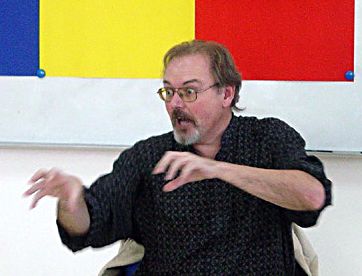
By the time I’ve done with this little poem, I’ll have recorded it three times – one, the first (already in the public domain) - expresses, I think, my true feelings for it as a work and it’s potential place in the ‘Canon’. The second I’ll attempt as an authentic pronunciation performance – something I noticed when playing around with the text is a distinctly different feel when the sounds are said in a sort of re-constructed pronunciation … I am not claiming it is right – treat it more as an archaeological experiment than authentic (and I’ve something to say on that issue over on my music review blog, pretty soon). The final is a straight reading – well, sort of, complete with introduction and after-word – that’s the ‘Introduction to the Sonnets for no-lifers’ performance. All will be You-Tubed in the ever fleeting chase after fame and fortune.
Gurr’s argument for this being an early poem (and consequently the first thing we have of Shakespeare’s writing) I find quite convincing … Greer (bbke) doubts, but nods in the direction of possibility and makes a very interesting observation … if this is written for Ann – then other sonnets were most likely also.
I have to admit that I rarely read ‘Let me not to the marriage of true minds …’ without thinking it was for her – separated, rarely seeing each other, married – and producing, what 8 (?) children: Love does not ‘bend with the remover to remove’; ‘it IS an ever fixed mark’; it’s ‘not times fool’.
Sonnet 145 is a rough teenagers attempt to capture this ‘true’ mind – Ann. To accept that, we have to dump hundreds of years of misogyny and presumption: We also have to accept a review of the concept of genius – of what this genius saw as a domestic ideal - marriage as the base and foundation of contentment and as a real passage to salvation: Marriage is a source of the deepest peace man can find on earth.
I find this a fascinating idea – especially as I’ll soon be moving on to two ‘comedies’ which deal with these subjects.
Another thing that has been washing around in my head is Brook’s little talk.
Shakespeare’s value lies partly in his ability to turn out poetry – and this poem really isn’t very good poetry – but it does have something about it.
Are we here seeing the moment when Shakespeare first connected his natural gifts to experience?
And a final thought – if Shakespeare is such a good portrayer of character – and he is (remember his is stage writing) – he must have understood people fairly well – why then marry Ann? Why, if this is about her, pursue her this way, why keep and include the text many years later in the published collection of sonnets (shut up – I know all about the ‘was he involved’ arguments over the printing)?
Whatever Ann Hataway was, this touching little attempt, if for and to her, is a clue to a very different Shaksper to the one male piggery and the combined-Bardolatories is fond of exhibiting.
A note of caution ...
...for all potential bloggers - the world is full of can't-see-the-wood-for-the-trees idiots all too willing to criticise your insights and efforts without either understanding or even bothering to read what you write and do.
There is a classic case over on Shakespeare Geek at the moment.
The little 'tongue in cheek', 'over the top' performance of Sonnet 145 I did as a birthday present and as a start to my Odyssey through the complete works attracted an 'I can't stand ....' comment: No surprise.
Well - if the person had actually watched the images and thought about them [if capable of recognising them, their sources, their significance ... etc], had read this blog and noticed what I said about Greensleeves (and realised the choice was carefully made), if listened to my other performances on You Tube of two more famous sonnets, and noticed this was somewhat odd compared to them ... read the Greer (bbke) reference I gave (where the sainted Ms is distincly ambiguous to the claim of this being what is claimed); if checked the Gurr paper I quote below and re-referenced, then maybe, just a very big, maybe ....
Well, this is my blog and I'll cry if I want to!
Dramatic I run from me.
Technorati Tags: Shakespeare, Sonnets, Idiocy
There is a classic case over on Shakespeare Geek at the moment.
The little 'tongue in cheek', 'over the top' performance of Sonnet 145 I did as a birthday present and as a start to my Odyssey through the complete works attracted an 'I can't stand ....' comment: No surprise.
Well - if the person had actually watched the images and thought about them [if capable of recognising them, their sources, their significance ... etc], had read this blog and noticed what I said about Greensleeves (and realised the choice was carefully made), if listened to my other performances on You Tube of two more famous sonnets, and noticed this was somewhat odd compared to them ... read the Greer (bbke) reference I gave (where the sainted Ms is distincly ambiguous to the claim of this being what is claimed); if checked the Gurr paper I quote below and re-referenced, then maybe, just a very big, maybe ....
Well, this is my blog and I'll cry if I want to!
Dramatic I run from me.
Technorati Tags: Shakespeare, Sonnets, Idiocy
Wednesday, April 23, 2008
First Step ...
All journeys start with a first step - and this is mine:
Not the sound quality or video quality I hoped for - but I think you get the idea.
Enjoy.
Not the sound quality or video quality I hoped for - but I think you get the idea.
Enjoy.
Friday, March 28, 2008
You're Kyd (ing)
Not content with Howling at the Moon (Barking, Barking!), I'm also dancing with the Hares; it is, after all, still March.
Resisting the temptation to just close the door and start, preparations go on.
The Sonnet issue is resolving itself - there are blocks of sonnets linked together that can be treated as a whole early in the journey - one fascinating little snippet is sonnet 94 being quoted in Edward III (which is dated early).
Today's teaser is what was he doing before he wrote?
- I'm dismissing teaching in Lancashire (I've lived there, I am a Lancashire Lad - I've taught there: I didn't become Shakespeare - ergo, neither did Shakespeare).
He was, of course, an actor - possibly with his wife's encouragement. (La loon, la loon.)
Therefore, he acted - what?
Well, chances are he did some Marlow (e-less) and Mr Kyd was popular 'on the block' too.
Right - need to at least read those two before I set out - and it's looking like The Spanish Tragedy gets the go-ahead (because it was on the shelf in the Library when I was there yesterday - and its on-line, and I like it so re-reading is not a problem).
Some of the best Marlow (e-less) was produced after the first Shakespeare - so, Tamburlaine the Great needs reading before I start, but Faustus after (?).
Damn map is glaring at me though - Holinshed's Chronicles (2nd edition) were published just before .... no, 'tain't a play, didn't act it. Might read bits at appropriate times.
Resisting the temptation to just close the door and start, preparations go on.
The Sonnet issue is resolving itself - there are blocks of sonnets linked together that can be treated as a whole early in the journey - one fascinating little snippet is sonnet 94 being quoted in Edward III (which is dated early).
Today's teaser is what was he doing before he wrote?
- I'm dismissing teaching in Lancashire (I've lived there, I am a Lancashire Lad - I've taught there: I didn't become Shakespeare - ergo, neither did Shakespeare).
He was, of course, an actor - possibly with his wife's encouragement. (La loon, la loon.)
Therefore, he acted - what?
Well, chances are he did some Marlow (e-less) and Mr Kyd was popular 'on the block' too.
Right - need to at least read those two before I set out - and it's looking like The Spanish Tragedy gets the go-ahead (because it was on the shelf in the Library when I was there yesterday - and its on-line, and I like it so re-reading is not a problem).
Some of the best Marlow (e-less) was produced after the first Shakespeare - so, Tamburlaine the Great needs reading before I start, but Faustus after (?).
Damn map is glaring at me though - Holinshed's Chronicles (2nd edition) were published just before .... no, 'tain't a play, didn't act it. Might read bits at appropriate times.
Thursday, March 27, 2008
Always need to prepare ...
It is looking very much like I'll be starting with a sonnet!
Andrew Gurr suggested it some time ago - sonnet 145 is likely to have been written early on - possibly when Shakespeare was still in his teens.
There is the serious possibility it was written to Anne, his soon to be wife - which makes it sort of 'sweet' and "Ahhhhhhh"-able.
This would certainly be the earliest of his writings.
I am having not-much-fun trying to sort out the dates of the sonnets - they were collected together and published in 1609 - and arranged in an order that makes a sort of narrative - but they were written in a different order.
Possibly the first 17 were in fact written a little later than the next sequence; and the dark lady poems earlier than the ones before!
What a life!
I am also doing all my preparation with a little programme available from the OU called Compendium: If I ever find a way to do it I'll publish the 'map' I make to go with the journey.
(Just think all journeys should be mapped.)
Andrew Gurr suggested it some time ago - sonnet 145 is likely to have been written early on - possibly when Shakespeare was still in his teens.
There is the serious possibility it was written to Anne, his soon to be wife - which makes it sort of 'sweet' and "Ahhhhhhh"-able.
This would certainly be the earliest of his writings.
I am having not-much-fun trying to sort out the dates of the sonnets - they were collected together and published in 1609 - and arranged in an order that makes a sort of narrative - but they were written in a different order.
Possibly the first 17 were in fact written a little later than the next sequence; and the dark lady poems earlier than the ones before!
What a life!
I am also doing all my preparation with a little programme available from the OU called Compendium: If I ever find a way to do it I'll publish the 'map' I make to go with the journey.
(Just think all journeys should be mapped.)
Saturday, October 06, 2007
Friday, December 08, 2006
If iness
(On Auden's Poem, If I Could Tell You)
Daniel Barenboim, at the start of this year's Reith Lectures, reminded his audience that it is not possible to talk about music - only people's reactions to music. Sometimes I think that this is also true about literature - especially literature which uses words with the intensity Auden manages in this poem.
If asked,
"What is this poem about?"
I'd answer something like:
"The fearfulness of unknowable inevitability."
For me, it is a poem which touches on the limitation of human reasoning, which asks unanswerable questions while longing for certainty, which expresses an 'existential angst'.
But above all, it is a love poem.
Let me start with the uncertainty.
Two other 'If' poems come to mind - 'If I should die' and Kipling's, 'If'.
What is noticeable about both these is the certainty of them: Things will happen, states of being will come into existence, under certain conditions.
Both go, If : Then!
There is a 'knowableness' here. We can predict the future; Cause and Effect are in observable operation.
In contrast, Auden's 'If' leads to 'would' - and the unspoken, 'But I can't'. It expresses an unfulfillable desire.
I think this is most clearly stated in the third stanza. What is wanted here is knowledge - of the future, of "fortunes". This suggests not just what will happen, but how good (or bad) will it be?
An image, of Adam and Eve, came to me while thinking of this stanza - of Adam saying these lines to Eve, and Eve popping off to grab 'the fruit of knowledge' in order to satisfy both their desires.
If I can pass beyond the superficiality of this (and it makes me smile, I must admit), the 'tree of knowledge' myth does reflect a deep, possibly genetically pre-programmed, desire in all humanity for a patterned, readable, knowable existence. Our Human curiosity demands answers.
The fourth stanza tackles a couple of these demands:
"Where does the wind come from?"
And:
"Why do leaves decay?"
Human 'reason' can take us so far - scientific answers can be given about the physical world - but Auden doesn't seem to mean this sort of answer when he posses questions of origins and reasons: His is a metaphysical demand.
The fifth stanza has moved firmly beyond 'realism' - we have roses with wants, and visions becoming manifest.
Except, we don't.
We have a 'Perhaps' at the start. And I 'hear' a tenderness in the tone of voice - especially in the last line repetition of the 'if I could, I would' sentiment.
This is, after all, a 'Love Poem'.
One of the forces behind it is the desire to satisfy a partner: Which begs the question, "What thought or feeling has the partner expressed to provoke this response?"
Is it a desire for knowledge of their future happiness? Or was it an expressed fear of their love not lasting?
Or is the poem 'more cerebral', like a Shakespeare sonnet - provoked not by an external prompt, but by an internal searching?
Shakespeare’s sonnets also remind me of the themes and images used by Auden.
Time's influence on external beauty is to register decay
Internal beauty is eternal.
Whether it is the 'too short a date' of a summer day, or time's 'I told you so', there is a price to pay for living:
The leaves decay.
We exist in nature –
'too hot the eye of heaven shines',
and winds blow - even if we don't know their source.
But there is something beyond this reality - Love,
'the ever fixed mark';
love which the 'I' of both Shakespeare and Auden, feel and know - and confirm in their poems.
The final Shakespearean quality I find in the poem is in its use of form.
This is not a sonnet - but its form carries as much weight and contributes considerably to the meaning.
There is a thudding base line of repetition - Time, Time, Time; I told you so; I told you so; I told you so.
This contributes considerably to the overall feeling –
Time is inescapable: Consequence inevitable.
The repeated, 'If I could, I would' gives that dreadful sense of the unknowable.
The final twisting of 'Time will', to 'Will Time?' drags in a desire for certainty, which the final defeated 'If I could, I would' can only admit to.
And a final poem this overall encounter with time, nature and love reminds me of is ‘Dover Beach’ by Matthew Arnold.
There the voice of the narrator conjures up the great questions I feel are touched on here by Auden in what is quite a remarkable poem.
Subscribe to:
Posts (Atom)


 Posts
Posts

