Showing posts with label Midsummer Nights Dream. Show all posts

Tuesday, May 20, 2008

Shakespeare Intelligence

No, I'm not about to launch a review of Shakespeare the Thinker (the very title, for some reason, sends shivers of distaste through my body), but muse about something that has been brewing for a week or so now -


Shakespeare


and

Multiple Intelligence


Multiple Intelligences has proved illuminating: It is an attempt to define "Intelligence" in a way that recognises the multitudinous and complex nature of the connections the human brain can make, and has provided a basis for explaining why some forms of education are just plain 'dumb-making'. What I really like about it is the fact that it is inclusive - it attempts to explain why there are differences in the way people think and why those differences result in a rich variety of human strengths.

Unfortunately, most Shakespearean scholars (of the old school) don't seem to have been raised in a Multiple Intelligence environment and certainly have never got to appreciate the differences between themselves and other, equally, but differently, 'intelligenced' people. Older, and less enlightened, educational systems - the ones which the 'Shakespeare Wallahs' were successful in - tend to emphasis language and numerical skills - they tend to call them 'standards'. What Multiple Intelligence theory suggests is that this is a very limiting (and ultimately counter-productive) educational endeavour.

Shakespeare's plays, and the massive dislike engendered in school for them, are a case in point. In the theatre, they are popular; in the 'linguistic' oriented, text based school, they are not. If you don't like School Shakespeare, it is your fault - generations have loved the plays - so there is something wrong with your Intelligence.

(I should at this point point out, Dr. Howard Gardner himself sometimes prefers the word talents rather than intelligence - which he sees as too limiting: I'm just being provocative sticking to the 'I' word.)

My main question could be framed, How does Shakespeare manage to survive in the hostile world of ivory towered scholarship and text based examination?

Well, the answer is glaring obvious - Shakespeare wrote plays. They survive in the theatre, on the screen (large and small) in the imaginings of a Multiple Intelligenced world.


What the plays in performance do is stimulate a whole range of 'intelligence' - in fact, there isn't one which a good production of a Shakespeare play touches on.

Shakespeare has 'coded' into his text a lot of the clues as to what to do - but the spaces are there for the actors, directors, and everyone else, to fill in the gaps - be it music or dance, movement across the stage, or a glance between characters.

There is nothing particularly revolutionary in what I have just said - but, rarely in the 'Literature' classroom is anything other than a nod given to these overwhelmingly powerful factors of the play.

Of course - there have always been teachers who have attempted to bring the plays to life and have treated the texts as a starting point (I was fortunate enough to have been taught by a couple of such teachers) - but the educational systems soon force the written exam and the 'language' focus on to the majority of students.

The Shakespeare 'experts' ,consequently, are selected from the people who perform well in 'Linguistic-Literary' intelligence area. These people define what is good and valuable, make decisions as to text and argue interminably over minute language details which are inconsequential in the extreme.

But the plays actually appeal and stimulate and entertain a much wider range of - Intelligenced - people.

One of the striking things about the Shakes(blogo)sphere is how wide a range of people contribute to it (and why are so many connected to the Logical-Mathematical realm of computers?).

There is another insight to be gained from thinking Multiple Intelligently - individual play popularity.

I happen to think that the best of Shakespeare's plays is 'A Midsummer Nights Dream'. I think Hamlet is a damp squib with a serious need for throwing away and forgetting about until it gets a make-over. I happen to like 'The Two Gentlemen of Verona' - thinking it a better play than nearly every scholar who has commented has given it credit for.

Either I am a nut (and I don't come from Brazil) or something is going on here.

One thing worth noting is my Multiple Intelligence profile (as generated by the little quiz linked to at the start of this blog) - my strongest intelligence is Naturalist - no surprise the very 'green' 'The Dream' appeals. But also I notice the images to do with nature - the storms (I Like Lear) and talk of flowers; the cliffs of England, and worms.

The rest of my profile is fairly even - but the weakest area is interpersonal (I'm a Problem Play remember). Now, why don't I like Hamlet? Could it have something to do with all that uninteresting blah blah about relationships? Or maybe it is just that the interminable linguistic arguments and unsatisfactory performances generated from the incomplete final text?

It used to be put down to taste - with the suggestion that an 'educated' palate was more sophisticated and worthy than an uneducated one.

You can't do that in a Multi-Intelligent world - my tastes reflect my Intelligence - I AM right, 'A Midsummer Nights Dream' IS better than 'Hamlet' - you are just Naturalist-Intelligence deprived if you can't see it.


Technorati Tags: , , , ,

Sunday, May 11, 2008

Puddings


and proof thereof.

It never ceases to amaze me how some people judge plays.

I mentioned that I enjoyed 'The Two Gentlemen of Verona' more than I've enjoyed 'Hamlet' for a long time - and someone suggested my wits were crumbling.

Then I remembered me - of course, his is a judgement based on the book, not the performance.

How many people actually sit through a performance of Hamlet and come out of it able to say, 'I enjoyed that'?

As an imaginary percentage, if one were to compare the 'enjoyment' in a a performance of 'A Midsummer Nights Dream' to 'Hamlet', which would win?

Puddings are judged in the mouth, not the recipe book - plays should be judged in the theatre, not the script.

Technorati Tags: , ,


Saturday, April 26, 2008

I, the Man in the Moon ...


"...it is a tale of the man in the moon "

Another of those - sounds familiar.

No way Shakespeare was in this - it was performed by 'the boys' - but, you know what - I'd bet rather a lot he knew it.

That prologue - for what is a 'court performance' - is there in 'The Dream'.

More evidence of Shakespeare's involvement in court affairs? Maybe. And maybe the later play throws light on this play of Lyly, MA: Did the courtiers interrupt the silly prologue - the whole performance in fact? Intriguing.

Also intriguing is this little snippet:

his person -- ah, sweet ... [I.2.60]
person! -- shall he deck with such rich robes as he shall
forget it is his own person; his sharp wit -- ah, wit too sharp,
that hath cut off all my joys! -- shall he use in flattering
of my face and devising sonnets in my favor. The prime
of his youth and pride of his time shall be spent in melan-
choly passions, careless behavior, untamed thoughts, and
unbridled affections.


Is there a better description of so many of Shakespeare's early lovers? I am tempted to say of teenage Shakespeare himself if Sonnet 145 is anything to go by, but will refrain.

Performed around 1588. - Two Gentlemen of Verona has a similar first performance date if the earliest given for it is right. What are the connections?

There is an exploration of 'what is love' - there is man spurning woman - and women's revenge ... there is a wittiness in the dialogue.

But it is more a feel - a lightness and an expectation set up as to what such a play is about.

The business of boys and serving men also strikes a chord.

Apart from the direct links to 'A Midsummer Night's Dream', there also seem links to several other plays and characters - Falstaff is here in prototype (Sir Tophas) - but it is the Falstaff of Merry Wives rather than the Henry plays ... and elements of this Falstaff seem to have transmogrified into Pistol, and Armondo (Love's Labours Lost).

More than anything else though is a sense of elegance here - this is a 'court' play.


Technorati Tags: , ,


Tuesday, April 22, 2008

ALPHONSVS, KING OF ARRAGON


Alphonsus (on-line text) is a play printed in 1599 - but, seeing as it was written by Robert Greene (who died somewhat earlier) it is safe to assume it was in fact printed only after its useful stage life was over and the last drop of profit for the theatre company which owned it, came from the disreputable act of selling the text on.
One date given as a possible performance is 1587 - and by the Queen's Men. This puts it firmly in the realms of Shakespeare acting territory - at least one scholar suggests Shakespeare acted with the Queen's men - and he surely would know the play anyway.
It's not a bad play - its not the sort of play I'd give stage room to myself, but I can see the attraction - it is entertaining: It has all the elements needed for killing an hour or two before bedtime, and the language is quite good.
And straight away I'm into the entertainment at the end of 'A Midsummer Night's Dream'!
I couldn't stop thinking of 'The Dream' as I read - a snippet here, a sound there - and an idea or two.
If you want to know where Bottom gets his idea of declamatory acting from - and such delightful alliteration - read no further than here - Boom Boom Boom!
Amazon fighting and winning love doing injury - well, it's almost here.
And women being meant to flee, not chase - 'were not meant to woo' - almost word for word - almost - here.

But it's not only 'The Dream' - and the words: There's the stage action - there's a good dynamic at times - a flow of action, a movement of scene to scene.

I was reminded of the early History plays - the movement of armies - especially in the second two parts of Henry VI.

Fascinating too was the 'speechifying' - Here I was thrown back all the way to Beowulf, and the Anglo-Saxon penchant for self promotion - half the battle is in a good speech.

Well, tomorrow I'll be delivering two of the greatest - from Henry V - along with a couple of anti-dotes from Richard II - and Mr Greene is going to be haunting the party too.
Technorati Tags: , ,

Friday, April 04, 2008

Models or laziness?

There is a a post over on Shakespeare Geek which brings up the tricky issue of giving essays and having to write about Shakespeare and his work.

Whilst I am tempted to rant about the low level of the questions considering the age and location of the original setting of the task, I shall restrain myself. (But the gentle strains of 'Rule Britania and God Save the Queen throb away under this post.)


We're in the territory of 'originality' and 'personal response'; of having your own ideas and not being constricted by others; of predetermined requirements and (dare I say it?) THE CANON.

What strikes me as most pertinent is the education Shakespeare would have suffered - and which seems to have resulted in his ability to put pen to paper to scribe some of the greatest things ever written.

The models he would have followed were enforced across his bare backside with a bunch of birch rods - think of the reluctance of the schoolboy going to school 'like snail'.

He would have had to tightly follow the models of classical Latin writers and to learn to adapt and rephrase the ideas of others rather than be 'creative' (Lunatics, Lovers and Poets).

There was a movement in the 1960s in England to dump all that uncreative nonsense and let pupils 'express themselves': It produced a lot of very bad poetry (not recycled) and blinded an awful lot of people to the need for going beyond a draft.

It also produced me.

I don't teach that way - although I started off following the model of my teachers (all teachers should be forgiven their first 10 years - they are simply trying to break away from the tyranny of their own education).

Nowadays it's all 'models' and genre: If you want to do this, you need to do this, this and this - be creative within the bounds.

Much like Shakespeare was taught (although in those days there was a lot more 'acting out' done in the class - and I suspect fun, as long as you did what you were told)


Technorati Tags: , ,

Sunday, March 30, 2008

serendipity


A couple of things sent this wonderful word bouncing around in my head today.

First was watching a couple of ‘turtle doves’ flapping around in one of the parks down by the river.

I watched the Kevin Kline Midsummer Nights Dream last night – and thoroughly enjoyed it. I’m sure I’ll have more to say on it at a latter date – but today the line, “Begin these wood-birds but to couple now?” popped (not poo, this time) up when I saw the birds.

It was the colour that did it – and the naked young couples in the film as the line was delivered; Lots of very fleshy pink. Same as the birds.

I’d always thought of the birds mentioned as wood pigeons (well, I am English and did grow up in urban Manchester in the 1960.s) but Shakespeare must have meant their close relative, the ‘cooing’ or ‘turtle’ dove.

I’ve a couple visit the shelf outside my kitchen window each morning (sorry, I feed the little buggers); they’ve been around for over a year now. They tried to breed last year – but I think they were too young. The nest they built was destroyed in a storm and the eggs in it smashed. They’re looking at a different site this year. Fingers crossed for offspring.

What’s noticeable (and the constant cooing makes them noticeable) is they are almost inseparable – I haven’t checked but I think they must pair for life. So, when Theseus calls the lovers ‘wood-birds’ and says they are beginning to pair – he has seen more than linkage – it is a fidelity shining through too.

That’s what the flapping in the park reminded me of.

Second bit of serendipity came almost at the same time.

I was reading through Peter Brook’s Evoking Shakespeare and getting fired up to review it when, at the end of what was a talk given in Berlin, he answered a question – and came out with something so simple, so obvious I’d not thought of it (bit like the doves really):

(To paraphrase)

Shakespeare was born with a set of abilities, principle of which being a prodigious memory and a capacity to listen and observe; he used these capacities to the full when he wrote his first play.

At this point of first putting pen to paper he hadn’t ‘lived’ – hadn’t the experiences he would be able to add to these innate abilities to write the later ‘great’ plays like ‘King Lear’ and “eventually the Tempest”.

“… one sees a very interesting relationship between what’s inborn and what is developed by life.” (Evoking Shakespeare, pg 30)

Well, yes – that’s exactly what I want to see in this odyssey through the works, I thought.

How much is nature, how much nurture?

(Hopefully the doves have learnt to build a better nest this year.)

Thursday, October 04, 2007

A girdle round about the Earth

How can I not think of the lines from A Midsummer Nights Dream on the 50th birthday of Sputnik?

And this is a taster of the company I work fors progress into the Space Age - gives a perspective I think to some of the things they get me to do!!!!


Thursday, September 06, 2007

Voice of an Angel


(Well, maybe not!)

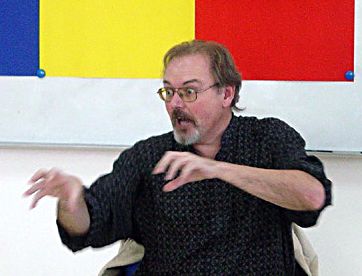
That's me to the right on stage leading the recent international workshop on texts held in Timisoara.

Click on the link to the name and you can hear me hamming my way through a couple of Shakespeare texts for Librivox.

Can't excuse myself really, but very limited equipment and somewhat rushed - still authentic Farrar.

(Willy Russel did say once that I was a, "King Actor - just like Orsen Welles: Maybe not good, but loud enought to do the BIG parts!"

Wednesday, September 13, 2006

Framed Again

" Theseus and Hippolyta are, as it were, a splendid frame for the picture; they take no part in the action, but surround it with a stately pomp."


That Shakespeare knew Chaucer's Canterbury Tales, especially the Knight's Tale, is certain; after all, The Two Noble Kinsmen is a reworking of that tale.

But there are echoes of the opening of the same tale in the opening of A Midsummer Nights Dream - Theseus wedding Hippolyta, "with muchel glory and greet solempnitee." (The 'stately pomp' of our Victorian commentator's 'splendid frame'.)

There is also talk of the battle they fought.

The names of certain characters, Theseus, Hippolyta, Philostrate come from the Knight's Tale and all appear and are named in the first few moments of the play.

If the Duke and his Amazon 'frame' the action of the play, they do so in a way which connects with a wider world - it is a frame which links to other frames and the pictures they contain. We have a gallery of images Shakespeare is willing to make reference to.

Shakespeare is invoking the Knight's Tale.

To do this, he must have been certain that at least some of his audience knew the work of Chaucer - and knew it well enough to recognise it quickly from the brief sketch he draws in the opening 24 lines.

But the connections seem to stop there: A Midsummer Nights Dream is a comedy with a happy ending; The Knight's Tale and The Two Noble Kinsmen are much darker, some would say tragic, stories with death and blighted love much to the forefront.

So, what is Shakespeare up to?

One thing I think he is doing is reminding his audience, from the outset, of this darker alternative to his happy ending - a sort of momento mori.

In The Knight's Tale, two friends end up loving the same woman and fight to the death for love of her: In A Midsummer Nights Dream, two friends almost end up doing the same thing. Without the alternative of The Knight's Tale ending, the Dream's ending is blunted.

If the border between Comedy and Tragedy is a knife edge, then this knife has been hoisted in the air and there is a dirty great chasm below it ready for someone to fall into.

When Theseus returns and finds the sleeping lovers, we are again reminded of Chaucer's Tale. Chaucer has Theseus and Ipolyta out hunting (and delighting in his hounds) when he comes across the two 'Noble Kinsmen' preparing to fight to the death; Shakespeare has the two lovers, who have spent the last part of the night before trying to fight each other, asleep. They will wake to a resolution worked by the 'magic' of the flower, but it is a resolution - the two kinsmen go on to fight until one is killed.

To know the Chaucer is to give an added depth to the Shakespeare who is framing his own Dream in the Knight's Tale.

But he doesn't stop there - he sticks another 'picture reference' into this frame - Ovid's Love Story of Pyramus and Thisbe. Remember, it is a gallery we are working in!

And here the twist is to bring 'Death' onto the stage and laugh at it. We cannot do this until we have finished with the 'action' contained within the picture, it can only be done in the frame.

There is a lot of milage in thinking about Theseus and Hipolyta as a frame to the action of the play, but it is a frame which does a lot more than provide a decorative container - it is the the conection with the outside world, it is the introduction to themes worked within the picture and it is the 'frame' on which the picture is stretched.

Tuesday, September 12, 2006

Framed


Another idea of merit from the Victorian article, at least at first glance, is the use of the metaphor of Theseus and Hippolyta as a 'splendid frame'.

Normally we seperate the play into the world of the wood and the city - and that has merit too - but Hippolyta and Theseus, like all the human characters, move out of the city into the wood. Theseus and his soon-to-be bride have gone into the wood to do 'observance' prior to their marriage. They then intended 'to get in a bit of hunting'. The speration of town and country is not quite so rigid as is frequently made out.

The idea of a frame, something which contains and limits (the idea here is of a rather ornate, Victorian picture frame), beautiful in itself, but which 'sets off' the contents, is interesting.

What is it that Theseus and Hippolyta have, are or represent that makes them suitable as a framework? One concept given to us is that of 'stately pomp': The frame is obviously covered in gold leaf.

Certainly the opening of the play would suggest such pomp - costumes in the Globe would be sumptuous for such figures as the hero and his 'Amazon', and the lovers and Egeus are aristocrates. Strict Elizabethan dress conventions would establish instantly for the audience exacly who and where these people were - courtiers in an urban, public place. Music would accompany the progress.

The After-the-wedding celebrations fit this pattern too - up to a point.

Conspicuous wealth on conspicuous show, something the Victorians understood.

However, this splendid frame gets a little disjointed - the mechanicals work their way into the wedding celebrations bringing with them a distincly tarnished patina and a danger of ugliness and ignorance. Almost a gargoyl on the cathedral wall (to crash quickly into another metaphor - the same way Shakespeare does by putting the mechanical's performance where he does).

And there are other twinges of doubt about the integrity of the frame - Hippolyta and Theseus don't quite seem to see eye-to-eye on a couple of issues: Her silence at the start of the play, after Egeus enters, 'speaks volumes' - so much so that Theseus has to ask, "What cheer my love?"

Their discussion of the role of imagination before the newly weds enter also smacks of disagreement, however civilized.

It is almost as if the frame also carries the themes of the contained picture, in a much more constrained way, but still complementary - not a neutral plain wood, but an active ornate, shallow carved but distinct piece of arabesque work?

So far I have concentrated on the constraining effect of the frame, but a frame also acts as a transition from the outside to the inside.

But more of that next post.

Wednesday, August 23, 2006

Thrown Snake Skins and Lords and Ladies

Hot as it was last week (back home in Romania), I was doing some digging, preparing a bed for sowing over-wintering broad beans, when I came across a thrown snake skin.

That in itself is not unusual (we have lots of snakes on the small-holding and I am quite happy about that - they keep the rodent population down and do no harm to the plants - and it is always thrilling when one comes gliding up onto the balcony to give a quick once over to the outdoor kitchen), but this was a complete skin rather than a fragment.

I suspect it was recently cast.

Looking at it I thought of the lines Oberon delivers in A Midsummer Nights Dream.

And there the snake throws her enamell'd skin,
Weed wide enough to wrap a fairy in.

It was beautifully 'enamalled', the reflecting sheen of light suggesting rainbows and brittle glazes: I could easily imagine a rare and expensive cloak made of this material wrapped around some not-so-delicate beauty parading the cat walks of Milan or London.

But however beautiful, it is still a strange item to choose to wrap anything in. Humans generally regard snakes, at best, with suspicion, if not downright hostility. They have associations with evil (certainly in Christian/Muslim/Judaic based cultures). Hypnotic maybe, but to deceive - the snake in the grass. "All the joy of the worm."

The reptilian head and the dragonish scales, all still visible on this thrown skin.

Why does Shakespeare give Oberon this particular image to say?

Whatever the Victorian Romantics and children's book writers have done to fairy myths, 'The Fair Ones' (sorry, stealing a Pratchett construction there) must have been a potent force in the lives of ordinary, country dwelling people at one time.

And that force was not benign innocence: Look at Puck, at his "jolly" antics - leading people off the road at night to get them lost; pulling people through briars (most modern town dwellers really have no idea of how awful it is to find yourself in a briar patch); getting a horse sexually excited to laugh at its enormous errection and frustration; making an old woman fall over by shifting the stool from under her (again, no National Health Service, or hospitals - a broken bone could leave you crippled and in pain, for life).

Fairies are part of the natural world, and the 'Natural World' is not governed by systems of morality.

Oberon's snake skin is a beautiful thing - and a dark reminder of the true nature of the world in which he lived.

One of the things Terry Pratchett's Lords and Ladies catches for me is this world of cruelty hidden behind the glamour and excitement of what was once called 'the high life' - a world most ordinary people read about through rose coloured glasses on the pages of daily papers, glossy magazines (snake skin enamal?) and the never ending chain of chat shows.

Thursday, January 19, 2006

You have but slumbered


here.

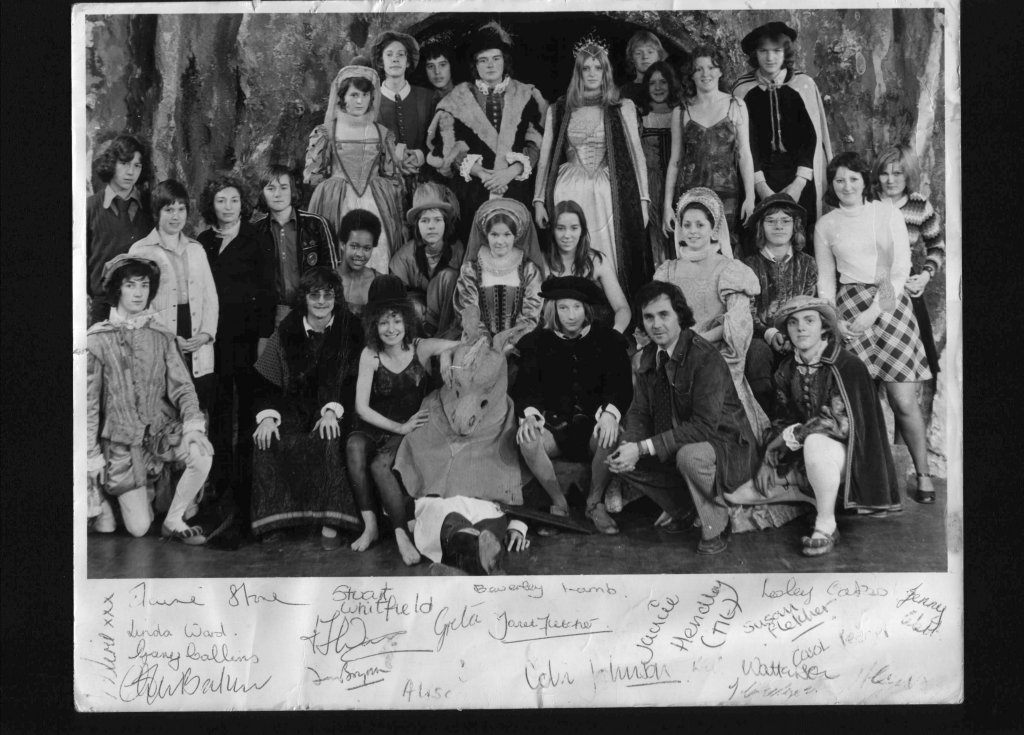
The start of the Shakespeare obsession. Yes, I am in there somewhere.
Fast approaching 50 and reflecting like mad. This production didn't only infect me with the Shakespeare bug, it introduced me to the music of Bartok: I now live in the part of the world he inhabited.

Theatre has been a major part of my life. Shakespeare fundamental to it.

This photograph captures almost the very moment all this happened. The people I now know little of but are echoing through my life.

Thursday, January 12, 2006

A Dreame.

Coming on the train to Romania yesterday I fell into a daydream.
I thought about the title of the play I have been spending so much time on. And had a very nasty thought.
So, I have just looked up the original printing of it: You can find it here:

http://prodigi.bl.uk/treasures/shakespeare/record.asp

That's the British Library for you - useful even on line.

What I notice is there is no punctuation. (Just what I suspected.)

Traditionally we add the apostrophe to night to make it look like it was one night and the dream belongs to that one night.
Why?

Why can't the s mean more than one night? A dream which takes place, not on Midsummer's Eve, but over several nights in midsummer.

Time has been causing me some problems recently so forgive the niggle I feel about this acceptance of a piece of additional punctuation which must be none sense.

At the start of the play Theseus talks about 4 nights - and his future missus repeats it.

When do we go into the forrest? The same day? Or does it take time for the lovers to sort out the escape?

And how long are they there?

The usual comment on all this is that Shakespeare didn't really take much notice of time: In which case, why did he mention it at all?
Or that he was careless: When we credit him with so much care in other areas?

There is a rather telling line in Henry 4, Part One (I think). Falstaff talks about being one of Dianne's servants: A thief of the night. This is just after Hal has asked about Falstaff's connection with time.
Could it be that, for Shakespeare, Time was only a phenomenon of the day light?

I shall be back on this one!

Saturday, December 10, 2005

Rotten Corn

The ox hath therefore stretch'd his yoke in vain,
The ploughman lost his sweat, and the green corn
Hath rotted ere his youth attain'd a beard;

One result of the rains this summer in Romania has been the rotting of the corn - maize now, unlike the wheat of Shakespeare's day.
It is hard for all of those people who live in towns and cities to grasp the significance of this.
The corn is used for two purposes - feeding the chickens and livestock through the cold winter, and as a staple of the human diet. Bread is a luxury in many villages and there is nowhere to buy it anyway.
The traditonal wooden containers found in many farmyards, usually full at this time of year, are empty. The stalks of the maize plants are still standing - barren. Animals will have to be slaughtered, and chickens will go hungry, get smaller, lay fewer eggs.
People are going to go hungry, their diets will be limited and various degrees of malnutrition will set in.
This is the reality hidden in the words - a true horror to those who still live this life all over the world.

Thursday, December 01, 2005

Titania's Speech

Therefore the winds, piping to us in vain,

Perhaps the most interesting thing to come from my experience of the rain (previous post) is a realisation of just how physically real this speech is.

As we approach 2007 - the year when over half of the world's population will be classified as urban - connecting our personnel experiences with the natural elements of Shakespeare is becoming increasingly difficult.

I suspect, in Shakespeare's time, listening to Titania's speech was a much more powerful experience - it certainly is for me now - and physical/tactile rather than intellectual. There is an overwhelming sense of uncontrolled energy - an energy against which we are impotent.

My understanding of this is not now in terms of psychology - it is in terms of a concrete feeling based, as it must have been for the vast majority of Shakespeare's original audience, on being forced to endure a real storm.
Pelting rain is no longer just uncomfortable, it is a force to be reckoned with.
And this is not an extreme event (as it is sometimes suggested by people who have lived in the closed world of the ivory tower) - my experience was only on the edge of the really serious flooding that devestated parts of Romania.

Just as in the politic world of Theseus/Hippolyta, Egeus is being allowed to break the harmony and sends out the forces locked in the lovers; so in the natural world of Oberon and Titania, a dispute unleashes considerable natural forces, normally held in check.

Friday, November 25, 2005

Every Pelting River made Proud

The experience

We had our own Niagra Falls within seconds of it starting to rain: The guttering running the 20 meter length of barn roof was overflowing.

And I mean flowing - a solid, metalic sheet of water heaved itself off the roof and plunged onto the cobbles below. – I've lived on and off in the village for several years now and I'd never seen anything like it.

For well over half-an-hour the downpour hammered everything.

The yard was under several centemetres of water. Drainage was through the barn – soaking the bottom of the stored hay.

The tell-tale sound of flowing water signelled the road down the hill outside the main entrance had turned into a torrent – normally this only happenes in the worst of winter, when the ground is frozen – and rarely with such intensity; never for so long.

Plum and walnut trees seemed pressed down. Goodness knows where the birds had gone – they couldn't fly in this.

It was not dark exactly – the rain was light – but you only saw the rain – and how it was pushing against everything.

Inside, the chimney soon ran with water – the plaster was stained and I had to put down sponges and cloths to try to absorb some of the flow.

I moved the small icon I had bought in a flea market in Moscow, and the fine Chinese statue from Shanghai, off the mantle piece. A few old letters had already soaked through and were sticking.

I could only move things out of the way of the ever increasind drips and dribbles: The roof, not in the greatest of states, was incapable of holding out rain under this pressure: At one point, quite frankly, it seemed to me as if it had given up trying.

Back on the veranda the tiles were seaping. I saw one of the local house snakes glide up and into the summer kitchen – wether it was escaping the water or because it had scented a mouse escaping the water, I couldn’t tell – but at that moment any living thing I could attach an atom of sympathy to was a welcome sight.

There was nothing I could do: Whatever damage there was, there would be.

But damage was the wrong word – this was an unfocused, complete and all encompassing force – pressing squeezing, shifting – but not total. You knew it could do a lot more.

It was unmotivated, aimless, inpersonal.

One element – water – against … what?

Nature itself?