Showing posts with label Romeo and Juliet. Show all posts

Thursday, July 17, 2008

Stolen Fire

Thanks to the Geek for the connection.

A lesson in not responding soon enough to blog ideas - a politician will come along and steal your fire! Johnson - odd looking Mayor of London - has connected a connection which is obvious to make. The Gruniad reports on his appearance before a House of Commons committee on Knife crime and he makes the Romeo and Juliet connection.

Unlike Mr Johnson, who had to explain his link (so much for the education of Members of Parliament - I'd love to know the political colour of the questioner) I'm sure readers of this blog will realise the 'gang' connection in the Capulet and Montague households, and get the poignancy of young life cut short.

Interestingly Mr Johnson then made the point my thoughts had been silently pointing to - the text is worth studying as illustrative of what is happening in places like London where there seems to be an increase in the knife carrying and fighting (although whether there is an actual increase or the media has just decided to bring it to the attention of the public is debatable).

Young people do 'gang' - young people do fight - carrying a weapon when you fight is going to cause more damage and death. Most fights are more about honour and macho-ness than any other lip-serviced reason, and there is great glamour in 'the kill'.

There is terrible social element to this too - the adults in Romeo and Juliet do nothing serious about the issue until the death of loved ones hits home - paralleled in some ways to the present media frenzy inspired by the death, not of any young person, but by the 'tragic' death (as if the others were not a tragedy) of 'respectable' youth.

There is a danger here of ghettoising the stabbers and innocent victimising the stabbed: If only it were that simple.
And, to his credit, I think this is partly what Mr Johnson was getting at -

It is worth studying the text because it does teach you something about the bogus atmosphere of glamour that can surround these gangs and the sort of romantic, sentimental feelings that can start to occur with knife crime and gang culture generally.
(As quoted in the Gruniad)

Emotional reaction is totally understandable (even Lady Capulet's) but not helpful (especially Lady Capulet's).

Where I do differ from Mr Johnson is his claim that Mercutio is actually a glamorous character ... but that will have to wait 'til I get on to Romeo and Juliet proper.


Technorati Tags: , , ,

Saturday, July 12, 2008

Global Satisfaction


I am not easily pleased in the theatre – especially with regard to Shakespeare and productions thereof. We’ve suffered (the text and I) more bad than good over the years, and few productions have left me either totally convinced or newly informed.

You will understand my hesitancy then about entering the open-to-the-elements courtyard of a local school to see a production of one of the more popular Shakespeare texts – on a night when the weather threatened and with an audience very few of whom were native speakers of English.

That night I went home more than satisfied: For the first time I’d seen a stimulating ‘Romeo and Juliet’ which I would unreservedly recommend to both novice and expert. I was both entertained (continuously) and learnt new things about the text, about Shakespeare production and the resourcefulness limited resources can impose.

The Globe Theatre, London sent out its touring team on a short European tour and landed up here in Timisoara, Romania – in the middle of what is turning out to be a hot summer: They brought the storm clouds with them (but thankfully not the rain).

As befits a company who aim to deliver Shakespeare productions for modern audiences informed by Elizabethan staging and practices, this touring company is reduced in numbers (a cast of 7: 3 females, 4 males) reduced in set (one battered van and two metal pillars) and great in energy.

Lines are taken at a ‘fiery footed’ pace – there is a serious attempt to make this a ‘two hours traffic’ of a performance, which has some pretty interesting consequences for both actors and audience. Principle amongst them is the reduction in what I can only call ‘emotiveness’ – no time in this production for dwelling on the luxury of romantic moments or the beautiful rolling of sounds.

Paradoxically, this doesn’t reduce the power of the words or the strength of feeling of the characters, or the demands placed on the actors: I’ve never before experienced the heady mixture of an awareness of character emotion, the separation of that emotion from the intelligence of the writing and an admiration for the verbal dexterity brought to the lines by the performer all at the same time. What was a shock was a realisation of this early on in the performance, Romeo’s first dialogue with Benvolio, as it happened. Many times I have been able to reflect back on a performance and separate out the fusion of these elements; this is the first time I’ve been made so aware of the elements and how well they have been fitted together, in real time. Multi-tasking!

Throughout the rest of the performance I never lost sight of this ‘keeping faith’ with the text. It is a keeping faith – surely this is the speed Shakespeare intended when writing, and the text benefits from performance at the speed.

A second consequence of the treatment of the lines in this way was the actors speaking for meaning before feeling – and a consequent clarity of text. I actually understood the ‘Friar’ talking about herbs, and believed the actor understood too! In the interval I spoke with a student whose English I’d describe as adequate-business and asked if he was following –

“Easily,” came the reply.

That is as strong a testament as I can give to the production.

By sticking to the ‘Elizabethan’, the company also had to deal with the issue of doubling.

I’ve long suspected Shakespeare’s plays need parts to be doubled to give a dimension of theatricality and an inter-textual frame of references which one person per part causes to evaporate. Here, with only seven actors, there was a need for extreme doubling and the potential for confusion.

Apart from the very end (where one actor shifts from the Friar to old Capulet and then to old Montague), there was no confusion - it was easy to follow which character the actors were playing.

Each role was clearly defined by the cast, who made apparently light work of what could have been a serious difficulty. The result was a series of significant connections usually lost in reading (and in most productions).

Romeo kills twice – both times here it was the same actor he ‘killed’ – the doubling of Paris and Tybalt begs the question of Romeo’s innocence and youth – OK, the first death is possibly excusable, but the second?

The Prince and Mercutio are the same actor – when the Prince talks of loosing family, you get an extra point when you have just seen him die on stage!

Old Montague, Old Capulet and the Friar are all the same actor – setting up a resonance which unites these characters – they are of equal dignity, could they also be equally tired of the dispute, be equally desirous of some means for settling and have been equally receptive to Romeo and Juliet uniting?

Old Capulet battles with Tybalt at the party, the Friar with Romeo later – a perennial theme of age versus youth; different youth, same age.

What was brilliant here was the actors’ and the production’s ability to suggest ‘type’ whilst differentiating individuals. A token cross and coat turned character – but the actor had to shift personality too: No doubt that the be-sandaled, trendy, socially aware, Anglican vicar was different from the ‘used to getting my own way’, businessman Capulet.

There was even room for a doubling joke – the servant Peter was played by all 5 of the cast who doubled parts. Which left Romeo and Juliet un-doubled (if I ignore the opening, ritualised, fight).

Around these two ‘pure’ characters an ensemble performed – Romeo and Juliet became the centre in a remarkable way, much as a piano might in a concerto, surrounded by orchestra.

The amount of work each and every actor had to do also neutralised the tendency to look for stars – this was real ensemble work. No person stood out –either above or below the others. Celebrity was subverted to the text, the production benefited.

The production also benefited from some serious directorial input.

There was a reassessment of several of the characters. Romeo, instead of the usual moony eyed wet, got a bit of guts (helped, I have to say, by the Mancunian accent). The scene with the Nurse and the Friar after Romeo’s banishment was turned on its head - this was an angry despair, this was a testosterone driven lament which overpowered both the Friar and the Nurse. Another first – I didn’t want to slap Romeo at this point, I actually felt he was being driven by forces outside his power to control.

There was also a remarkable attention to detail. In another Romeo scene, the one where he buys the poison, the Apothecary is usually played as something of an aside. Here, the director took the ‘need’ of the character and gave us a bit of stage business which really brought home the desperation of this character but also the import of Romeo’s lines – Romeo takes the drug and withholds the money – sheer desperation drives the Apothecary to scramble and fight and moan, frightened she’d been tricked. When Romeo finally passes over the money, his lines concerning the corruptible power of money had a significance.

The fact that the Apothecary was played by the actor who played Lady Capulet also left another hint of resonance – Lady Capulet seeks unadulterated revenge, slaughter, death, but is impotent to deliver it despite all her wealth and influence; the economically impotent Apothecary, desperate to help and sustain life, is forced to deliver the means for Romeo’s death. Theatrical (rather than dramatic) Irony at its most potent.

And theatrical was a watchword for the production..

Shakespeare uses the theatrical as a metaphor throughout all his stage works – at no point does he want you to forget these are actors playing the part, that this is a stage, not the real world, that these are ideas given flesh and, as human constructs, pale reflections of whatever truth is.

At the most serious moment, a joke can slip in – alienating the emotion. Towards the end, Peter pops up, played by yet another actor. The actors include elements of the real world into the false world of the play. Here in Timisoara, Romeo points at the real school building in whose courtyard the play is being performed, when he talks of love going to school; Capulet points to the church next to the school when he talks of Juliet going to church; Juliet’s talk of the lark in the morning is serendipitously accompanied by the evening chorus of local birds, all singing their hearts out; and, in the background, as the deaths are played out, a real bat flits above the stage catching the moths attracted by the stage lights.

There are many more things I could say of the production – the use of the van, the really great balcony scene, the humour – but I think the most important thing is I feel changed, just a little, by the production. I have been forced to reassess a play I thought I knew and to find in it a dignity which it had lost.

Thank You to the performers, the backstage crew and all who were responsible for giving me the chance to revive – it was a real ‘Shakespeareance’.

Technorati Tags: , ,

Tuesday, April 08, 2008

Monday, March 10, 2008

Burn, Baby, BURN!


Have we taken the tragedy out of Romeo and Juliet?

Modern audiences believe ‘it is a beautiful thing to die for love’ – deep sighs all around. They are following in that nasty Romantic ‘suicide is beautiful’ nonsense.

The focus is on the wonderful resolution at the end of the story – the united families, the golden statue, the Happy Prince!

Ker-plonk!

What Happy Prince? He’s pretty unhappy and threatening dire consequences as well as begrudging pardon (possibly enforced by separate laws for the clergy).

And hold on – not just a statue, but a golden one? Do I get an echo of ‘Golden Idols’ here? Earthly treasure brings no reward in heaven.

And here is the bit where the tragedy has gone through the window – they go to hell! The two silly children commit suicide and are consequently condemned to eternal damnation.

Romeo and Juliet BURN!

There is the tragedy – that is what we, following the Romantic reinterpretation, have lost – not a beautiful pagan ‘cut out in stars’ ending, swelling strings and a beautiful death – cacophony, devils, eternal pain!

Bring back the Shakespeare!

Thursday, September 06, 2007

Me at work!

Results of Shakey and You!

Click on the above or see me here too:

All the World's a Stage:


To Be:


Romeo and Juliet:


Voice of an Angel


(Well, maybe not!)

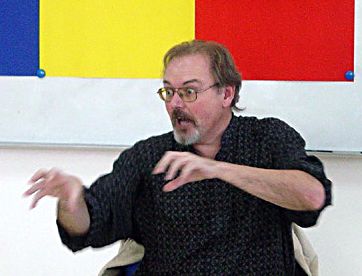
That's me to the right on stage leading the recent international workshop on texts held in Timisoara.

Click on the link to the name and you can hear me hamming my way through a couple of Shakespeare texts for Librivox.

Can't excuse myself really, but very limited equipment and somewhat rushed - still authentic Farrar.

(Willy Russel did say once that I was a, "King Actor - just like Orsen Welles: Maybe not good, but loud enought to do the BIG parts!"

Friday, April 21, 2006

Shakespeare stealing again

One of those frequently misunderstood problems with Shakespeare is his propensity to lift material from other people - nowadays we would call it plagiarism.

One of the most fascinating, I think, is the meeting of Faustus and Helen:

FAUSTUS. Was this the face that launch'd a thousand ships,
And burnt the topless towers of Ilium--
Sweet Helen, make me immortal with a kiss.--
[Kisses her.]
Her lips suck forth my soul: see, where it flies!--
Come, Helen, come, give me my soul again.
Here will I dwell, for heaven is in these lips,
And all is dross that is not Helena.
I will be Paris, and for love of thee,
Instead of Troy, shall Wertenberg be sack'd;
And I will combat with weak Menelaus,
And wear thy colours on my plumed crest;
Yea, I will wound Achilles in the heel,
And then return to Helen for a kiss.
O, thou art fairer than the evening air
Clad in the beauty of a thousand stars;
Brighter art thou than flaming Jupiter
When he appear'd to hapless Semele;
More lovely than the monarch of the sky
In wanton Arethusa's azur'd arms;
And none but thou shalt be my paramour!
[Exeunt.]

Now, do you remember Romeo seeing Juliet for the first time?

Something like

- Oh, she doth teach the torches to burn bright. -

Do I smell the smoke of Jupiter in this?

And what are we to make of the stage action - Kiss and Kiss again?

ROMEO If I profane with my unworthiest hand
This holy shrine, the gentle sin is this:
My lips, two blushing pilgrims, ready stand
To smooth that rough touch with a tender kiss.

JULIET Good pilgrim, you do wrong your hand too much,
Which mannerly devotion shows in this;
For saints have hands that pilgrims' hands do touch,
And palm to palm is holy palmers' kiss.

ROMEO Have not saints lips, and holy palmers too?

JULIET Ay, pilgrim, lips that they must use in prayer.

ROMEO O, then, dear saint, let lips do what hands do;
They pray, grant thou, lest faith turn to despair.

JULIET Saints do not move, though grant for prayers' sake.

ROMEO Then move not, while my prayer's effect I take.
Thus from my lips, by yours, my sin is purged.

JULIET Then have my lips the sin that they have took.

ROMEO Sin from thy lips? O trespass sweetly urged!
Give me my sin again.

Now, if that isn't a direct copy of the Faustus scene, I am a Dutchman.

What is amazing is the way this connection is frequenltly ignored.

Why has Shakespeare chosen to lift a scene where a man very close to death and on his way to hell is instantly struck by a beautiful illusion and plays a word game of passing sins and souls in kisses?

He knew his audience - and they knew Marlow's play.

Modern interpretations of the Shakespeare scene all seem to focus on the beauty of the young lovers, the magnificent of the sentiments, the way Romeo has suddenly matured into a warm feeling adult (hours before he was an unfeeling teenager).

Put it next to Marlow though and a rather darker image emerges - a fool heading for death and hell, blinded by the devil's false beauty.

And because of the mindset, it is beautiful, interpreters tend to ignore the blasphamy too. Romeo, in order to impress Juliet, uses religous images - compares himself to a pilgrim and links prayer to his base wish for her body.
That would not go down well with the strongly held religous views of Shakespeare's audience.

Friday, March 24, 2006

It is the lark . . .

. . . or, "Those bloody birds are singing again."

Few people who have not lived in the wilder parts of a country (possibly Temperate zones only) can have experienced a true Morning Chorus.

It is starting to get Spring here (Hungary) and I was woken a couple of days ago by a rather weak effort on behalf of the local bird population - I suppose it has the excuse of being more or less urbanised and so deplete of the true masters of song that it was a little shy of giving it full throttle. The slothful 'cooing-doves' did there usual late entry and continued long into the morning.

I lay in bed thinking - Now, if this were back in the village, the noise would be so loud that I would be fully awake and not half and half.

And, off went the thoughts on walkabout to Shakespeare, morning chorus and dawn.

First to mind for me is always A Midsummer Nights Dream.

Puck warns Oberon of the approach of daylight with, "Fairy King, attend and mark, I do hear the morning lark."

Which I find strange, as it is rarely the lark I hear first: But I don't live in England.

Certainly the chorus starts with a few tentative voices - quite high (and very unlike the Nightingale - so yar-boo-sucks to Juliet). Then builds to a most impressive mix and volume.

This happens in darkness (which most townies don't know because they are still asleep) several minutes before the first light creeps into the sky. And that gives the lie, by the way, to the idea that Oberon and his Kingdom can play in the sunlight: Earlier, Puck has mentioned the rise into the sky of Venus, the morning (and evening) star. This happens a good time before the sky gets light, and it is the signal for the Dark Spirits to disappear into their graves - the remaining Spirits can still hang around, but not face full sunlight. As soon as the grey sky shows sign of the sun rising, off they jolly well go.

Which brings me to the idea of dawn.

There are distinct stages to the morning awaking of the Sun and arrival of the day.

The first sign is Venus. The star appears as the Sun approches (it is a planet close to the sun so is always associated with it). It is a very bright star and has a mixed reputation in a number of cultures - the Romanians call it Lucaferul (bit of a strong sex drive with him) and of course the planet is the goddess of love, Venus in other western cultures. It disappears last from the lightening sky as the other 'candles' burn down a little more quickly.

The star is though, silent. No one can hear it - so you only know about it if you are awake in the night - it is a sign to lovers and shepherds (it is always so cold in the morning that the Shepherd wakes early). Romeo is familiar with it.

Around the same time, the temperature drops (if it is a clear sky - and if you are seeing the stars, it is). The dew drops with it. Everything gets wet (I'll go on about this another time).

Then the birds join in - the chickens (and village dogs) are regular noise makers throughtout the night and their use as a clock is quite inexplicable to me. Maybe it is their regularity of their noise that has them marking the hours rather than signals of change.

It is still dark but the length of time left in darkness is now marked- barely half an hour and the sky will have lightened enough for people to get up and start work.

“And merry larks are ploughmen’s clocks.” [Love’s Labour’s Lost – V, 2]

Too damn right - get out of bed, get some breakfast and get to work.

The human country side starts with the light, and ends with it too.

By the time the lazy sun heaves itself over the horizon, a good period of light has gone by. When I am back in the village, it is a time to work - not too hot and the flies haven't got up yet. I will see the local cowherd go by with all the village cows, and many of the foresters will be up and on their way long before the Sun rises.

Ever must it have been, until Industrialisation.