Showing posts with label shakespeare. Show all posts

Saturday, September 13, 2008

Black Marks, on Skin of Calf ...

Ambivalent Writes, Certain Deaths


A little ‘sub-text’ developing in the play is concerned with writing.


The written word has made a number of appearances so far – too many to be accidental?


Each of the occasions has also shown a degree of falsehood and/or innate disaster.


The play starts with a written contract – the marriage contract; the petitioners try to present written petitions; Eleanor’s questions and the spirits answers are inscribed and recorded.


It is not hard to see the reaction of Cade to lawyers (hang all of them) and writing as potentially justified in the light of these documents.


The marriage contract is seen as disastrous – Gloucester has a fainting fit when he first reads it and it sets off the whole chain of events of the play. As I mentioned earlier, it is a contract binding unequal partners in a ‘til-death-do-us-part’ union.


The petitioners rightful grievances, once written, are either taken and used as a weapon against someone not concerned in the original petition (York) or are simply ripped up and prove impotent – although costly, for a scribe will have had to have been paid, and a lawyer consulted. Can we say it is the written word that ultimately causes the battle between the apprentice and his master – and the death of one of them?


In this last scene of the first act we have the written word associated with evil – it is used to write down the words of a Devil, and York, even though he knows the seriously ambivalent nature of what is written, still holds on to it. Again, the written words will be used in a court to condemn people – and whilst Eleanor gets sent to the Isle of Man (a living death) the others are killed. It is noticeable that the one person really responsible for the getting together of the condemned ( Hume – truly a devil’s advocate) escapes the power of the words to entrap.


For a playwright, written words are ambivalent – she or he puts into the written form meaning and intent - but the performance of any play will never equal the intent.


Shakespeare, as an actor and playwright was well aware of this. Indeed, all three of the plays he has so far written have shown considerable propensity to ‘interpretation’ – the words do not pin down to a single meaning, the actor has scope to interpret and almost completely invert the meanings.


There is a strong belief held by many (meaning me) that Shakespeare didn’t want his play texts published – that he didn’t want them read – precisely because they are not complete on the page – that as writing they are open to the evil of distortion and misjudgment – used to make a trap for fools – and, until in the mouth of the actor, they are incomplete.


Did Shakespeare play Cade? Did he want all the lawyers and dealers in written words, the teachers and those who can read, executed – Academics and readers of Shakespeare as literature, beware!

Wednesday, May 07, 2008

Janus


Down to business.

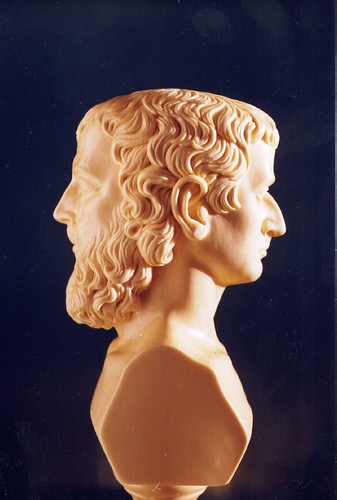
Janus is the God of doorways - and if Wells et al are right,

'The Two Gentlemen of Verona'

is the first play He wrote - in other words, my entrance into the Complete Works.

It is certainly a play which looks forward - there are countless points when reading and watching when you go - ah, that's in Romeo and Juliet, that's in A Midsummer Nights Dream, didn't that happen in The Merchant of Venice, or Othello ... that reminds me a little of the scene in Twelfth Night, or, surely that is a little like Hamlet's ....

But it's more than just action and incident, word and phrase - there is a usage of language and a usage of theatre that makes this a very Shakespearean play.

This is already Shakespeare the poet (in Brook's sense) - the resonance and reference looking back into experience and encounters.

This is Shakespeare digging into the works of other stage professionals - there is a strong link, I think, to Lyly - I couldn't stop thinking of the 'courtly' actions and the word play found in the older man's work and attempts to satisfy for Elizabeth's taste.

There is Greene, in the character and spirit of these two young men.

But it is not the 'borrowed clothes' plagiarism of A Groatsworth of Wit, which would suggest an insecurity - for this is quite a confident play - it is an early exploration of the power of the theatre to self reference - and to deepen and even create meaning through such reference. It is a shorthand - why waste time going over the same ground already covered. It is a playing with the audience - spot the quote (remember, education was mainly about quoting the right authority when you are debate).

Curiously enough - it is a play about leaving a woman you love to go to another city - and, to commit the sin of implied biography, I can't help linking this to the earlier sonnet (1 aka 145).

It is also very much a genre play, with a set of conventions to guide both the performance and the watching - and I suspect part of its unpopularity is due much more to the genre being out of fashion than with any quality of the play itself.

This is a play of wit - and therein lies another difficulty: Wit frequently requires a knowledge of and easy flexibility with language - and we are just too distant to take the 'set-piece' exchanges without a degree of study beforehand.

Above all else, this is an entertaining play - something doubted at times: I enjoyed watching it, I enjoyed reading it through.

Whether it is a play to be 'studied' is a different question - but then, I very much doubt whether any of the plays should really be studied - death by academia.


Technorati Tags: , ,

Friday, May 02, 2008

Forget Shakespeare!

Shakespeare never intended anyone to study Shakespeare. It is no accident that he made himself so anonymous.

Peter Brook

The second ‘piece’ Peter Brook provides in Evoking (and forgetting!) Shakespeare is on an actor’s need for amnesia. This is a short (2500 words approx) essay with some very sound advice to young actors taking on a role in Shakespeare.

Brook starts out by reminding us of the pendulum of acting styles – how it was all emotion and no meaning when he was young, and how it swung to all meaning and no emotion. The present extreme is one of reductionism (remember this was written in 1994) – cutting Shakespeare down to size:

“… young actors are once more drawn into the trap of believing that their own everyday experiences can give them what they need and that they can base their understanding on their personal set of references.” Pg 40

Interestingly, Brook suggests this is a cause of some of the politically clichéd and socially stereotypical productions that regularly pop up as ‘contemporary’ Shakespeare. He gives the example of colonial-Tempests and suggests that the adoption of ‘sexual-attitudes’ in current vogue for complex characters who have fascinated for centuries because they were unfamiliar is, at best, counter productive.

His suggestion for avoiding such pitfalls – forget Shakespeare.

I remind you he is talking to the actor who is to perform Shakespeare – he is not suggesting this is the path for anyone else (although I do wish most academics had taken the advice).

What follows sounds simplistic – but is very difficult to do, and rarely done successfully – imagine Hamlet really existed.

Treat the script not as ‘written’ but as a record of a tape-recording of what was ‘actually said’ by a real person.

Brook suggests that the first consequence of such an attitude is to sweep away the ‘like-me’ attitude: No amount of improvisation on the character will reproduce the complexity or intensity of Hamlet’s words – his uniqueness. He goes on to further suggest that bringing in ‘Shakespeare the author’ and any ‘intention’ he had, would not only fail to help understand Hamlet, but would also ‘muddy the waters’ – require the actor to double think:

The actor’s task is not to think of words as part of a text, but of words as part of a person whom we believe actually minted them in the heat of the moment (pg 43).

Brook moves on to use Lear as an example and suggests that, with this approach, the actor cannot fail to recognize the extra-ordinary in the character – the actor will take his/her interpretation beyond both the ‘psychological’ and ‘textual’ approach – both of which reduce Shakespeare.

If you think of Lear as the man who gave his Kingdom away – he becomes a doting fool: If you approach him from the point of view of the man who says,

And take upon’s the mystery of things

As if we were God’s spies.

He is no ‘common-place mind’, ‘there is no trace of dotage’.

Shakespeare’s words, Brook reminds us, are ‘necessary expressions of the inner patterns of exceptional human creatures.’

I don’t think there can be any doubt that the approach taken by Brook has produced anything but some of the greatest Shakespearean productions – certainly in the second half of the 20th Century, possibly since Shakespeare himself directed.

It is only when we forget Shakespeare that we can begin to find him.


Technorati Tags: , ,

Tuesday, April 29, 2008

Original Pronunciation

Link for those interested:

Public Broadcast on Original Pronunciation at the Globe.

A lot of people seem unaware of the richness of resources available for reconstructing the sound - not the least being the glory of English Spelin - writ as proNounsed until some idiyuot invverntd dickshiooneries.

Too Bay, awe not to Bay!

Another link worth looking at is THIS: Jolly good fun for starters.

Finally - still to come over on the Music Review section of my blogomania is the piece on Elizabethan music being prepared as a response to all the cd and mp3 material I've been working through as a result of the 'Complete Works' project.


Technorati Tags: , ,


Monday, April 28, 2008

It's not what you do,

It's the way that you do it:


Before the vultures start picking - I know it ain't totally accurate - I can hear a couple of sounds that shouldn't be there, and the whole process of 'reconstruction' is speculative ... blah, blah, blah.


What I think is exciting is the difference attempting the original sounds makes - this suddenly becomes a much better poem. It is good fun to say.

I can see why it was included in the original collection - and even why Shakespeare might have had a fondness for it.

Performing it this way I felt like I was close to the young man who wrote it - and there is a sincerity to it that gets lost with 'posh-Shakespeare'.

I can also see the dramatic poet here - much more than the lyric one.


Technorati Tags: , ,

Sunday, April 27, 2008

Greer (bbke)

Amazing the reactions to Ms Greer and her book, 'Shakespeare's Wife'.

It's obviously getting a push in the New World at the moment judging by the number of reviews - many by people who admit a degree of bemusement at the subject, most by people with little expertise in the area and some who don't actually seem to have read the book.

A great many of the reviews are more concerned with 'Shakespeare' rather than the 'wife' - and with Greer herself, than the subject of the book. What is frightening is that several of the commentators don't seem to be able to get beyond the Wiki biography of Greer - which underplays considerably her respectability as a 'Shakespeare Scholar' - not one of the reviews I've read has mentioned her book in the Oxford series - A Short Introduction to Shakespeare.

Don't get me wrong - there are some good reviews: I quite like this from 'thestar' - even though the writer is no Shakespeare expert - and doesn't always agree with my views; another I quite like is in the New York Times, Reclaiming the Shrew ...

... and some truly dreadful ones from people who really don't get the point of the book - The Times of London's is a classic silly man talking!

Greer is also getting a bit of personal exposure - again, I like some of it, especially when she is doing the talking.

So much for the 'professional' reaction.

If that were all, I don't think I'd bother about it - book reviews are all part of the entertainment business; but there is also a strong reaction in the blogosphere - especially the Shakespeare blogosphere.

I need to be careful here - most of the people blogging are good honest citizens with a passion for Shakespeare and a desire to put that into whatever they write.

What has surprised me is the closed minds shown to the book by several people - who openly claim they would never read the book. A couple of common reasons given are 'it is only speculation' and it is an attack on good honest scholarship - and good respectable biographers who know what they are talking about. A third reason, not so often stated but implied, is the book is seen as an attack on Shakespeare.

The 'speculation' is interesting - especially as the whole point of the book is to point out how much of the accepted view of Shakespeare's relationship not only to his wife, but women and marriage in general is based on little if any evidence - and that much of the evidence there is is open to alternative interpretation. The book is aimed at revealing the degree of speculation, not claiming any 'correctness' in Greer's own speculations. Some of the views expressed by Greer are obviously slightly 'tongue in cheek

What Greer does give is a very clear, detailed and documented picture of domestic life for women like Ann Hathaway in towns like Stratford - a much firmer base for speculation than any supposed autobiographical element in the either the plays or the poems.

Interesting is the way such information gives a new set of parameters to view the plays through - and Shakespeare himself.

Far from being an attack on Shakespeare - he comes out of the biography very well - as a much more sympathetic human.

As for the attack on the the critics - well, maybe they deserve all they get?


Technorati Tags: , ,


Saturday, April 26, 2008

I, the Man in the Moon ...


"...it is a tale of the man in the moon "

Another of those - sounds familiar.

No way Shakespeare was in this - it was performed by 'the boys' - but, you know what - I'd bet rather a lot he knew it.

That prologue - for what is a 'court performance' - is there in 'The Dream'.

More evidence of Shakespeare's involvement in court affairs? Maybe. And maybe the later play throws light on this play of Lyly, MA: Did the courtiers interrupt the silly prologue - the whole performance in fact? Intriguing.

Also intriguing is this little snippet:

his person -- ah, sweet ... [I.2.60]
person! -- shall he deck with such rich robes as he shall
forget it is his own person; his sharp wit -- ah, wit too sharp,
that hath cut off all my joys! -- shall he use in flattering
of my face and devising sonnets in my favor. The prime
of his youth and pride of his time shall be spent in melan-
choly passions, careless behavior, untamed thoughts, and
unbridled affections.


Is there a better description of so many of Shakespeare's early lovers? I am tempted to say of teenage Shakespeare himself if Sonnet 145 is anything to go by, but will refrain.

Performed around 1588. - Two Gentlemen of Verona has a similar first performance date if the earliest given for it is right. What are the connections?

There is an exploration of 'what is love' - there is man spurning woman - and women's revenge ... there is a wittiness in the dialogue.

But it is more a feel - a lightness and an expectation set up as to what such a play is about.

The business of boys and serving men also strikes a chord.

Apart from the direct links to 'A Midsummer Night's Dream', there also seem links to several other plays and characters - Falstaff is here in prototype (Sir Tophas) - but it is the Falstaff of Merry Wives rather than the Henry plays ... and elements of this Falstaff seem to have transmogrified into Pistol, and Armondo (Love's Labours Lost).

More than anything else though is a sense of elegance here - this is a 'court' play.


Technorati Tags: , ,


On reading Stanley Wells ...


His introduction to:


'THE COMPLETE WORKS'
in

'THE OXFORD SHAKESPEARE'

(compact edition).


In the frantic moments of reading here and there, getting things down on video and audio, finishing reading texts to deadlines and generally surviving the departure of journeys (not to mention it is Easter here in Romania this week) - I took time out yesterday to sit by the Bega River and read through the 'General Introduction' Stanley Wells wrote for the Oxford Shakespeare back in 1988.

It stands up well to time.

I have to admit it did a great job in calming me down - of giving a firm platform on which to stage the plays (pun intended) and of reminding me I am here for pleasure ... this is not a duty, not work.

It is a hefty volume - I'd borrowed it from the local British Library (never got around to buying it - although I am thinking of getting my own edition, in the spirit of trophy hunting) and had it balanced on my knees as I sat on a variety of benches - moving with the sun, 'sometime too hot', 'often ... dimmed'.

The local pigeons seemed interested - especially one with a deformed foot, toes sliced off, which I thought was distinctly Shakespearean - several blackbirds took the opportunity to berate me; the sparrows: Tribal.

Wells has a clear style - and his facts are mainly just that - not an over extended 'Life'; firm-based supposition when appropriate; a good section on the theatre buildings and their relationship to the plays.

This last point again struck home - and the assertion that "the theatre" was Shakespeare's, "greatest collaborator," and, "encouraged his genius to flourish," found a warm welcome in this bosom.

Wells also provided useful information on the printing history of the plays and on the editing process - that was neither excessive nor unfitting for anyone coming to any edition of the works of Shakespeare either for the first time, or even after some acquaintance.


Technorati Tags: , ,


Friday, April 25, 2008

On Sonnet (the first) 145:

To Ann, a wyff of StratFord

Throu the Avon

By the time I’ve done with this little poem, I’ll have recorded it three times – one, the first (already in the public domain) - expresses, I think, my true feelings for it as a work and it’s potential place in the ‘Canon’. The second I’ll attempt as an authentic pronunciation performance – something I noticed when playing around with the text is a distinctly different feel when the sounds are said in a sort of re-constructed pronunciation … I am not claiming it is right – treat it more as an archaeological experiment than authentic (and I’ve something to say on that issue over on my music review blog, pretty soon). The final is a straight reading – well, sort of, complete with introduction and after-word – that’s the ‘Introduction to the Sonnets for no-lifers’ performance. All will be You-Tubed in the ever fleeting chase after fame and fortune.

Gurr’s argument for this being an early poem (and consequently the first thing we have of Shakespeare’s writing) I find quite convincing … Greer (bbke) doubts, but nods in the direction of possibility and makes a very interesting observation … if this is written for Ann – then other sonnets were most likely also.

I have to admit that I rarely read ‘Let me not to the marriage of true minds …’ without thinking it was for her – separated, rarely seeing each other, married – and producing, what 8 (?) children: Love does not ‘bend with the remover to remove’; ‘it IS an ever fixed mark’; it’s ‘not times fool’.

Sonnet 145 is a rough teenagers attempt to capture this ‘true’ mind – Ann. To accept that, we have to dump hundreds of years of misogyny and presumption: We also have to accept a review of the concept of genius – of what this genius saw as a domestic ideal - marriage as the base and foundation of contentment and as a real passage to salvation: Marriage is a source of the deepest peace man can find on earth.

I find this a fascinating idea – especially as I’ll soon be moving on to two ‘comedies’ which deal with these subjects.

Another thing that has been washing around in my head is Brook’s little talk.

Shakespeare’s value lies partly in his ability to turn out poetry – and this poem really isn’t very good poetry – but it does have something about it.

Are we here seeing the moment when Shakespeare first connected his natural gifts to experience?

And a final thought – if Shakespeare is such a good portrayer of character – and he is (remember his is stage writing) – he must have understood people fairly well – why then marry Ann? Why, if this is about her, pursue her this way, why keep and include the text many years later in the published collection of sonnets (shut up – I know all about the ‘was he involved’ arguments over the printing)?

Whatever Ann Hataway was, this touching little attempt, if for and to her, is a clue to a very different Shaksper to the one male piggery and the combined-Bardolatories is fond of exhibiting.

A note of caution ...

...for all potential bloggers - the world is full of can't-see-the-wood-for-the-trees idiots all too willing to criticise your insights and efforts without either understanding or even bothering to read what you write and do.

There is a classic case over on Shakespeare Geek at the moment.

The little 'tongue in cheek', 'over the top' performance of Sonnet 145 I did as a birthday present and as a start to my Odyssey through the complete works attracted an 'I can't stand ....' comment: No surprise.

Well - if the person had actually watched the images and thought about them [if capable of recognising them, their sources, their significance ... etc], had read this blog and noticed what I said about Greensleeves (and realised the choice was carefully made), if listened to my other performances on You Tube of two more famous sonnets, and noticed this was somewhat odd compared to them ... read the Greer (bbke) reference I gave (where the sainted Ms is distincly ambiguous to the claim of this being what is claimed); if checked the Gurr paper I quote below and re-referenced, then maybe, just a very big, maybe ....

Well, this is my blog and I'll cry if I want to!

Dramatic I run from me.


Technorati Tags: , ,


Wednesday, April 23, 2008

First Step ...

All journeys start with a first step - and this is mine:


Not the sound quality or video quality I hoped for - but I think you get the idea.

Enjoy.

444

Being "444". and being awake at an unseasonable hour with a 'show' to do - I searched.

A simple enough word - Shakespeare.

Google came out with the worthies: Top of the list, MIT and the Complete Works. Strange (and not) how our cousins across the sea feature at the top - the technology maybe giving the edge. Still, it would have been nice to see an English site as top dog.

And maybe not - top dog or no, there are problems following a 'disc failure' back in 2000 (so - no more talk of millennium bug freeness!) - and the top of the list complete works is anything but complete. A nice kind link to another site (number five in its own right) - with the correct spelling of theatre giving me hope - but no, that's in a Google ad! Another American hit I'm afraid.

Wiki makes it in second - as you'd expect. Have you noticed, Wiki is frequently second? It's a bread and butter entry - several points make me bristle, but it does the job - and I've seen worse - much worse. There are plenty of cross references to keep you busy and there are even real references - something I do like - allocating blame is good!

In Bronze position is shakespeare online: Damned in the deepest of Dante! 'Nice' looking opening page - but what happens then? Well, clicked on a 'nice' looking link for Sonnet 73 ("hailed as one of the best poems in English") and what do I get - About.com:Shakespeare flashing advertisements at me - I search for the poem ... split by adverts and knocked sideways after line 4, the following bit squeezed between a clipart photo and more adverts for for-sale services, and 'nice' annotations of the less intelligent 14 year old student kind.

So much for quantity rather than quality filters!

In despair I try Yahoo: about one hundred and twenty three million results! (Google had only managed forty one and a bit million.)

Horror of horrors - the same three top, albeit in a different order - Wiki first, MiT second and that other one third.

What follows is quite nice - a selection of the better sites I sometimes dip into.

Past three o'clock on warm and wet spring morning - is it any wonder that after four hundred and forty four years, the little lad from Stratford features so prominantly in my life? And if the number of sites thrown up by the search engines is anything to go by - in a lot of other people's lives too.

I think not - all you need to do is watch the plays, see the faces of people in the audience and .. for the sadder ones amongst us ... even just read the texts, and you'll know what a gift the world got as the screams of a fresh from the womb bloodied brat burst out.


Technorati Tags: , ,


Tuesday, April 22, 2008

ALPHONSVS, KING OF ARRAGON


Alphonsus (on-line text) is a play printed in 1599 - but, seeing as it was written by Robert Greene (who died somewhat earlier) it is safe to assume it was in fact printed only after its useful stage life was over and the last drop of profit for the theatre company which owned it, came from the disreputable act of selling the text on.
One date given as a possible performance is 1587 - and by the Queen's Men. This puts it firmly in the realms of Shakespeare acting territory - at least one scholar suggests Shakespeare acted with the Queen's men - and he surely would know the play anyway.
It's not a bad play - its not the sort of play I'd give stage room to myself, but I can see the attraction - it is entertaining: It has all the elements needed for killing an hour or two before bedtime, and the language is quite good.
And straight away I'm into the entertainment at the end of 'A Midsummer Night's Dream'!
I couldn't stop thinking of 'The Dream' as I read - a snippet here, a sound there - and an idea or two.
If you want to know where Bottom gets his idea of declamatory acting from - and such delightful alliteration - read no further than here - Boom Boom Boom!
Amazon fighting and winning love doing injury - well, it's almost here.
And women being meant to flee, not chase - 'were not meant to woo' - almost word for word - almost - here.

But it's not only 'The Dream' - and the words: There's the stage action - there's a good dynamic at times - a flow of action, a movement of scene to scene.

I was reminded of the early History plays - the movement of armies - especially in the second two parts of Henry VI.

Fascinating too was the 'speechifying' - Here I was thrown back all the way to Beowulf, and the Anglo-Saxon penchant for self promotion - half the battle is in a good speech.

Well, tomorrow I'll be delivering two of the greatest - from Henry V - along with a couple of anti-dotes from Richard II - and Mr Greene is going to be haunting the party too.
Technorati Tags: , ,

Monday, April 21, 2008

Johannes Factotum


Yes, trust them not, for there is an upstart crow, beautified with our feathers, that, with his Tygers heart wrapt in a Players hide, supposes he is as well able to bumbast out a blanke verse as the best of you; and being an absolute Johannes Factotum, is in his owne conceit the onely Shake-scene in a countrie.


Back to Mr Greene's outburst.

I've been reading a couple of his plays - and, by the standards of the time, they were not bad - in fact, they were made for a specific audience and served that audience well.

What has upset Mr Greene? And, as the Bordolators have done an effective knife job on his reputation, how can we look at this comment - fairly?

We all assume (meaning, I do) that the above quote is aimed at Shakespeare the writer - but I'm not so sure. That 'bombast out a blanke verse', the more I look at it, and the more I re-read of the plays of the time, seems a comment on Shakespeare the actor rather than Shakespeare the writer. Was Shakespeare in a Greene play - and 'bombasting away? Or did Greene see him in Marlowe (and it must have been a big role) mangling the verse? Was Shakespeare ham acting for the crowd?

You know, I wouldn't be surprised: One thing that makes his plays so successful is his attention to the groundlings.

And that 'Shake-scene'? That's a full throat shouting out the lines performance if ever I saw one.

Was Shakespeare guilty of something worse - dare he add extra lines to an already written play?

And was that a Greene play?

And was it a "popular" alteration?

I'll post soon on the couple of Greene plays I recently read (only a partial re-read this time) but I do actually suspect Mr Greene had something to complain of ...

... not the plagiarism that we see with hindsight - but the actor messing up the text (after all, what did Hamlet say on that?).

Technorati Tags: , ,

Friday, April 18, 2008

Famous victories

Back in 1586 (all dates debatable), the play, "The Famous Victories of Henry the fifth" was performed -

I've been reading it (a performance now is almost impossible to see - indeed, should be, because, despite any archaeological interest, Shakespeare re-wrote and expanded it into a series of much better plays).

The trouble is it is difficult to read fairly - I know what was written after, and, with hindsight (you can't read without it) see what Shakespeare will do with this play. What is interesting though is how indebted Shakespeare is to this earlier version, not just for a story line, but for character, stage business - and a lot of what-not-to-do.

And, always there, the question - did he know it from the inside? Is this one of the works he acted in?

Another leap gets made - did some of the same actors play in Shakespeare's Henry plays? Was Falstaff, for example, expanded as a role to be played by the same actor who played 'Oldcastle'? - It would give an extra 'piquancy' to the apology and disclaimer of the later plays.

The biggest difference is in the language - there is little of Peter Brook's poet here: Jokes and word play abound, some to be echoed later by Shakespeare. One exchange that jumped out for me was over the job of cobbler: Surely this is the spark that ignited the opening exchange in Julius Caesar?
But there are some very close lines - Here King Henry says,

"My lord prince Dolphin is very pleasant with me"

- not a great distance from the more familiar:

"We are glad the Dolphin is so pleasant with us," (Act 1 Scene 2, Henry V)

But what a difference - the 'me' to 'us' - and from a personal insult to an international crisis.

And surely I am not wrong to hear in,

"My Lords and louing Countrymen,
Though we be fewe and they many,
Feare not, your quarrel is good, and God will defend you:"

the 'very words' that 'stir up the hearts' of every Englishmen, when fine tuned by Shakespeare:

"We few, we happy few, we band of brothers;" (Henry V, Act 4, Scene 3)

Taking another cue from Brook, I am curious to know where the play was performed - or intended for performance. It has a feel of a small space - a very flexible space - a pub yard? There is no of that 'dimension' in the writing which shows a depth and juxtaposition of ideas. Scenes flow rapidly from one to the other and the amount of 'knock-about' comedy surely indicates a boozy, boisterous audience?

This Henry is 'one of the boys' - he is a down and out rough with none of the 'pretence' Shakespeare gives him. Or feels the need to give him.

And most of the other characters too have not yet gained the dimensions they will achieve in Shakspear's play: Principle here is surely Oldcastle!
Sir John Falstaff is not Oldcastle (Shakespeare tells us this clearly enough) - he has 'surfeit swelled' by absorbing the bodies of so many other of the characters from this play - he is an amalgam (like a recent Dr Who Monster absorbing others and having their faces pushing out all over its body).
In this play, The Famous Victories - Henry rejects a variety of his ex-colleagues: Jockey, and Tom and Ned: Shakespeare concentrates and intensifies all this rejection into Sir John.

There is direct stealing by Shakespeare - the hangman idea (and is the knocking at the gate going to pop up in Macbeth?) and borrowed material - Shakespeare refers to Hal's encounter with the Chief Justice but this play shows it.
Here the tennis balls are a constant theme - which allows Shakespeare to refine a single joke.

There are adaptations and shifts - surely the Hal/Falstaff double enactment of the future encounter between Hal and his father is proto-typed in the acted out court scene and then the re-enacted court scene using 'clowns'?
What a brilliant shift Shakespeare makes - what depth and 'poetry' come into it as a result of this change (one is tempted to say, slight of hand).

And another shift of note is the departure of Hal's former cronies for France - many of the same people are present, but here they are pressed - the magnificent melancholy of Shakespeare's play is nothing more than an opportunity for more knock-about (including a Shrew-like wife).


Technorati Tags: , ,

Monday, April 14, 2008

This falls out better than I could devise


(or Serendipity 2)

I've already mentioned that I am starting the 'Complete Works' Odyssey on St George's Day - reputedly Shakespeare's Birth-Day and Death-Day.
I was wondering how to start - it surely needs something special? I'd got a couple of ideas, including digging out a statue of St George in the centre of Timisoara (and puzzling about what to do with it).

Well - job sorted!

I've been asked to do another, "Shakespeare Thing" (in fact, the question, "You know April the twenty third?" was asked! - Not so subtle my bosses.)

So - Shakespeare - from first to last, is in preparation.

I'm going to start - for gratifications of my own - with a performance of what I wish to believe is Shakespeare's first extant piece: and his last.

I suspect Mrs Shakespeare is going to feature heavily - in Ms Greer's (bbke) version - as fits.

And, on England's national day, some of the more patriotic bombast has to be given full throat.

Hopefully some of that will get released in video format for all to endure.


Technorati Tags: , , ,

Friday, April 11, 2008

Books Reflected: Nuclear Shakespeare

Each line in Shakespeare is an atom. The energy that can be released is infinite – if we can split it open.


Books Reflected: Nuclear Shakespeare


I am going to be viewing the Complete Works with this work very fresh in my head!

Technorati Tags: ,

Tuesday, April 08, 2008

Sunday, April 06, 2008

Background ... forever background


As I lay in bed this morning, instead of music, I Sunday-morning-indulged and listened to an 'In Our Time' podcast I had downloaded a week or so ago - on The Dissolution of the Monasteries. It is still 'listenable-on-line' by clicking on the link - it is a showcase of clarity and excellence in discussion.

Not quite Shakespeare's time - although much closer than people realise: Counting history in terms of Kings and Queens sometimes lends a distance which shouldn't be there: The time between Fat Henry's theft and Shakespeare's Elizabethan birth is much shorter than one would think.

What I found fascinating at first were the parallels with modern Romania and the 'Dissolution of Communism'.

The monasteries had an apparent function associated with belief - they percolated into all aspects of community and into many people's individual lives. Economically they had a powerful control over vast resources (up to one third of the land of England was theirs).

No surprise then that there was a sense of loss at the dismemberment of the system resulting in a public outcry from one section of the community (The Pilgrimage of Grace). This was echoed after the fall of communism in Romania, not least amongst those economic elements which had been subsidised and supported under the old system.

Importantly, there was a lot of support for the change - not least from within the system itself - Erasmus was a good Catholic - and, however later historians and partisan fighters might colour the change, it seems there was already a movement away from monasticism - it was a system waiting to fall.

But I don't want to focus on the causes - it is the aftershocks and their immediate consequences which interest me.

Education changed - schools became more significant: Habergham High, Burnley, where I worked when Romania had its recent revolution, was founded as a small town grammar school in this period; The Shakespeare School, Timisoara where I first worked in Romania, was founded immediately after communism fell.

Shakespeare himself most likely benefited from this educational boom - his wife not.

What has come with the loss of the certainties of communism is an open questioning and the growth of alternatives - something similar must have occurred after the monasteries fell. Prayer and 'the certainty of salvation' proved rather ineffective against the legality of Cromwell (Fat Henry's man); Relics proved to be just that - old and dated.

Surely we find this questioning in the plays? Not, I suggest, as a direct link - but as the ripple still travelling across the pond minutes after the fish jumped in the evening twilight.

And the economic shifts that occurred - the enrichment of the middle sort, the need for poor laws, issues of land ownership - all colour the texts acted in the globe.

It makes me hopeful for Romania - although I doubt whether we will produce another Shakespeare (sorry Tudor).


Technorati Tags: , ,

Saturday, April 05, 2008

Things coming together!


A picture of the route has almost been formed - and a starting day set: It won't, I imagine, come as a surprise to people to know I will take the first steps on 'St George's Day'.
A surge of ancestor pride - I refuse to accept it as Nationalism, and patriotism is too sexist for my tastes (distinctly "Macho" if you live here in Romania).

A couple of interesting points and ideas have popped up as I've researched.

One concerns the ubiquitous 'Greensleeves'.

I had, along with countless others always thought this was possibly composed by Fat Henry (8th King of the name in the English realms).

Apparently not. Too modern for him to have done. But quite possibly written around the time Shakespeare was starting out as a sonnet writer - remember that.

I am also, as you might have guessed from that little snippet, working my way through the music of the period too - and came across a great double cd - Celebrating Shakespeare: This World's Globe.

I'm also getting heavily tied down in the church music of the period and taking every excuse to listen to William Byrd.

And final snippet (No 3, for those counting) - Dido, Queen of Carthage! By Mr Marlow (e-refused).
Not a play I know well, possibly the first Mr M. wrote - with another (so Elizabethan).
What got to me was the almost opening - after a prologue of gods and things, there is a Storm.
Now, read that if you dare and refuse to connect with Shakespeare's 'Tempest' opening. Replace Prospero for Jupiter - Hermes - Ariel; We've got a daughter and a man washed up on shore - with his son ... all echoing the latter play - and all so much poorer!

I am tempted to suggest that this could well be a play Shakespeare acted in.
(If I was really pushing it - and speculation is firmly drifting into dreamland now - I'd be tempted to say it could well be the first play Shakespeare acted in! And did he play Jupiter?)

The final scattered thought comes from slightly later in the same play - Aeneas has one of those speeches which point out beautifully the difference between Shaksper and Marlow (e-less in Timisoara): The mighty line.
It's a great speech to 'Bombast' out. Is this the sort of thing Shakes was trying to copy early on?


Technorati Tags: