Showing posts with label Henry VI. Show all posts

Sunday, September 28, 2008

Animal Magic!

Lions and Lambs, Foxes and Chickens, Doves, Snakes, Wolves, Eagles, Crocodiles, Porcupines and Dogs … oh yes, and Caterpillars ... and a Calf and his dam.

Not a list of creatures you can see in a zoo, but the menagerie invoked in the first Scene of Act 3 of The First Part of the Contention … (Henry VI, Part 2).

It is quite a list – deliberately extending earlier references to both the domesticated and wild and linking them to the Duke of Gloucester (most are used with reference to him) the King and the realm of England itself.

Some carry a weight of obvious symbolism – the Lion, as king of the jungle is also the animal seen ‘rampant’ as representation of England itself (even Willy was a lion – the first ‘mascot in any Soccer World cup – now copied ad nausea and sub-intellect into every sporting event). Ravenous lions are a powerful image – but incorporate a residual (at least for the ‘true’ Englishman – and if you saw the mustache and leg hair on the average English beauty you’d know that was not sexist) jingoism and a degree of pride (sorry for the pun) in strength.

Lambs take on the inevitable representation of sacrifice and the christian association with Christ – as well as provoking the sentimental in urban dwelling moderns: Not an ‘original’ Elizabethan sentiment perhaps.

And of course – the lion shall lie down with the lamb – not exactly a threat in the long term.

A careful look at the list of animals reveals several ‘double edged’ and consequently ‘interpretable’ linkages.

If the fox is a predator on chickens he is also respected for his cunning – and as long as that cunning is used for good purposes it can be an appellation of respect ( it should be remembered that Shakespeare used ‘Foxes’ Book of Martyrs as a source) – chickens are silly, ‘headless’ creatures which make a lot of noise – begging the question, ‘Who, in this play, are the chickens?’

The King – who in this scene loses all the respect gained during his last appearance and is revealed as weak and ‘empty headed’- could certainly be seen as the chicken – but if the king is the head, then the dukes and the Kingdom are in fact the fowl so foolish. There plots and counter-plots, their clucking complaints and their single-minded stupidities are the very reflection of a bunch of farmyard hens.

Doves and snakes seem less ambiguous but both reference back to the ‘Book of Genesis’.

The Dove – as a symbol of love and peace – is the superficial reference made by most commentators … but in the play it is the King who first uses it in this scene – and his religiosity suggests the need to dig a little deeper: The dove is the bird that brings the leaf to Noah in his ark – a pointer to a future on dry land and final ‘saving’ after turbulent times.

The Snake – with its definite reference to Aesop and with a proverbial linkage - is also inescapably knee-jerk linked to the Satan/serpent of the Garden of Eden. For the Queen, daughter of Eve as she is (and French daughter of Eve at that), to raise the devil is an inevitable ‘back-fire’ with an audience schooled each Sunday in the sins of our progenitors.


The wolf is a pack animal – the Eagle is a noble bird: Not the intended meaning given by York as he hypocritically works against Gloucester and the King under the guise of legality.


Crocodiles and Porcupines are a touch exotic – and hence suspicious …weakening in this English context any power they might have and more suggestive of flights of fancy and trivial image making than serious insight.

At which point I go back to my last post –

and show itself, attire me how I can


the Duchess’s exiting lines and reminder that the truth will out in the end.

Having been both a writer of references for people applying for higher education and employment, and a reader of references written, one thing is certain – bad comments say more about the writer than the subject. The instant you read a negative comment you ask – why have you put that? – you don’t say, ‘really, that’s not a nice thing’.

Shakespeare’s loading of the negative comments here with the animal images is a fascinating exploitation of this phenomenon and a delicious insight (in our post-subconscious world) into the slip from domestic husbandry to vicious wildness that the country is making as it removes the final good shepherd from his post.

Friday, September 26, 2008

Diptych; Triptych

Key pointer to change in a stage performance is the passage of people – an empty stage is a far greater marker of end/beginning than the written word ‘exaunt’ (with or without a new scene or act number).


The flow of people onto the stage – sometimes with a musical accompaniment, sometimes silently or with the clashing of weapons, the marching of feet and waving of banners – is an important stimulus to pay attention – something new is going to happen; the draining away of all, leaving a bare wooden platform, is a sure fire kick-start to the question, ‘Well, what was all that about then?’


Part of the difficulty of ‘reading’ a play like The First Part of the Contention … is this lack of definition – I am tempted to say it is the difference between seeing a postcard of Nelson on his column and being in Trafalgar Square, pigeons, traffic, tourists and all.


Paradoxically, a greater clarity of the individuality of scenes also leads to a sense of cohesiveness: Humans love to sum the parts.


It is a mistake to over emphasis the narrative as sole foundation upon which Shakespeare is building. It is a mistake easy to make – especially with the History Plays which are based on a national narrative, pre-written and only adapted by the word-play-forger.


The director in me (small, sniveling, unfulfilled, deflated, vestigial lump that it is) never lets go of Shakespeare’s love of juxtaposition. Examine any two scenes he placed next to each other and you will usually find a wealth of links – frequently, but not exclusively, in the form of a contrast. Put three scenes side by side and the sum becomes greater than the parts.


Act 2 of The First Part of the Contention (Henry VI, Part 2) provides an example in scenes 2,3 and 4.

Quite frankly, they are not a good read.


We have a complicated spoken genealogy guaranteed to confuse, even when re-read; a scene that seems to be taking place in a court – possibly a public execution place – with a short announcement and bit of a fight; then a scene in a street with more talk and next to no action: Nothing happens twice with a bit of physical distraction in-between.


Overtly scene 2 is York’s explanation of why he is the rightful heir to the throne and why Henry is an usurper. It is possible to dig out a genealogical table and follow his argument (although beware – Shakespeare, copying his source closely, gets a bit of it confused) – and come to the conclusion, ‘he has a point’.


Legally then, York should be King – but Shakespeare doesn’t leave it there – he adds a coda. When Salisbury and Warwick have knelt and declared him King, York goes on to suggest the need for all three to be deceitful and pretend to be what they are not – with the purpose of disposing of Gloucester, ‘the shepherd’.


At which point Mr Shakespeare empties the stage.


So – what was that all about?


We have a justified legal claim which sounds like ‘words, words, words’, and an intended illegal action in promotion of that claim. Do actions subvert rights? If York gets the crown this way is he in rightful possession?

By which time the trumpets are sounding and in walks the un-rightful king – in full splendour (complete with the crown) and power. He gives judgment in a court case – sentences, in full public view and with assurance (and a glimpse of god’s anointed majesty) to death evil-doers and, with rightful distinction, to internal exile their silly dupe (Gloucester’s wife). The language used is clear, straight and unambiguous.


The criminals go off to ‘execution’ and in come the master and apprentice for the trial by combat. One is drunk and getting drunker – the other almost insensible with fear. The drunk has pro-claimed York true King and is assured victory by both experience and physical size; the apprentice – and that meant boy – has no chance, even though right is on his side.


But a ‘miracle’ happens – the excessive drink confounds the man and the boy wins.


Watching this is Henry, the ‘young’ King, York, Warwick, and the rest of the court … including all of those mentioned in the previous scene as subverters of the state and its laws.


York, in two quick lines, sees not the actions of God, but the wine as cause of the victory; Henry, closing the scene in 6 lines (looking always for the interventions of God) heaven’s intent to punish and bring low the unrighteous, reward those true.


And the stage empties again … with trumpets and display, cheering and the dragging off of a dead body.

Clearly there is a demonstration of ‘right over might’ – but York was on stage – and all those lords he was talking about … is Henry falsely secure?


And where were the combatants standing? Was Henry ‘above’ and the fight below? Where was York (and his friends) standing in the scene before? If York, then the witch and Gloucester’s wife, then the fight are all seen on the same spot – they are linked.


Why the drink? The previous scene took place after the Lords had dined together – were any of them slightly drunk? (It would make for a more entertaining scene if Warwick was slightly tipsy). Excessiveness in drink is a metaphor for other excessiveness – and the armorer was the one who supported York’s claim to the throne – is there truth in wine or is it just oil for the wheels on the tumbrel?


In silence, Gloucester enters. He is here to watch his wife’s punishment and penance – was he ordered to?


Eleanor Cobham enters – dressed in a simple white sheet (a shroud? Memento mori? Gloucester and his servants are is mourning black).


Gloucester refuses to break the law and rescue her – but she, apparently learning nothing from her experience, berates him for allowing her public disgrace. She invokes the image of Gloucester as a bird when she says a bush is being limed for his capture. Gloucester gently rebukes her and tells her to keep faith with the laws of the land – she is being rightly punished for a crime she did commit. She warns him that he will not live long – he is next in line for the chop.


She is taken off to the Isle of Man and Gloucester leaving earlier to go to the King’s parliament. Eleanor’s words close the scene – no matter how well dressed, she will always bear the ‘shame’ of the shroud.


The biggest contrast between scenes 3 & 4– and surely the one with the initial impact – is the costume: Scene 3 is all colour, all state, all heraldic splendor – Eleanor Cobham is still ‘Duchess’ and is in her finery, the King in his robes of state, and the peers of England resplendent; Scene 4 is plain black and then white – the black of mourning and the white of the dead. There is the martial uniform and weapons of the Sheriff and his men encasing the woman ‘caught in sin’ … and a brief reminder, in the person of the herald, of the previous colourful scene.

Eleanor’s closing words force us to think back to the previous scenes – and point to the future – we cannot hide our guilt in our surface appearances. It is a common enough theme in Shakespeare – no less significant for its ubiquity.


These juxtapositions reveal interesting aspects of the play which might not be noticed as so significant if analysis is restricted to any individual scene (or the play ‘as a whole’) – but what happens if we look at the three of them as a triptych?


One element that strikes me is the intensity with which the relationship between legality and right is put under the spot light.


It is clear that York has a legal claim to the throne – but has he any ‘right’? The first doubt to his claim is found within the scene where he expounds that right – he is willing to cheat, lie and play false in order to win. This is immediately brought into contrast with the Kingly Henry – for the first time (and possibly last) behaving as a true king – and with the condemnation of those who plot against the rule of God and the state. The fight then emphasises the ultimate exposure of such falsity even when supported by might. The drunkenness suggests an excessive intoxication as a cause of ultimate failure, which is a point acknowledged by York – but not absorbed.


The failure to act moderately results in death – both the physical death of the man (as the body carried off at the end of the third scene clearly indicates) and the spiritual death of Eleanor Cobham – who goes to her exile not repenting her sin, but repenting her fall.


Eleanor Cobham and York are paired in these three scenes – both have been driven by ambition, both are playing the Devil’s game, both wish to abuse the laws of the land for personal gain.


Henry appears in the central scene as a right acting rock standing against a battering sea of false aristocracy – he is ‘Peter’ – the name given to the winning apprentice – and the true rock on which the foundations of Christianity are laid. He has a blind faith in right winning out in the end. But we mustn’t forget - true justice is blind!


Which pairs him with Gloucester – the ‘Good Duke Humphrey’ of the plays original, full title. For in the fourth scene Gloucester makes the claim that he cannot be harmed because he has committed no crime.


The second scene has prepared us to hear these words with a dramatically ironic ear – we know the plots and traps being laid for the old man, the limed twigs that will snare him – but we have also just seen right winning in the end. If York and Gloucester’s wife are linked – then the ultimate fate of both is also linked and no matter what deceptions York contrives, in the end he will be made to do penance for his crimes – and go to punishment after that penance.


It is worth remembering that Shakespeare’s play, despite its verisimilitude, has taken a great liberty at this point – it has moved the events of 1442 when Gloucester’s wife and the others were tried and condemned forward to 1448 when York and his two friends met in the garden. This is not the accidental juxtapositioning of chronology – it is the deliberate artistic mixing of disparate events in a unified space.
Saturday, September 20, 2008

Wind and fair weather friends… ?


After several days of wet miserable (English-style) weather, the rain dropped away and left a cool, billowy day yesterday.

I sat in the Park. Wet drips from the trees and grey clouds canvas out the sky; I listened to/read the first scene in Act 2 (The First Part of the Contention).

There were similarities – none more so than the difficulty the birds were having flying. Most of the ground level, tree flitting birds were OK – it was the cross the sky birds – the crows, the occasional adventurous pidgin and the Kestrel I usually see circling behind the cathedral tower that were having difficulties. They were there, they were getting on with their ‘birdie lives’, but it was difficult.

Wind is exciting – ask any school teacher on playground supervision (do teachers do that sort of thing now?). Great childhood battles brew under Aeolia’s influence …; Juno bribed and browbeat the original in an attempt to destroy Aeneas; Chicago, the windy city, is famed for its gangs and violent crime.

The Queen is under the influence of the wind – she enters the stage on a high. And if the behaviour of the Lords is anything to go by, they too have their schoolboy spirits stirred: Gloucester and the Cardinal plot, the others bicker. The King ignores, to his cost.

It is marvellous how Shakespeare, in a few moments of dialogue, can sum up the basic human experience of exposure to nature. And the wind will be back …

We are out in the wind with our ‘falcons’ – well, Taming the Shrew was an act of falconry and here, in the next play, the we are reminded again of that early marriage comedy – the King tells his wife to shut up – and she apparently does.

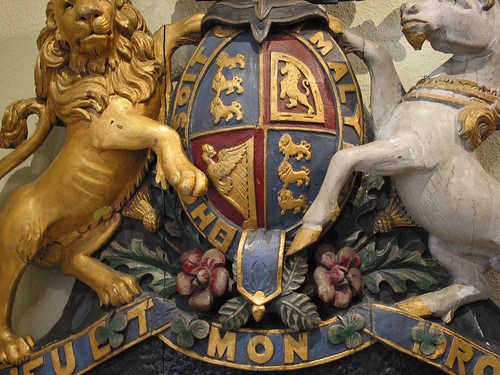
Behind the dialogue, spurring it on, one might say, is Gloucester’s Heraldic crest. This included a hawk – so the jokes which follow are bound in with the identity of the Gloucester family in a way which modern audiences have no real way of grasping.

Nowadays we are familiar with the Logo of sports teams and manufacturers of sports wear … a few people might recognise the heraldic devices of a few countries, some still carry them on their flags – but for most, the shield and the livery are quaint ideas, symbols of decadence or mere decoration.

Not so to Shakespeare – he after all, went to get his own coat of arms drawn up. It is worth noting that Shakespeare was not the only stage professional who did this – Augustine Phillips also applied … which would suggest that the heraldic was something of meaning and worth at least to the theatre people. One of the written pieces of evidence for Shakespeare as a writer is in the account books of the Earl of Rutland – payment to Burbage (a carpenter who could act and paint!) and Shakespeare for making/painting/writing a heraldic device and accompanying poem to be used at a ‘joust’ celebrating a visit of James I/VI .

Punning on the meaning of such devices must have been a very powerful ‘weapon’ in the political armoury of the play … giving the right ‘nickname’ to an opponent can be very revealing – children may shout out, ‘Sticks and stones may break my bones, but names will never hurt me’ – but they will go home and cry about it in the secrecy of their own bedrooms.

And the fact that the jokes about towering and raising above don’t reflect the person of Gloucester doesn’t negate the fact they do reflect his ‘family’ in the person of his wife – who we have just seen arrested and the news of whose arrest brings the scene to an end.

Which brings us to the second part of the scene – the revelation of false miracle and reminder of the ever-present ‘low-life’ undertow to the play.

What interests me at this point is plums (testicles) and climbing plum trees (sexual intercourse). We have some overt punning going on here. Again, likely to be lost to modern audiences – and to have been crystal clear to the early watchers of the play.

When ‘the wife’ says:


…, and bought his climbing very dear

a set of levels of meaning are activated – which resonates through all on stage.

Simpcox must surely be regarded as ‘driven’ by his wife – or led through his lust for her. His wife has possibly led him on using his uncontrolled passions.

On stage, we see Gloucester – he is about to fall, like Simpcox, because of his wife – although it is not Gloucester’s fault – but his wife’s blindness to god which will make her husband lame.

The Queen, who is still playing a virtuous game (Henry VI Part I, has not yet been written) is going to go the way of ‘The Wife’ and use a man’s lust to bring down the Lancastrian family fortunes.

The lustful man is surely William de la Pole – Suffolk: He, like Simpcox, will defy God and, attempting to climb into the Queen’s Plum Tree, fall and break his head.

Finally, another, easy to miss element is the onlookers – the crowd who will accompany Simpcox and his wife in the direction of fortune, cheering them on – and then join as heartily in the jeers as they are whipped through the towns – the playground crowd watching the for any excitement and excuse to coagulate.

Friday, September 12, 2008

Devil in t' tale ...

Nothing separates me further from the average Elizabethan than belief in the supernatural.


There not only was a God, but a Devil – that personification of Evil was a physical reality which was capable of manifesting itself and which had servants, both human and other.


It is quite ‘remarkable on’, that, in this first of the History plays, Shakespeare brings on to stage one such ‘servant’ and several human exploiters of Evil – and provides what must have been a sensational end to the first act (if he was thinking in acts at the time).


When I say sensational, I am using the term in a way that indicates the stimulation of the senses rather than ‘original’ – because it is not very original - it is one of the older tricks in the book – for what is raised for the Duchess is very much a Mediaeval Mystery Play deceiving devil – the chase-through-the-crowd with horns and pitchfork devil which must have been a mix between clown at the circus and horror movie thrill.


There is not a great deal of subtlety in it – and Marlowe and Greene, both write around the same time plays which include spirit raising.


What is the supernatural doing in a retelling of History?


The obvious answer is that it was in the history books – the characters named and the events portrayed on stage were, more or less, in the chronicles. This, more than anything else, should hammer home the way the spiritual was ingrained in the early modern mind’s perceptions of reality.


What Shakespeare does is shift the timing – moving the downfall of Eleanor Cobham forwards into the time frame of the play – in reality she had committed her witchcraft (which included the making of a doll of the King for an ‘attempt on his life’ – things Shakespeare cuts) before Margaret came to England – they never actually met.


Why?


Two reasons fall into place for me – one to do with Shakespeare’s exploration of the metaphor of marriage and one to do with the ‘theatrical’.


In direct disobedience to her husband and all the warnings of religion, Eleanor, Duchess of Gloucester consorts with evil spirits. She does so in order to promote her own status in search of the crown of England. This heady combination of ambition and disobedience is played out several times in the play – with consequences.


It is not only the female characters (for this is what Margaret does, and Simpcox’s wife) but, if we take the idea of husband equating with King, also the Cardinal and York – in fact, it is at the root of nearly every dispute and disagreement.


The only character who seems true to both king, country, religion and family is Gloucester … ironically enough. It is Gloucester who maintains the faith – as is shown in the previous scene where he sentences to trial by combat, despite the obvious physical disparity, York’s armourer and his apprentice. He is saying, ‘God’s will be done’.


This is not the passive Christianity of Henry – it is a forceful assertion.


Eleanor goes against her husband – showing as strongly as possible the doctrine of free will and independence of judgment. In Shakespeare’s previous play (The Shrew), Katherine submits to Petruccio not through force – but through realisation of the rightness of her submission. As a consequence, what will Petruccio not do for his wife?


So too with Gloucester – as long as it is within the bounds of morality, what will Gloucester not do for his wife – he has raised her to the status of second woman in the realm … but she wants more.


To get it she chose the summoning of spirits … and how could Shakespeare not exploit the theatrical possibilities of such an opportunity?


As I mentioned above, there is the thrill and excitement of such an enactment – sound effects and special effects (the stage directions of the time call for them) were possible – if the play is being performed on stage there is the chance to raise the devil through the trap on stage: The stage picture itself emblematic – a semi-circle of conjurers around the chalk marks on the platform, one man with pen – putting to paper the words spoken and on the upper platform, standing at the apex of a triangle, Eleanor.


Eleanor doesn’t speak – her words are transmitted – through writing: Later, in Macbeth, Shakespeare (or Middleton) dares go one further and have a direct between the questioner and the answerer.


In the theatre, you remember this scene – on the page it looks somewhat limp and silly.


There is another element which is worth comment.


Giotto, an Italian painter who looks somewhat dated to us (although with his frescoes nicely cleaned he has a great line in blue), has claim to be the first great modern man – certainly in the world of arts. Before Giotto, the visual representation of people was somewhat formulaic – and very one dimensional. With a few strokes of his brush he gave a reality to his people – three dimensional bodies. It was the start of a roller coaster leading to perspective, the portraits of the Renaissance and even the Sistine Chapel roof painting.


Shakespeare’s first ‘spirit’ manifestation has something of that renaissance makeover feel too.


If it is the child of the Medaeval Mystery Devil – gone is the flatness. This is a devil in torment. The language spoken, nodding in the direction of ritual and Latin (kick at the Catholic church?) is clearly a modern English – and the modernness of it is an extra source of fear … this is possible, this is real, this could be us.


Cutting edge or what?

Sunday, August 31, 2008

The Olympics, Democtatic Convention ...

and Shakespeare’s first history play.


It’s a sort of weird brace of metaphor for:


‘THE FIRST PART OF THE CONTENTION BETWIXT THE TWO FAMOUS HOUSES OF YORK AND LANCASTER’.


During the Olympics I couldn’t help thinking of the way in which people were investing the participants with a sort of representative nationality – by this I mean they became like the ‘coronated’ king (yes, I know the word should be crowned but I wanted to ‘mark’ the idea); the sporting hero went out as a single champion (even if they were in a team) and fought not so much for a national pride as for that part of ‘me’ I had deposited in the symbol of ‘you’.

A bit abstract maybe ….


It was easy with Thorpe: Henry V if ever there was one. What a hero, what a fund of pride … and strangely, like Shakespeare’s Henry V, his magnificent success transcended any nationalism. By the end, all but the meanest minded wanted him to succeed … even if at the expense of ones own favourite. Bolt was more a Hal than a grown king – his antics not quite mature.


For Henry VI there were a number of contenders … we need a sportsman who shows a lot of early promise but who hasn’t quite lived up to them. The obvious contender is the British diver, young Mr Tom Daley: The build up he got, the press coverage and the general media attention lead a lot of people to expect … and what a flop (except, it wasn’t …) ! No medal, lost hopes, wasted investment.


No blame to the young man himself – it was our over expectation, our unsolicited demands, our unreasonable faith in a maturing boy … sound familiar? Henry VI is expected to perform in the same way … especially in competition with France. He doesn’t … and at the start of this play, we feel that disappointment. The magnificent ceremonial hype of trumpets and hautboys … and the immediate disaster of the loss of France.


But the Henry VI of this play is not Mr Daley - he is older … maybe Tom is the Henry of Henry VI Part 1. (And I want to make it very clear the boy done good – I am talking here of the expectations of others and the disappointment their wrong placed expectations result in.)

We need to look for an older, high expectation, low performance competitor … someone like Andy Murray?


Tennis got a bit of a rough ride from the English sporting press (well it might) for not really being an Olympic sport … there are much more important events for it than the Olympics (bet Mr Nadal and certainly Mr Federer would beg to differ). Murray wasn’t taking the competition seriously, he hadn’t prepared, he was focussed elsewhere. He thought he could swan in and get somewhere reasonable and people would be happy …


Now, that is more like the Henry VI of the ‘First Contention’. Henry is more focused on the Kingdom of Heaven than that of England … his paradise is not of this earth, he is not so interested in an Eden, although he doesn’t mind being there whilst he waits for a more important job of work over in the Flushing Meadows of … perdition.

But we are stuck with Murray – he’s the English number one, but there are obviously much better foreign princes and real monarchs out there … he is never going to perform, not even at home.


But, hold on, he’s not English … he’s really not entitled to the job of representing me … isn’t there someone else with a better right to do that?


Welcome to the American Political Conventions!


In the UK speechifying is about as important as … learning grammar: People nod in the direction but realise it is an outdated and impotent way of getting things done. The press conference and the sound bite are much more important (like genre and texting).


Not so in the quaint old US of A!


The conventions (origin: with talk although I had hoped it was with wind) are back to back speech making getting prime time coverage and swamping a nation already deaf to meaning with more meaningless but impassioned sounds.


And we are back to Shakespeare’s play.


As soon as Henry enters, his warm-up man, Suffolk, gives us a speech. It is one sentence long, lasts for around 15 lines and drops a lot of names. Great start to the convention. Set the ground, pull out all the supporters and place yourself at the centre of attention whilst nodding in the direction of the guy currently in power.


The new Queen throws in a similar but more fawning speech … great to be here, happy with the husband and the land (Mrs Obama or what? – God Bless America!). Then it’s the turn for the heavyweight contenders to way in … old powers first, Gloucester … (read Kennedy) and Cardinal Beaufort (read Clinton – which one I’ll lead you , and the results of this November’s election to decide).

But this is not the convention of today … this is a ‘certain loser’ convention. As soon as the candidate leaves the stage the speeches of descent start – each speaker jockeying for position.


I will watch the Republican convention with interest …

Wednesday, August 13, 2008

What the BBC did with it ...

I have to start out by making it clear, it was the BBC production of the three Henry VI Plays which got me hooked on the History plays - yes I knew Henry V and Henry IV Part 1, I'd endured Richard the Second and seen Larry hamming up the Third for all it was worth. But it was the BBC that made me register 'History Play' as something different. And they still keep up the good work: How well did Shakespeare know history?

The BBC though took a path I am not taking - they did the three Henry VI plays in historical chronological order, I am looking at them in a reconstructed order of their writing.

The three plays as a sequence I will leave until later on - possibly when I have finished the three Henry VIs, possibly when I look at the whole of the history plays.

Here I want to take a look at what the opening of 'The First Part of the Contention ...' was like - taking into consideration what I posted last and those rather irritating Olympics which have me glued to the TV even as I write.

I've blogged on the opening ceremony of the Olympics over on Thoughts from the Edge and won't tread the same ground - I will say though that both Shakespeare and the BBC open this exploration of a national history in the same spirit - big loud and colourful.

Which is precisely what the BBC production gave us - well, not so big (as befits a stage play) but certainly loud and colourful.

Trumpets blared, drums rolled, crowds cheered and in marched the key agents to the play which will follow - each preceded by a flag, each marching in and nodding to the king, who we don't see as the camera is peeping over his shoulder, and each taking up his appointed place.

The colours are all there - mainly in the costume but also in the painted wood of the 'bear-pit' the production is placed in, and in all the fluttering flags and shiny clothes.

Then, with all the 'athletes' in place, in comes the 'torch' on the hand of an upstart - rose-petal like discs of coloured paper fluttering around Margaret and Suffolk just as after a wedding - but this is a bride who has not yet married although a 'troth' has been plighted.

This has the essence of an Olympic ceremony and is as much an attempt to claim national identity and significance as any such splendours played out nowadays.

You get a 'feel good factor' - there is pride and there is hope.

Suffolk, speaking as only the politician in front of a national audience can, declares, "... in sight of England and her lordly peers ..." to have fulfilled all that was requested of him.

And you just know, in the original production - that sight of England was accompanied by a gesture to the assembled theatre - already dragged in emotionally by the music and flag waving.

You didn't quite get that from the TV. Although the voice made clear its importance - we are watching you - the world is watching you; Cue camera and roll.

Henry, weak of voice, pale of colour (although with lively eyes) responds.

He thanks Suffolk, then kisses his bride - and, if you are expecting warmth and love, excitement and passion, forget it. In a triumphal theatrical moment, Henry kisses the hand of Margaret. She had moved to kiss cheeks or lips and is visibly surprised.

This is back to the question of the marriage relationship - Henry, as a devout man, as a Catholic King esteems the Platonic above the lustful. Whatever, union is about to be sanctified, it is not going to be carnal. Friendship before equality? And, after the three kisses of 'The Taming of the Shrew' what clearer indication could you have of all not being well?

There is a disappointment - it is as if you were to discover the fireworks opening the Beijing Olympics were a computer trick, or the cute girl singing the Chinese national anthem was miming to someone else's voice.
The difference, of course, being we do not discover 'til after the event, the slight of hand in China - here the BBC give us, in the middle of the ceremony, disappointment and unease.

And they haven't finished with us yet ...


Technorati Tags: , , ,

Wednesday, August 06, 2008

And the trumpet shall sound


The first thing to strike you as the play opens is the noise – as my new ‘Complete Works’ (2nd edition) informs me,

trumpets flourish,

then hautboys

which is a pretty impressive, if loud, way to open.

You do notice it – there is a majesty, and a ceremony about it. A good trumpet ‘flourish’ – none of your wishy-washy blowing – this is a growing vigorously, a grand gesture, a flaunt, a boom! And then the hautboys follow – which is the signal for the stage to be processed (as in procession) on to … for a hautboy is to be processed to.

I like a good hautboy flourish almost as much as I like a good trumpet flourish.

Neither of Shakespeare’s previous plays even thought of opening like this – they both sort of … started: Which fitted their ‘domestic’ themes. Here we are in a different world – and, for the original Theatre audience, a more familiar world.

This is to be a play about England - this is to be a play about Dukes and Kings, about Duchesses and Queens, their lovers and rebellion – above all, rebellion: Overt, physical fighting and secret caterpillar creepings and crawlings; rebellion in the state, in the town, in the countryside and in the family.

And what colours and materials soon fill the stage! The royal velvety reds and rich shimmering blue silks, the sparkling cloth of golds, the lions and unicorns rampant, the full panoply of state laid out for both a royal wedding and a coronation.

For the young Henry VI, King of England is to meet for the first time his espoused bride and straight away lead her into Westminster Abbey for their wedding and her installation as Queen.

Which is when you notice that there is a link to both the previous plays – this is yet another play about marriage. Here the marriage is the actual union of man and woman, complete with all the associated ‘Shrew’ commands of mutuality and respect; but it is also the greater marriage of subject to state, for Henry is England; further, as God’s representative on Earth, wedding Henry is a holy marriage.

Now that is cause for the trumpets to flourish – and well might the hautboys ‘en-music’ the march to the alter.

How will Henry and Margaret measure up to the standards set by Petruccio and Katherine?


Technorati Tags: , ,

Friday, August 01, 2008

To begin, at the beginning ...


We don't have any of the playbills which were posted to announce the performance of a Shakespeare play - although it has been suggested that the frontispieces of the early editions of the plays very much resembled them. With that in mind, I move on from the two early comedies to the first of the Histories ...

The announcement is up ... a new play by - well, it doesn't say. So, Mr Shksperd ain't yet well known enough - but the material is fairly extensively explained.

We start off with the announcement it is the first part - so this is like that Marlowe play - the one with Tamburlaine in it ... two parts.

And its about the fighting between the Yorkists and the Lancastrians ...

In fact - a lot of the plot is told - Humphry dies, Suffolk gets banished and dies, a Cardinal dies, tragically, and there's a rebellion - Jack Cade's.

Lot's of fighting and death then ... sounds a bit of an action movie to me ... just the sort of thing to fill in a cold winter's afternoon ...


Technorati Tags: , ,

Tuesday, April 22, 2008

ALPHONSVS, KING OF ARRAGON


Alphonsus (on-line text) is a play printed in 1599 - but, seeing as it was written by Robert Greene (who died somewhat earlier) it is safe to assume it was in fact printed only after its useful stage life was over and the last drop of profit for the theatre company which owned it, came from the disreputable act of selling the text on.
One date given as a possible performance is 1587 - and by the Queen's Men. This puts it firmly in the realms of Shakespeare acting territory - at least one scholar suggests Shakespeare acted with the Queen's men - and he surely would know the play anyway.
It's not a bad play - its not the sort of play I'd give stage room to myself, but I can see the attraction - it is entertaining: It has all the elements needed for killing an hour or two before bedtime, and the language is quite good.
And straight away I'm into the entertainment at the end of 'A Midsummer Night's Dream'!
I couldn't stop thinking of 'The Dream' as I read - a snippet here, a sound there - and an idea or two.
If you want to know where Bottom gets his idea of declamatory acting from - and such delightful alliteration - read no further than here - Boom Boom Boom!
Amazon fighting and winning love doing injury - well, it's almost here.
And women being meant to flee, not chase - 'were not meant to woo' - almost word for word - almost - here.

But it's not only 'The Dream' - and the words: There's the stage action - there's a good dynamic at times - a flow of action, a movement of scene to scene.

I was reminded of the early History plays - the movement of armies - especially in the second two parts of Henry VI.

Fascinating too was the 'speechifying' - Here I was thrown back all the way to Beowulf, and the Anglo-Saxon penchant for self promotion - half the battle is in a good speech.

Well, tomorrow I'll be delivering two of the greatest - from Henry V - along with a couple of anti-dotes from Richard II - and Mr Greene is going to be haunting the party too.
Technorati Tags: , ,

Sunday, March 23, 2008

Selective Truth

Romanian football might not be everyone’s starting point for a quick look at Henry VI (part 3) – but there are parallels.

(I suppose, for cultural clarity, I should, at this point make clear I am talking about the game for men with balls that are not an odd shape.)

Soccer in Romania is dominated by baronets – rich men who ‘own’ clubs. There are 4 or 5 of them and they are very ‘public’ in their ownership: Never a day goes by without one of them appearing on the television; usually it is more than one.

Partisan is an understatement – ‘rude ignorant pigs’ still a bit too subtle.

They interfere in their own teams to the distraction of the managers – buy players who are not needed and sell others without replacing them with anyone to ‘fill the gap’ the exiting player leaves. They complain publicly about the managers performance, undermine their authority continually, and begrudge them the bonus payments when they win. It is strongly suspected that one baron even bribes individuals of his own team to loose matches so he doesn’t have to pay out larger sums to the whole team if they win. Of course, he then goes on television and says the manager is not doing his job properly.

More worryingly they are regularly accused (and even more regularly accuse each other) of corrupting match officials and rigging matches through other nefarious practices.

These are not the mighty magnates of English football – truly rich men who stay quiet publicly, dig deep into their pockets and let the teams get on with the job. These are petty men – pale shadows of the greats they attempt to imitate.

And here is the first link to Shakespeare’s play – gone are the great men of the earlier instalments (apart from York – who exits in Act 1) - to be replaced by much smaller men – men whose vision is not broad enough, token representatives and partisan upholders of faith in themselves.

“Mink coat and no knickers” (as my father used to say).

They ‘ape’ their predecessors but do not seem to understand what it is they copy.

They exist for the moment – there is no real continuity: Strategy is short term only. And so too is their perception of the world they live in.

In Shakespeare’s play, the past becomes a thing for selective quotation – a truth for being economical with. Partial truths about the past are used to justify present actions – and are publicly invoked in that justification.

In exactly such a partial way the truth has been used in an incident between two teams here in Romania.

Straight away, one petty owner leapt in front of the nearest television camera and started screaming about ‘the rules’ the past, the way it was done …

He was quick to add blame for the official (who had just been hit on the head by a flying object – premeditated, according to the all seeing owner).

Dangerous stuff – especially as public disorder, already abroad, was provoked, and awaits a next encounter.

Such are the things of civil war.

What I am left with is the sense of small mindedness, of a gap left which needs filling with truth, with authority based on right, … a worthy King.

Wednesday, March 12, 2008

What's in a name?

A question to think on:

Why does Shakespeare call the play Othello, Othello?

And why is Julius Caesar, Julius Caesar?

Well, of course, the first thing to notice is that they weren't:

Julius Caesar, as first published in the First Folio was called:

THE TRAGEDIE OF
IVLIVS CAESAR.

And the word Tragedie makes a difference -

Othello was called:

The Tragedy of Othello the Moore of Venice

Here we seem to have got the spelling right - but notice the emphasis on Othello's Mooredom and his Venetian-ness!

I don't think we have the playbills for either of these plays - but I wonder what the audience entering the Globe in London thought they were going to see as a consequence of the playbills posted?

By putting the character's name in full view - they become a focus - and that is something we tend to loose a sense of when we spend hours studying the text.

With some plays though, it becomes more important to know exactly what Shakespeare called it in the first place:

In the Folio we have:

The second Part of Henry the Sixt,
with the death of the Good Duke
HVMFREY.

Which we reduce down to Henry the Sixth, Part two- decapitating poor old uke Humfrey!

But if you go back 30 years to the first performance it had a very different title:

THE
First part of the Con-
tention betwixt the two famous Houses of Yorke
and Lancaster, with the death of the good
Duke Humphrey:
And the banishment and death of the Duke of
Suffolke, and the Tragicall end of the proud Cardinall
of VVinchester, vvith the notable Rebellion
of Iacke Cade:
And the Duke of Yorkes first claime unto the
Crowne.

Now - not a mention of part 2 nor a mention even of Henry 6! Is it even the same play?

A rose, is a rose, is a ... sweet briar!