Showing posts with label akfarrar. Show all posts

Saturday, August 23, 2008

Playing Tag ...

Strange game for grown people ...


However, seeing as El Geek has set the challenge I will go, so far, with it ... with a difference:

1) My first 'big' role in a school play (apart from doing 'all' the singing in earlier productions) was as Oberon - and Theseus ... and my costume was on hire from the RSC - as worn originally by ...Ian Richardson, I am not sure - but I think it was the one worn in the production Judy Dench played Titania and Helen Miren one of the lovers - so my costume 'big' resonance.

2) My mother, when she was at school, had stared in a performance of 'Midsummer Nights Dream' as Titania ... and was on her way to being a professional until struck down with TB. She always claimed to have been pushed in her pram by a young Charlie Chaplin and his brother Sid - but after she died we discovered it wasn't her but her older sister, Madge, who had that honour ... my grandmother, also invalided off the stage ran a 'guest house' for Music Hall performers in Manchester.

Her 'god father' was George Robey, the Prime Minister of Mirth which sort of compensates for her claiming more of a connection than she really had to greatness ... I of course would never dream of doing such a thing!

3) Willy Russell once described my acting as being, 'like that of Orson Welles' - he described me as a 'King Actor' ... and then added the somewhat deflationary, 'not necessarily good, but certainly big.' That was at a time he was casting his play, 'Blodd Brothers' first productin in Australia ... which eventually included Russel Crowe in the cast.

4) I attended the first ever public performance at the New London Globe - quite by accident. I was on holiday in London and had heard the place was opening ... went along with a friend to see it and they were selling tickets ... so, we bought a couple for the yard and that was it ... i was one of many, my friend, the first Romanian ever to see a production at the Globe!

5) When I was training to be a teacher I did my teaching practice in 'Mirfield', which is in Yorkshire - and many would regard it as the armpit of England. It is a town with two famous inhabitants .. one, the Yorkshire Ripper ... the other Patrick Stewart. He, as you may be aware, has gone on to greater things ... although I did teach at the school he attended, it was some time after he left - and no one knew in the school just what a star they had on their hands.
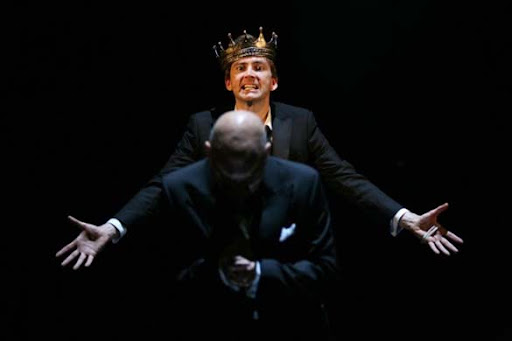


6) And a final Shakespeare (not spectacular) Farrar experience - Hamlet (above) is being played by Doctor Who ... the actor who played the Doctor before, Christopher Eccleston was taught drama by the boy (grown to man) who played Lysander in the production of The Dream I appeared in at school ... he also went on to teach the most recent 'Othello' at the RSC.

Small world isn't it ...


Monday, June 16, 2008

On Sly's small beer ...

Few of us know (or would want to know) Small Beer.

Sly, when he wakes up calls for small beer -

SLY. For God's sake, a pot of small ale.

Benjamin Franklin drank it for breakfast, George Washington had a recipe for it, Ann Hathaway would have made it at home for the whole family to drink - and schoolboys at Elizabethan school were given it to drink at lunchtime.

When I visited a village in Oltenea (a part of Southern Romania) back in the last century (think about it) I found out exactly why people drank small beer:

The water is dangerous.

I arrived in a small village - the only road in being along a dried river bed - in winter there are times when you can't drive in.

There was no electricity - maybe there still isn't.

I was treated royally - good food, plenty of alcohol.

I stayed overnight there - sleeping in the same room as the family - hot and mosquito bitten.

In the morning I woke with a 'bit of a head' (much like Sly must have woken) and asked for water -

"Water is for animals."

I was given a glass of wine ... water just was not available. There was a well, there was 'water' but unfit for human consumption - experience had taught the villagers that it was better to drink the fermented juice of the grape - unfermented when available (as must but that is only available for part of the year).

The youngest children drank milk - the older ones wine. When it was available, and up in the mountains it was throughout the summer, you drank the liquid that comes off the top of the sheep cheese - the whey.

So too in England for most of its history - drink water and risk serious disease and death.

When you make very low alcohol beer (small beer) you will boil the water - it 'kills the germs' and so is much safer to drink than water from a well. There is alcohol in it - but not much.

Sly calls for small beer - not because he is in need of alcohol, but because he is in need of liquid - do the servants offer the upper-class wine - in the same spirit? Is it the equivalent of the red wine I got in Oltenea?


Technorati Tags: , , ,

Tuesday, May 20, 2008

Shakespeare Intelligence

No, I'm not about to launch a review of Shakespeare the Thinker (the very title, for some reason, sends shivers of distaste through my body), but muse about something that has been brewing for a week or so now -


Shakespeare


and

Multiple Intelligence


Multiple Intelligences has proved illuminating: It is an attempt to define "Intelligence" in a way that recognises the multitudinous and complex nature of the connections the human brain can make, and has provided a basis for explaining why some forms of education are just plain 'dumb-making'. What I really like about it is the fact that it is inclusive - it attempts to explain why there are differences in the way people think and why those differences result in a rich variety of human strengths.

Unfortunately, most Shakespearean scholars (of the old school) don't seem to have been raised in a Multiple Intelligence environment and certainly have never got to appreciate the differences between themselves and other, equally, but differently, 'intelligenced' people. Older, and less enlightened, educational systems - the ones which the 'Shakespeare Wallahs' were successful in - tend to emphasis language and numerical skills - they tend to call them 'standards'. What Multiple Intelligence theory suggests is that this is a very limiting (and ultimately counter-productive) educational endeavour.

Shakespeare's plays, and the massive dislike engendered in school for them, are a case in point. In the theatre, they are popular; in the 'linguistic' oriented, text based school, they are not. If you don't like School Shakespeare, it is your fault - generations have loved the plays - so there is something wrong with your Intelligence.

(I should at this point point out, Dr. Howard Gardner himself sometimes prefers the word talents rather than intelligence - which he sees as too limiting: I'm just being provocative sticking to the 'I' word.)

My main question could be framed, How does Shakespeare manage to survive in the hostile world of ivory towered scholarship and text based examination?

Well, the answer is glaring obvious - Shakespeare wrote plays. They survive in the theatre, on the screen (large and small) in the imaginings of a Multiple Intelligenced world.


What the plays in performance do is stimulate a whole range of 'intelligence' - in fact, there isn't one which a good production of a Shakespeare play touches on.

Shakespeare has 'coded' into his text a lot of the clues as to what to do - but the spaces are there for the actors, directors, and everyone else, to fill in the gaps - be it music or dance, movement across the stage, or a glance between characters.

There is nothing particularly revolutionary in what I have just said - but, rarely in the 'Literature' classroom is anything other than a nod given to these overwhelmingly powerful factors of the play.

Of course - there have always been teachers who have attempted to bring the plays to life and have treated the texts as a starting point (I was fortunate enough to have been taught by a couple of such teachers) - but the educational systems soon force the written exam and the 'language' focus on to the majority of students.

The Shakespeare 'experts' ,consequently, are selected from the people who perform well in 'Linguistic-Literary' intelligence area. These people define what is good and valuable, make decisions as to text and argue interminably over minute language details which are inconsequential in the extreme.

But the plays actually appeal and stimulate and entertain a much wider range of - Intelligenced - people.

One of the striking things about the Shakes(blogo)sphere is how wide a range of people contribute to it (and why are so many connected to the Logical-Mathematical realm of computers?).

There is another insight to be gained from thinking Multiple Intelligently - individual play popularity.

I happen to think that the best of Shakespeare's plays is 'A Midsummer Nights Dream'. I think Hamlet is a damp squib with a serious need for throwing away and forgetting about until it gets a make-over. I happen to like 'The Two Gentlemen of Verona' - thinking it a better play than nearly every scholar who has commented has given it credit for.

Either I am a nut (and I don't come from Brazil) or something is going on here.

One thing worth noting is my Multiple Intelligence profile (as generated by the little quiz linked to at the start of this blog) - my strongest intelligence is Naturalist - no surprise the very 'green' 'The Dream' appeals. But also I notice the images to do with nature - the storms (I Like Lear) and talk of flowers; the cliffs of England, and worms.

The rest of my profile is fairly even - but the weakest area is interpersonal (I'm a Problem Play remember). Now, why don't I like Hamlet? Could it have something to do with all that uninteresting blah blah about relationships? Or maybe it is just that the interminable linguistic arguments and unsatisfactory performances generated from the incomplete final text?

It used to be put down to taste - with the suggestion that an 'educated' palate was more sophisticated and worthy than an uneducated one.

You can't do that in a Multi-Intelligent world - my tastes reflect my Intelligence - I AM right, 'A Midsummer Nights Dream' IS better than 'Hamlet' - you are just Naturalist-Intelligence deprived if you can't see it.


Technorati Tags: , , , ,

Wednesday, March 26, 2008

odyssey


The question has been raised - Have you read all of Shakespeare?

Well, yes, I have - several times in fact. But it is my profession in a way.

Not that I haven't had great pleasure from doing so - even the poems. And I have returned to many of the works repeatedly.

I suspect I am now coming to the end of my "intellectual wanderings or quest": Certain signs in my body prompt expectations of mortality.

Siren like, the words call again.

I have decided, on a whim, to make a final pass through the complete works and have gone into preparation.

Keeping faith with the theatre, I am going to do the journey in performances. Of necessity they will be mainly on DVD - Romanian theatre is limited in live performances, and, as it is Shakespeare's words I want, limited there too.

I hope to get in a trip to The Globe - and possibly the RSC too.

I am fortunate to have the local British Library - they have nearly all the BBC Shakespeare for loan (although, irritatingly, someone has stolen Titus). And I have a selection of my own of the more popular.

Just to add spice, I have plumbed for an unusual (although quite logical) route: I am going to do it in the same order as written.

Now, I know this is a contentious issue - so I am following Stanley Wells and the Penguin Shakespeare Chronology. No objections accepted.

I hope not only to revisit old friends, but maybe get a couple of insights on the way - juxtaposing what was in the craftsman's mind as he worked.

Needless to say (so I will) I'll be blogging along the way.

A travel diary forsooth.