Somewhere between the habitual Sunday morning hangover and nipping to the local Praktika to check the price of petrol driven chainsaws, I picked up and read the 16 pages of Daemonologie I'd managed to print off.
What a surprise!
It is one of those books you know about - one referred to as having some sort of connection to Macbeth - and a possible minor source for a few bits and pieces of information - and a good excuse for Shakey to brown-tongue to his new boss.
What you don't grasp until you read it (and until recently how accessible was it? Long live the Internet and all who search it) is how close a foundation the work gives to the witches scenes - and to some fundamental elements in the character of Macbeth himself.
The first thing I noticed was in the preface – Mr Scot, the Englishman (!), who denied witches existed.
So: There was serious doubt in England – serious enough for it to be printed and for the king of Scotland to ‘name and shame’ his future subject.
A few years later, Shakespeare, loyal English subject and chief ‘poet on the payroll’ churns out, possibly for a visit of the new King’s father in law (I did read that somewhere didn’t I?) a script with more than nodding acquaintance to the published views of his patron: “Look daddy-in-law, ain’t my boss learned and ‘ingine’ (ingenious?)!”
Then, in Chapter 1 of the first book, a couple of phrases leapt out.
‘… as first wilfully deceiues them-selves, by running vnto him . . .’
and
‘And as to the diuelles fortelling of things to come, it is true that he knowes not all thinges future, but yet that he knowes parte, the Tragicall event of this historie declares it, . . .’
A suspicion crept on to me at this point – Macbeth could be described as wilfully deceiving himself – and he certainly runs to the devil later in the play.
And did the fortune telling idea - partly true fortune telling at that – give Shakey the idea for the ‘tragicall historie’?
So far this is only tweaks and nudges.
Then, in Chap. 2, there is the mention of two branches of sinning against ‘the holie Ghost’.
One, ‘falling backe’, the second falling back knowingly.
I suspect this is a key to Macbeth’s fall: It starts unknowingly, but quickly develops a self-knowledge that takes it beyond excusable sin.
Next comes an exploration of Magic and Necromancy. Like most people, I suspect, I hadn’t taken a lot of notice of this second word – just assumed it to be a synonym.
Not a bit of it.
As our most knowledgeable King lets us know – ‘Necromancie’ is compounded of the Greek roots meaning ‘prophecy by the dead’.
And shortly after he adds, ‘…the Witches ar servantes onelie, and slaues to the Devil; but the Necromanciers are his maisters and commanders.’
If we look over Macbeth’s relationship with the witches, it starts with him getting information from them – but later in the play he commands – and commands them to produce dead spirits to tell the future. Macbeth has gone deeper into sin than the witches themselves by this action.
Later in the same chapter there is the ‘slippery slope’ (or primrose path?) theory – you start by wanting legitimate knowledge and then get trapped to wanting to know things you shouldn’t be asking about – all for ‘blindlie glorie of themselves’.
And they become, ‘… in verie deede, bond-slaues to their mortall enemie: and their knowledge . . . is nothing increased, except in knowing evill, . . .’
And a final very telling point – ‘ … as Adams was by the eating of the forbidden tree.’
So, Macbeth is Adam! Wham, bam, thank you mam! Lady M. is Eve – and a whole ‘mythic’ significance comes clearly into focus.
Macbeth is all mankind – that is why we watch with horror his fall: It is our fall.
But what is the fruit? Knowledge. Macbeth knows too much. Ignorance truly is bliss – heavenly bliss; knowledge is the work of the Devil.
And take no comfort all you misogynists – Lady Macbeth is no more responsible than Eve in the Jacobean World Picture (He for God, she for God in him.)
In chapter 4 we get a lovely, ‘dafte wiues’ (daft wives – oh, Lordy!), which is surely a nod in the direction of what most of the audience think of witches – and partly accounts for the humour (although I would still put most of that as due to theatrical tradition) that comes through – but we shouldn’t forget – King James has made the distinction between ignorant and knowledgeable sin – Macbeth is well beyond the daft wife stage.
Chapter 4 also has reference to battles and winning – what do the witches say in the first scene?
Chapter 5 gives us a repeat, ‘…to make himselfe so to be trusted in these little thinges, that he may haue the better commoditie thereafter, to deceiue then in the end with a tricke once for all; I meane the euerlasting perdition of their soul & body.’
And Chapter 6 gives us the witches familiars – ‘a dog, a Catte, an Ape’, and repeats the ‘dead bodie’ and ‘…to giue such answers, of the euent of battels, of maters concerning the estate of commonwelths, and such like other great questions . . .’
There is now no doubt in my mind that Shakespeare read this text, before writing Macbeth. There just seem to be too many connections for it to be accidental.
I am sure much of what is written by the King is common place knowledge – but the combination of ideas and expression seem to me to reverberate in the text we have of Macbeth.
And I also suspect the play went down really well with the man who had written Daemonologie.
Monday, November 27, 2006


Thursday, November 23, 2006
Enter the King
(Macbeth: Act 1, Scene 2)
What would Shakespeare's audience have experienced at the very start of this scene?
Firstly, there would have been music - the entrance of a King is marked by trumpets.
These trumpets, though, are more battle alarms than ceremonial entrance music. The Elizabethan audience would know the difference.
And instead of the usual stately King’s entrance (see Olivier’s Film, Henry V) we have a rushed entrance – but, it is still ordered, it is still according to rank and the costumes make fairly clear who is more important, who less; who is noble, who a servant: Who on active service, who civilian civil servant.
If this were the start of the play, it would be confusing – to make sense of it, you need to know what is causing the rush.
But it isn't the start of the play - it follows the first, witches scene - which sets up an anticipation in the audience.
The witches dress 'out of rank', they indicate an evil force at work in this state, they show the battle and mention, - Macbeth.
The sound effects in their scene is ‘thunder and lightening’ – rumbles and crashes – the trumpet music, in comparison, is much more ordered.
Much of the second scene only makes sense (and unity) in the light of the first scene.
When the 'sergeant' enters - what does he look like? How does he 'fit in' to the rushed, but essential order and harmony of the court? - He doesn't. He is a bloody man - a phrase often laughed at as weak, but at the time of writing, pregnant with meaning.
Modern televised war, pictures edited to reduce exposure to too much horror (for political and taste considerations) doesn't begin to represent the reality of hacking away at human beings with sharp edged weapons. Try slitting a man's throat and not getting blood on your shoes.
Bullets kill much more cleanly than swords.
I remember the Peter O'Toole Macbeth - derided because it attempted to bring back the blood - but truer to the original in this respect than any other modern production (including film).
The blood screams out - the State is in danger - we can't tell what this man is - he is a soldier of some sort, an officer? Rank has become confused. To the Elizabethan mind, few things were more dangerous than rank confusion (sorry, couldn't resist the pun).
‘What,’ thinks your average 'Lizy apprentice, ‘were those words of the witches? Fair is foul, etc.' - what is rotten in this State? What is upside down?’
‘And what of Macbeth - "they" mentioned him?’
Without the first scene, the subtext is missing - and a considerable amount of the depth of meaning we get out of these scenes comes not from the words, but from the "production" – especially costume.
Shakespeare's words are only part of the work he did - he acted, and directed as well.
Tuesday, November 21, 2006
Witches and fine weather
The opening of Macbeth is a classic case of, "Will we ever be able to understand what Shakespeare originally intended?"
Quite frankly, the answer is no – but we can take a trip along the path in the right direction.
Let's think about one of the aspects of 'witches'.
Most people follow the argument that Shakespeare's audience would have believed in witches and therefore the opening of the play meant something much deeper to them than it does to us.
Their reaction would have been an instinctive, emotional one - as well as intellectual. They would take it much more seriously than we do.
The first thing we need to get our heads around is the nature of Evil – as personified by the witches.
Germaine Greer, in her ‘SHAKESPEARE: A Very Short Introduction’ makes a couple of interesting points about evil when she is discussing Iago:
‘The point about evil is that it is absurd, unmotivated, inconsistent,’ (pg. 53/54)
and
‘Iago’s behaviour cannot be explained in terms of personality, but rather in terms of force,’ (pg. 56).
(Before anyone goes for my throat, she does make the point that Iago is a much more complicated manifestation of Evil than the witches in Macbeth)
And Greer ties Iago to the earlier stage representation of Vice.
Several issues rise in my mind at this point – but maybe the most important is how is the Globe’s audience expecting evil to be portrayed physically on the stage?
Are they actually linking into the tradition of a comedic evil – absurd to the spectator, easily seen through? The Vice and Devils of the mystery plays? Characters played by the comedians!
In which case, our ‘wasn’t funny in those days’ isn’t strictly accurate.
And who actually acted the witches? Was it boys? What are we to make of the beards? So men! If it was the comedy actors - ? Not funny? Remember, Shakespeare has a set of around 16 male actors to use – if the witches are not played by the comedians, who is? We have the Porter – but that’s a short scene only. Some seriously under used personnel in this production.
And what about costume?
The Elizabethan ‘dress code’ was fairly strict – rules about who could wear what, uniforms (nicer word, livery, used at the time) for everyone and no problem interpreting them. What is traditional ‘witch wear’? (Not the black pointy hat for certain – incidentally has anyone ever seen a production with witches dressed in black pointy hats?).
Women’s clothes – yes (mentioned in the text).
What social class? – Real witches could come as easily from the middle classes as from the poor (Pendle witch trials a little later in the century).
I suspect (or rather speculate) Macbeth’s witches are actually going to dress ‘outside the regulations’: Which would speak volumes to his audience – these are a force for disruption, a force against stability, for chaos.
Which brings me back to Germaine Greer’s point – Evil is a force.
Modern Western Society lives indoors. Natural forces are diluted in our day to day existence – wind, rain, sun and snow barely affect us. The occasional disaster might break through, but it is just that, a disaster, a special occasion – and it takes only days to get back to the electricity, the shelter and the Internet.
In several of Shakespeare’s plays nature is present as unchallengable power – Titania’s speech in Act 2 of A Midsummer Nights Dream being one notable example sometimes cut in modern productions as unintelligible.
In this opening scene, natural forces are summoned into the audience’s imagination – thunder, lightening and rain: Crop destruction, hunger, starvation, ruin to an Elizabethan.
The performance most likely had sound effects – rolling cannon balls for the thunder – possibly battleground noises and trumpets. War and weather – what bigger forces are there – and what have these witches got to do with it? Are they in control?
If we put all of this together we get a very complicated set of meanings.
The witches are not reducible to a single meaning.
Yes, they are “Evil” – but they are also stage representations of evil linking into a tradition – funny, absurd and disruptive. All the World’s a Stage – and a play is what you are watching.
These are not witches, these are actors pretending to be witches: But the world is only an illusion – so what is the truth?Macbeth is a play about the struggle for Macbeth’s soul.
According to Greer, we have to meet the witches, his tempters, before we meet him – and we have to know what they are, what their nature is – she says they have the power of fallen angels – but the fallen angels as presented in popular mediaeval drama, the imps of Satan. ( Pg. 68/69)
Friday, November 17, 2006
Reflections after a Lost Crown
End of a bottle - and distinctly dis-con-bobulated: Tooth had to be totally removed - cracked all the way up.
No pain (for first time in a visit to the dentist) but there is now a gap in the front of my mouth and I make the oddest noises when I try to speak. The "th" sound is distinctly silly, and 's' and 'r' (which was always a problem) are way out of line.
My smile is that of a punch-drunk boxer.
The cost is not small either - a quarter of my official monthly wage!
Enough to drive a man to drink - except it feels strange going down - a warm 'bloody' senstation in the gap as the alcohol passes over the raw flesh.
Eating is odd too - bringing the teeth together results in cutting the swollen gum.
Sans eyes, Sans teeth, Sans everything.
No pain (for first time in a visit to the dentist) but there is now a gap in the front of my mouth and I make the oddest noises when I try to speak. The "th" sound is distinctly silly, and 's' and 'r' (which was always a problem) are way out of line.
My smile is that of a punch-drunk boxer.
The cost is not small either - a quarter of my official monthly wage!
Enough to drive a man to drink - except it feels strange going down - a warm 'bloody' senstation in the gap as the alcohol passes over the raw flesh.
Eating is odd too - bringing the teeth together results in cutting the swollen gum.
Sans eyes, Sans teeth, Sans everything.
Saturday, November 04, 2006
You Are What You Wear
In the words of a Genesis song:
Old man says, "You are what you wear" - wear well.
Certainly, in Shakespeare's England, you were what you wore: And Shakespeare makes use of this (overtly and covertly) in his plays.
In the modern Western World, we have lost 'the meaning’ clothes had attached to them in Elizabethan and Stuart England. There is a superficial understanding in some contexts - we can recognise the Queen of England on state occasions for example - she will wear one of her crowns - preferably with a big diamond in it - and a set of gowns somewhat out of date - made of materials distinctly politically incorrect (like dead animal).
But is there any difference between what a Prince wears or a Premiership footballer (soccer) visiting the sick in hospital? In the UK, both are exceptionally wealthy men, both will be wearing custom-made, designer suits.
Take a photograph of the Queen of England on any but a state occasion, remove the head (whoops, bit of republican sympathy there) and tell me what identifies her as Queen.
We can determine, to a certain degree, wealth by clothing - although with some fashion trends that is difficult. The people in Shakespeare's audience could recognise rank, and status, as well as wealth. Occupation was also much easier to 'see'.
This isn't simply blue-collar/white-collar social class, it is much deeper.
Let's look at a couple of examples of how Shakespeare overtly uses his audience's ability to distinguish and interpret role and give meaning through clothing.
The opening scene of Julius Caesar provides a prime example.
In Shakespeare's Globe Theatre, the crowd that comes onto the stage would have been wearing Elizabethan 'Sunday Best' - perhaps with a band of material over that to indicate they were Romans.
What would the audience have instantly seen? - Ordinary working men dressed out of work-clothes and therefore celebrating either a Religious day, or a special occasion. By their behaviour we can assume they would not have been dressed in Puritan Black, nor in wealthy materials like silks - which were reserved for a better rank of people. What the audience wouldn't see would be the occupations of the men - which on a working day would have been apparent - nor the relative ranks - who was a master craftsman, who a journeyman, who still an apprentice?
This gives a sense of disorder and Saturnalia from the instant the men are sighted. It also helps explain what happens when to two 'magistrates' come on - they see the disorder and react against it. Under their token Toga, the Elizabethan would have seen a very different rank of person. Richer materials would be worn, possibly some indication of office - a mayoral chain for example - gentleman certainly, possibly knights. The way the workmen respond, taking this in mind, indicates a very dangerous state of affairs - and the Elizabethan would have seen it as a danger to the status quo - foreshadowing the civil strife to come.
If a modern production chooses to dress these characters in 'Roman' costume, we loose all sense of this distinction and danger - we cannot interpret Roman costume in the same way. If we dress 'modern' we still have to find some way of packing into the clothes meanings we don't normally identify.
Another opening, with a similar 'packing-in' of meaning, is that to Romeo and Juliet.
After the Prologue, two servants enter. How does Shakespeare show they are servants? - They wear livery.
The very concept of livery is strange to us - but was essential to Shakespeare. On the entry of the new King, James, to London, Mr William Shakespeare and some of his fellow actors were issued with a quantity of red-dyed, woollen cloth - to make the livery of the King of England. Shakespeare marched in procession, carrying the awning over the head of the King, as he entered under specially constructed arches.
The new livery was a step up for Shakespeare and his fellow actors - they had become 'The King's Men'! They had worn livery before - it protected them when they moved about the country - it marked them as the servants of 'The Admiral' and then 'The Chancellor' - each liveery different - each not just saying, I am a servant, but my Lord is so and so, my Lord is 'this important', my Lord is the King of England - so leave me alone.
I do not know how often Shakespeare wore his livery - I suspect quite a lot - especially at court - but many lowlier servants wore theirs all the time, and may higher officials also.
When the Capulet and the Montague servants appear on stage - all this meaning is carried with their clothing - and when the fight starts, in rush more people dressed out of livery - working people, ordinary people, then in comes the 'Princes' livery - and woe betide anyone ignoring that.
I have to say at this point how good the Baz Lurhmann version is in this respect - we do get the sense of difference (through design) between the fighting parties - and the police uniforms work well to identify, ‘The State’. Contrast this with the 'traditional, Renaissance set, Zefferellie version - and you see how so much is lost in the 'authentic' costuming - we do not understand the connotations of livery instinctively (and that is part of the point - intellectually I can add it, but I don't feel it at first sight).
A final point here might be to contrast the two ‘designs’ of Friar Lawrence – Milo O’Shea as the traditional brown robed priest vs. Peter Prothero’s tattooed bruiser! I know which I think is closer to the spirit of an increasingly Protestant England with growing suspicions of Catholic infiltration and invasion.
The History plays are perhaps the most difficult for us to come to contemporary terms with – but some thought given to the workings of the costumes and the props on Shakespeare’s stage does help.
Henry IV, part 2 contains the remarkable scene of young Hal ‘trying on’ the crown – to us, “So what?”
But the crown is much more than an indication of political Kingship – it is a divine symbol – to rightfully assume the crown is to be elected of God. It would ‘shock’ the audience – as it shocks Hal’s father. We can never understand the meaning, or get the same impact from the simple action of taking the crown.
When he does acquire the crown and become Henry V, he changes role, becoming no longer a Prince, but KING – which is also very difficult for modern audiences to understand. Hal never had any moral authority, Henry V does.
Just as an actor changes character with costume changes (something Bottom and his colleagues didn’t understand) so too, the man changes with the costume. Shakespeare and his actor friends went from being the servants of a nobleman to being the ‘National Theatre’, and the red cloth showed that – embodied the status.
In what is most likely Shakespeare’s first History play, Henry VI, Part 2, we have the character of Gloucester, Uncle to the Young King and Lord Protector of England. He is known as Lord Protector by the black staff he carries – it is the symbol of his office – he makes his entrance, with the King in the first scene carrying it. When he loses the office, the staff goes too – he is denuded, becoming a naked, vulnerable human being again: Prospero breaks his staff and his power goes at the end of the Tempest and the same thing happens – denudation and change.
Shakespeare must have given up his livery when he left the Kings men to return to Stratford-upon-Avon, his wife and children.
The fact that so much meaning has been lost to us, leaves great empty spaces in the text – and, more importantly, in the performance of a Shakespeare work.
To attempt to recreate the original ‘performances’ is a non-starter – we do not view the world the way they did then – we cannot understand their performances.
The empty spaces have to be filled though – and that is why Shakespeare, when performed well, is so contemporary – it has to be filled with design and direction which fits today’s worlds.
Old man says, "You are what you wear" - wear well.
Certainly, in Shakespeare's England, you were what you wore: And Shakespeare makes use of this (overtly and covertly) in his plays.
In the modern Western World, we have lost 'the meaning’ clothes had attached to them in Elizabethan and Stuart England. There is a superficial understanding in some contexts - we can recognise the Queen of England on state occasions for example - she will wear one of her crowns - preferably with a big diamond in it - and a set of gowns somewhat out of date - made of materials distinctly politically incorrect (like dead animal).
But is there any difference between what a Prince wears or a Premiership footballer (soccer) visiting the sick in hospital? In the UK, both are exceptionally wealthy men, both will be wearing custom-made, designer suits.
Take a photograph of the Queen of England on any but a state occasion, remove the head (whoops, bit of republican sympathy there) and tell me what identifies her as Queen.
We can determine, to a certain degree, wealth by clothing - although with some fashion trends that is difficult. The people in Shakespeare's audience could recognise rank, and status, as well as wealth. Occupation was also much easier to 'see'.
This isn't simply blue-collar/white-collar social class, it is much deeper.
Let's look at a couple of examples of how Shakespeare overtly uses his audience's ability to distinguish and interpret role and give meaning through clothing.
The opening scene of Julius Caesar provides a prime example.
In Shakespeare's Globe Theatre, the crowd that comes onto the stage would have been wearing Elizabethan 'Sunday Best' - perhaps with a band of material over that to indicate they were Romans.
What would the audience have instantly seen? - Ordinary working men dressed out of work-clothes and therefore celebrating either a Religious day, or a special occasion. By their behaviour we can assume they would not have been dressed in Puritan Black, nor in wealthy materials like silks - which were reserved for a better rank of people. What the audience wouldn't see would be the occupations of the men - which on a working day would have been apparent - nor the relative ranks - who was a master craftsman, who a journeyman, who still an apprentice?
This gives a sense of disorder and Saturnalia from the instant the men are sighted. It also helps explain what happens when to two 'magistrates' come on - they see the disorder and react against it. Under their token Toga, the Elizabethan would have seen a very different rank of person. Richer materials would be worn, possibly some indication of office - a mayoral chain for example - gentleman certainly, possibly knights. The way the workmen respond, taking this in mind, indicates a very dangerous state of affairs - and the Elizabethan would have seen it as a danger to the status quo - foreshadowing the civil strife to come.
If a modern production chooses to dress these characters in 'Roman' costume, we loose all sense of this distinction and danger - we cannot interpret Roman costume in the same way. If we dress 'modern' we still have to find some way of packing into the clothes meanings we don't normally identify.
Another opening, with a similar 'packing-in' of meaning, is that to Romeo and Juliet.
After the Prologue, two servants enter. How does Shakespeare show they are servants? - They wear livery.
The very concept of livery is strange to us - but was essential to Shakespeare. On the entry of the new King, James, to London, Mr William Shakespeare and some of his fellow actors were issued with a quantity of red-dyed, woollen cloth - to make the livery of the King of England. Shakespeare marched in procession, carrying the awning over the head of the King, as he entered under specially constructed arches.
The new livery was a step up for Shakespeare and his fellow actors - they had become 'The King's Men'! They had worn livery before - it protected them when they moved about the country - it marked them as the servants of 'The Admiral' and then 'The Chancellor' - each liveery different - each not just saying, I am a servant, but my Lord is so and so, my Lord is 'this important', my Lord is the King of England - so leave me alone.
I do not know how often Shakespeare wore his livery - I suspect quite a lot - especially at court - but many lowlier servants wore theirs all the time, and may higher officials also.
When the Capulet and the Montague servants appear on stage - all this meaning is carried with their clothing - and when the fight starts, in rush more people dressed out of livery - working people, ordinary people, then in comes the 'Princes' livery - and woe betide anyone ignoring that.
I have to say at this point how good the Baz Lurhmann version is in this respect - we do get the sense of difference (through design) between the fighting parties - and the police uniforms work well to identify, ‘The State’. Contrast this with the 'traditional, Renaissance set, Zefferellie version - and you see how so much is lost in the 'authentic' costuming - we do not understand the connotations of livery instinctively (and that is part of the point - intellectually I can add it, but I don't feel it at first sight).
A final point here might be to contrast the two ‘designs’ of Friar Lawrence – Milo O’Shea as the traditional brown robed priest vs. Peter Prothero’s tattooed bruiser! I know which I think is closer to the spirit of an increasingly Protestant England with growing suspicions of Catholic infiltration and invasion.
The History plays are perhaps the most difficult for us to come to contemporary terms with – but some thought given to the workings of the costumes and the props on Shakespeare’s stage does help.
Henry IV, part 2 contains the remarkable scene of young Hal ‘trying on’ the crown – to us, “So what?”
But the crown is much more than an indication of political Kingship – it is a divine symbol – to rightfully assume the crown is to be elected of God. It would ‘shock’ the audience – as it shocks Hal’s father. We can never understand the meaning, or get the same impact from the simple action of taking the crown.
When he does acquire the crown and become Henry V, he changes role, becoming no longer a Prince, but KING – which is also very difficult for modern audiences to understand. Hal never had any moral authority, Henry V does.
Just as an actor changes character with costume changes (something Bottom and his colleagues didn’t understand) so too, the man changes with the costume. Shakespeare and his actor friends went from being the servants of a nobleman to being the ‘National Theatre’, and the red cloth showed that – embodied the status.
In what is most likely Shakespeare’s first History play, Henry VI, Part 2, we have the character of Gloucester, Uncle to the Young King and Lord Protector of England. He is known as Lord Protector by the black staff he carries – it is the symbol of his office – he makes his entrance, with the King in the first scene carrying it. When he loses the office, the staff goes too – he is denuded, becoming a naked, vulnerable human being again: Prospero breaks his staff and his power goes at the end of the Tempest and the same thing happens – denudation and change.
Shakespeare must have given up his livery when he left the Kings men to return to Stratford-upon-Avon, his wife and children.
The fact that so much meaning has been lost to us, leaves great empty spaces in the text – and, more importantly, in the performance of a Shakespeare work.
To attempt to recreate the original ‘performances’ is a non-starter – we do not view the world the way they did then – we cannot understand their performances.
The empty spaces have to be filled though – and that is why Shakespeare, when performed well, is so contemporary – it has to be filled with design and direction which fits today’s worlds.
Tuesday, October 24, 2006
Empty Spaces
(Or: Shakespeare, Everyone’s Contemporary)
I am not interested in repeating the old ‘A’ Level arguments; the grade 12/13 and equivalent essay: Is Shakespeare relevant?
The answer is, "Yes."
If you don't like it: Go away and grow up!
My question is this:
Why are Shakespeare's plays so contemporary?
How can we find ‘Post-Holocaust Landscapes’ in Lear? How does Richard the Third become subversive in the Muslim World (and in communist Romania before the fall of the Soviet Block)?
He’s Shaikh Al-Zubair, the Bard of Basra (aka Shakespeare).
What is in Romeo and Juliet to make modern film audiences go and watch - and black and white adaptations of Macbeth into Japanese film classics?
Young starlets wanting to make a name for themselves, and tired old thespians, willingly tackle the language of 400 hundred years ago, and Egyptian academics fight over the correct way to translate it - into modern or classical Arabic.
Why do the Turks - and Kurds - value the work of this very dead, very white (when he washed), very Christian, English Man?
I think a very large part of it is not what he wrote, but what he didn’t write.
It’s the empty spaces left to be filled by the actors, designers, directors (and the audience’s) imaginations.
People forget that Shakespeare was a man of ‘The Theatre’ (and afterwards, ‘The Globe’, and ‘The Blackfriars’). Many don’t like to be reminded that the building of ‘The Theatre’ was not only cutting edge art, but also great commerce.
No one knew how to write plays for this building – but they knew they wanted to write plays that made a lot of money.
As a jobbing playwright Shakespeare was the craftsman who produced words that were the starting point of these money-making productions. He had no concept of their being works of literature to be preserved – like Bach and Mozart in music, he was expecting his works to have a very limited period of use – disappearing, sometimes before his own life was ended.
The script was incomplete – in the very real sense of Shakespeare bringing into the rehearsal rough manuscripts, which he would work on and adapt during the rehearsals as he directed.
A contemporary reference to Elizabethan Theatre mentions the fact that the playwright directing the plays was one of the more distinctive features – and one of the main reasons the standards were so good in England when compared to continental Europe.
The words were also written in the knowledge that they had to be adaptable: Different spaces and different audiences required different versions – think what happens in Hamlet to ‘The Murder of Gonzago’ – how the play is added to, and changed, at very short notice.
The complete Hamlet, in the printed text academics are now so addicted to, was never performed in Shakespeare’s theatres: It is far too long – Shakespeare would have sliced it to pieces, ruthlessly cutting much of what is now thought to be essential.
There is no way, for starters, the groundlings would have ‘stood’ for the long hours needed to go through the whole text (a six hour Hamlet!). It would have got dark anyway and no one would have seen the stage. And why waste that much energy on performing when the punters would pay for less?
Unfortunately, when it was printed, it looks like someone used the unedited rough version – not the final stage version. I don’t think it is a coincidence that the drastic cuts needed to produce a filmable script, make Hamlet much more bearable and popular (with audiences) as a film than as a stage production: Hamlet in the cinema is entertainment, at ‘The Royal Exchange Theatre’ in Manchester, a religious observance.
A lot of the stage action couldn’t be fixed in the manuscript – it would change according to which actors (and how many) were available. How many people were available to represent an army? How much space was there? Was there a pair of good swordsmen? What was popular with the audience at the time – ‘shall we slip in a favourite visual joke this time?’
The playwright needed to make minimal commitment and leave it to the rehearsals to fill in the details. Shakespeare as the writer/director, was happy to do this – after all, no one else was going to mess up his text. It is a very different world from Sam Beckett who tried to control ever detail in the script – and to achieve a minimalism on stage, not only in the script. Although he did sometimes resort to directing, he usually relied on others to ‘see through’ his text and produce the play.
Bertolt Brecht, on the other hand, was very similar to Shakespeare in the way he wrote and directed. Interestingly, he did what Shakespeare never managed, he changed the way the world produced plays: So much of what we take for granted in theatre productions today, comes from Brecht that it is mind-blowing.
Shakespeare’s outdoor ‘Theatre’ blossomed. It fruited when it turned into ‘The Globe’, but then atrophied and went to the indoor Blackfriars. And that is when Shakespeare retired to the life of an English Country Gentleman: He’d lost the stand in the cold, groundlings, and their taste for the ‘Big Issue’, and got the seat loving rich, who didn’t want the tastes of the ‘poor populace’ thrust down their throats.
Mind you, they paid well.
Where Shakespeare is more like Beckett than Brecht is in the limitation of the resources available and the great use made of that limitation.
Shakespeare had a limited number of actors, all male - in various stages of life. He could either, like Beckett, limit the number of characters, or like himself – as writer, director, actor, promoter, and profit taker - have the same actor play many parts.
The consequences of taking the latter route have contributed to his remaining contemporary.
The same man playing different parts requires the audience to be flexible – they have to accept the deceit – the man stops being a real human and becomes a cipher –a representation of something in humans rather than a real person.
How do we know who or what he is (or represents)?
Shakespeare tells us. He frequently names the person and gives us, in Picaso-like brevity, the essence of the character.
With a Picaso, you, the spectator, have to work – to fill in the blanks. A two dimensional line on the page is ‘filled’ into a three dimensional face. So with Shakespeare – you fill in from your own (contemporary) experience the characters – and the wholeness of the characters cannot be formed without your contemporanianity.
The actor playing that character is wearing costume (or not) – and in Shakespeare more than any other English writer I can think of, the costume is pregnant with meaning.
As every school child knows (!), in Elizabethan England, the actors wore Elizabethan costume – and that is all the ‘justification’ needed to ‘dress’ modern productions in the most outlandish ways imaginable – sometimes, it seems, the wilder the better.
What is lost when we do that is the very remarkable and instant effect the costume had in a production in Shakespeare’s time.
A character’s rank and standing, psychological state and religious views, as well as gender, were defined the moment an actor stepped onto the stage by the costume he was wearing. Clothes then carried meaning in a way that only a few uniforms (official, like police, or unofficial, like businessman) do nowadays.
One reason it was so easy for an actor to change roles is this defining function of clothing – just as a crown made a king, and only a true king should wear the crown – think of the disputes over the crown in Richard the Second – so every costume said something about who the character was – and a change from servant to lord required no explanation and led to no confusion; the audience ‘saw’ the role change.
You wore what you were.
The paradox is that the very effectiveness of the costumes meant that Shakespeare didn’t waste time over clarifying many of his characters – the Costume defined them for him – Now, we have to add what the visual reference contained in whatever way we can.
But this ‘emptiness’ does give us the ability, in the theatre, and in the rare cases of designers who have grasped the import of their role, to bring in what is definitive in our own societies and sub-cultures.
That does not mean ‘modern dress’! Living where I do in Eastern Europe, 1956 is a more defining moment than 2006, and setting a Shakespeare History play, say Henry the Sixth, Part Two, in Revolutionary Hungary would most likely resonate with ordinary Hungarians much more than setting it today.
However, there is a danger of superficiality in this: Too often designers mix and match leading to questionings and confusions where the Elizabethan’s had clarity.
It is also a danger in the academic world where the expectation is that the written words carry far more meaning than was originally intended. Unintentionally we give characters characteristics and motivations to fill in the gaps, not always aware of the modernity of our in-fills.
The classic case for me is Romeo and Juliet, where the idiocy and sinfulness of the joint suicide has been turned ‘arse over tit’ into beauty and divine love.
Interestingly, this re-evaluation came to me teaching Muslim students in England and North Cyprus who added their own ‘contemporariness’ and relevance to Shakespeare’s words and came up with a very different reading from the post-Romantic standard unforgivably droned out in a thousand classrooms and lecture theatres across the United Kingdom, and beyond.
(To be continued)
I am not interested in repeating the old ‘A’ Level arguments; the grade 12/13 and equivalent essay: Is Shakespeare relevant?
The answer is, "Yes."
If you don't like it: Go away and grow up!
My question is this:
Why are Shakespeare's plays so contemporary?
How can we find ‘Post-Holocaust Landscapes’ in Lear? How does Richard the Third become subversive in the Muslim World (and in communist Romania before the fall of the Soviet Block)?
He’s Shaikh Al-Zubair, the Bard of Basra (aka Shakespeare).
What is in Romeo and Juliet to make modern film audiences go and watch - and black and white adaptations of Macbeth into Japanese film classics?
Young starlets wanting to make a name for themselves, and tired old thespians, willingly tackle the language of 400 hundred years ago, and Egyptian academics fight over the correct way to translate it - into modern or classical Arabic.
Why do the Turks - and Kurds - value the work of this very dead, very white (when he washed), very Christian, English Man?
I think a very large part of it is not what he wrote, but what he didn’t write.
It’s the empty spaces left to be filled by the actors, designers, directors (and the audience’s) imaginations.
People forget that Shakespeare was a man of ‘The Theatre’ (and afterwards, ‘The Globe’, and ‘The Blackfriars’). Many don’t like to be reminded that the building of ‘The Theatre’ was not only cutting edge art, but also great commerce.
No one knew how to write plays for this building – but they knew they wanted to write plays that made a lot of money.
As a jobbing playwright Shakespeare was the craftsman who produced words that were the starting point of these money-making productions. He had no concept of their being works of literature to be preserved – like Bach and Mozart in music, he was expecting his works to have a very limited period of use – disappearing, sometimes before his own life was ended.
The script was incomplete – in the very real sense of Shakespeare bringing into the rehearsal rough manuscripts, which he would work on and adapt during the rehearsals as he directed.
A contemporary reference to Elizabethan Theatre mentions the fact that the playwright directing the plays was one of the more distinctive features – and one of the main reasons the standards were so good in England when compared to continental Europe.
The words were also written in the knowledge that they had to be adaptable: Different spaces and different audiences required different versions – think what happens in Hamlet to ‘The Murder of Gonzago’ – how the play is added to, and changed, at very short notice.
The complete Hamlet, in the printed text academics are now so addicted to, was never performed in Shakespeare’s theatres: It is far too long – Shakespeare would have sliced it to pieces, ruthlessly cutting much of what is now thought to be essential.
There is no way, for starters, the groundlings would have ‘stood’ for the long hours needed to go through the whole text (a six hour Hamlet!). It would have got dark anyway and no one would have seen the stage. And why waste that much energy on performing when the punters would pay for less?
Unfortunately, when it was printed, it looks like someone used the unedited rough version – not the final stage version. I don’t think it is a coincidence that the drastic cuts needed to produce a filmable script, make Hamlet much more bearable and popular (with audiences) as a film than as a stage production: Hamlet in the cinema is entertainment, at ‘The Royal Exchange Theatre’ in Manchester, a religious observance.
A lot of the stage action couldn’t be fixed in the manuscript – it would change according to which actors (and how many) were available. How many people were available to represent an army? How much space was there? Was there a pair of good swordsmen? What was popular with the audience at the time – ‘shall we slip in a favourite visual joke this time?’
The playwright needed to make minimal commitment and leave it to the rehearsals to fill in the details. Shakespeare as the writer/director, was happy to do this – after all, no one else was going to mess up his text. It is a very different world from Sam Beckett who tried to control ever detail in the script – and to achieve a minimalism on stage, not only in the script. Although he did sometimes resort to directing, he usually relied on others to ‘see through’ his text and produce the play.
Bertolt Brecht, on the other hand, was very similar to Shakespeare in the way he wrote and directed. Interestingly, he did what Shakespeare never managed, he changed the way the world produced plays: So much of what we take for granted in theatre productions today, comes from Brecht that it is mind-blowing.
Shakespeare’s outdoor ‘Theatre’ blossomed. It fruited when it turned into ‘The Globe’, but then atrophied and went to the indoor Blackfriars. And that is when Shakespeare retired to the life of an English Country Gentleman: He’d lost the stand in the cold, groundlings, and their taste for the ‘Big Issue’, and got the seat loving rich, who didn’t want the tastes of the ‘poor populace’ thrust down their throats.
Mind you, they paid well.
Where Shakespeare is more like Beckett than Brecht is in the limitation of the resources available and the great use made of that limitation.
Shakespeare had a limited number of actors, all male - in various stages of life. He could either, like Beckett, limit the number of characters, or like himself – as writer, director, actor, promoter, and profit taker - have the same actor play many parts.
The consequences of taking the latter route have contributed to his remaining contemporary.
The same man playing different parts requires the audience to be flexible – they have to accept the deceit – the man stops being a real human and becomes a cipher –a representation of something in humans rather than a real person.
How do we know who or what he is (or represents)?
Shakespeare tells us. He frequently names the person and gives us, in Picaso-like brevity, the essence of the character.
With a Picaso, you, the spectator, have to work – to fill in the blanks. A two dimensional line on the page is ‘filled’ into a three dimensional face. So with Shakespeare – you fill in from your own (contemporary) experience the characters – and the wholeness of the characters cannot be formed without your contemporanianity.
The actor playing that character is wearing costume (or not) – and in Shakespeare more than any other English writer I can think of, the costume is pregnant with meaning.
As every school child knows (!), in Elizabethan England, the actors wore Elizabethan costume – and that is all the ‘justification’ needed to ‘dress’ modern productions in the most outlandish ways imaginable – sometimes, it seems, the wilder the better.
What is lost when we do that is the very remarkable and instant effect the costume had in a production in Shakespeare’s time.
A character’s rank and standing, psychological state and religious views, as well as gender, were defined the moment an actor stepped onto the stage by the costume he was wearing. Clothes then carried meaning in a way that only a few uniforms (official, like police, or unofficial, like businessman) do nowadays.
One reason it was so easy for an actor to change roles is this defining function of clothing – just as a crown made a king, and only a true king should wear the crown – think of the disputes over the crown in Richard the Second – so every costume said something about who the character was – and a change from servant to lord required no explanation and led to no confusion; the audience ‘saw’ the role change.
You wore what you were.
The paradox is that the very effectiveness of the costumes meant that Shakespeare didn’t waste time over clarifying many of his characters – the Costume defined them for him – Now, we have to add what the visual reference contained in whatever way we can.
But this ‘emptiness’ does give us the ability, in the theatre, and in the rare cases of designers who have grasped the import of their role, to bring in what is definitive in our own societies and sub-cultures.
That does not mean ‘modern dress’! Living where I do in Eastern Europe, 1956 is a more defining moment than 2006, and setting a Shakespeare History play, say Henry the Sixth, Part Two, in Revolutionary Hungary would most likely resonate with ordinary Hungarians much more than setting it today.
However, there is a danger of superficiality in this: Too often designers mix and match leading to questionings and confusions where the Elizabethan’s had clarity.
It is also a danger in the academic world where the expectation is that the written words carry far more meaning than was originally intended. Unintentionally we give characters characteristics and motivations to fill in the gaps, not always aware of the modernity of our in-fills.
The classic case for me is Romeo and Juliet, where the idiocy and sinfulness of the joint suicide has been turned ‘arse over tit’ into beauty and divine love.
Interestingly, this re-evaluation came to me teaching Muslim students in England and North Cyprus who added their own ‘contemporariness’ and relevance to Shakespeare’s words and came up with a very different reading from the post-Romantic standard unforgivably droned out in a thousand classrooms and lecture theatres across the United Kingdom, and beyond.
(To be continued)
Friday, October 20, 2006
Dream
I am busy writing a version of the Midsummer Nights Dream plot for publicatin on Wiki.
For reasons of vanity it is over on the Ecce Homo blog.
Any comments welcome.
For reasons of vanity it is over on the Ecce Homo blog.
Any comments welcome.
Thursday, October 19, 2006
bardseyeview: Henry IV - Casting Today's Falstaff
bardseyeview: Henry IV - Casting Today's Falstaff
Further thoughts on Falstaff.
Scroll down a bit (Little Grey Cells) and the connection to Socrates and their deaths is explored a little.
Appologies to Bardseye for coercing a connection his end - one of these days I'll start to understand what all these buttons and things do.
Further thoughts on Falstaff.
Scroll down a bit (Little Grey Cells) and the connection to Socrates and their deaths is explored a little.
Appologies to Bardseye for coercing a connection his end - one of these days I'll start to understand what all these buttons and things do.
Friday, September 29, 2006
Brando, Collins and El Prat

Just about the most irritating film version of Julius Caesar (out of a pretty poor bunch) is the one (ill)staring Marlon Brando.
The deadly thing is his accent - his "British" accent. Sensibly, most of the Americans in the film keep their accents over the other side of the Atlantic leaving the genuine Brits to this side.
Not Brando - the method gets hold, the real Antony is to be found in a British Accent, so a British Accent he has to have!
It is a faultless British Accent too - not a sound out of place - as rigidly coiffured as Brando's greasy black hair.
And as false and dead.
It is too real - too correct - faultless and, so, faulty.
Real living Brits don't sound like that - the idiosyncrasies and foibles of the individual are missing. It tries so hard to be British it ends up an unintentional caricature. Not 'Allo Allo' caricature - that's funny because it is intentional - and is as much the English laughing at their own inability with languages as anything else. More a bad Elvis impersonator caricature – the costume white and sparkling, the gyrations all there, the exact copy of the voice – all lifeless.
I get the same feeling about 'Woman in White'. I'm up to the end of the lawyer's narrative.
It's very worthy, very realistic - checked for factual accuracy by a genuine lawyer - and as dead as the proverbial extinct bird.
Take Sir Percival Glyde, for example. We’re given lots of little details intended to bring a roundness and verisimilitude to the character – his balding head, his worn face, his tender, affectionate behaviour with Laura, his directness over the business of the letter – every sort of detail you would wish!
What’s the mantra of junior school teachers about character?
“You know a character by what he says, what others say about him, how he dresses, what he does and what he doesn’t do.”
It’s all there for Glyde. Nothing, so far, though really brings his character life. It’s just too correct.
And what is his character? The bad-man; the impostor: The beautiful, attractive gentleman everyone is in love with – he’s an Elf from ‘Lords and Ladies’!
In that book you don’t have to ask the question why people fall for the ‘Fair Ones’ – it is magic, they just do – and it takes a coven of exceptional “old prunes” to see through to the reality behind the mask. All the other characters fall for the attraction.
In Woman in White, the problem seems to be that in attempting to be realistic you have to give realistic reasons for people’s belief and faith in the ‘Attractive One’. No magic allowed (unlike in ‘Gothic’).
But Collins has spent a lot of his energies making sure none of his characters is actually attracted to Glyde. They all see through him – even the couldn’t-care-less uncle is aware of a problem.
And he doesn’t give the reader anything to say I understand why people fall for this man’s charms.
He’s wearing a black cowboy hat for goodness sake!
Tuesday, September 26, 2006
Little Grey Cells
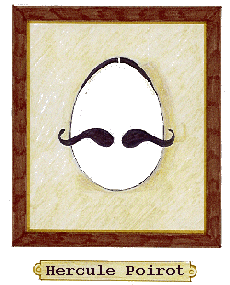
I was watching an Agatha Christy DVD - one of the Poirot stories Granada filmed with the excellent David Suchet playing the pear-shaped, little detective - when one of the characters read out the description of the death of Socrates from Plato.
Suddenly the similarity of Mistress Quickly's description of the Death of Falstaff struck.
I'd never registered the similarities before (although I possibly had read about it).
Why now?
I suspect it had something to do with the performance - the fact that I had heard an actor deliver the description, and that Dame Judy Dench's delivery of the Shakespeare had lodged very firmly in 'd' little grey cells'.
Was it tone of voice, or manner of delivery?
I don't know - but if it struck me, sat in front of a t.v. in provincial Hungary, how much more quickly it would have struck the audience in Shakespeare's London - not just used to listening more carefully, but primed in the classics.
What was Shakespeare up to with the connection?
Two diametrically opposed possibilities pop into my mind.
Either:
Shakespeare is suggesting that Falstaff, like Socrates, has to be 'killed-off' for perverting the youth of the nation - that it is a judicial action on behalf of the authorities (not to mention the playwright) to rid itself of a rotten apple before the whole basket is useless;
Or:
Shakespeare is making it very clear that Falstaff has died a death undeserved and the authorities really should be elevating him to the pantheon of greats for the service he has done in educating the young of the nation in the realities of the world - just like Socrates.
And then that really irritating habit of thought Shakespeare had of 'negative capability' kicks in - you just know he meant both at the same time.
Both Socrates and Falstaff will be remembered long into the future - and the youth of nations not yet formed will admire the disgraceful lack of respect for constituted authority they both have in abundance.
And the rediculousness of comparing the 'great philosopher' with the 'tub of lard' will stick in the minds of the older and wiser.
Wednesday, September 13, 2006
Framed Again
 " Theseus and Hippolyta are, as it were, a splendid frame for the picture; they take no part in the action, but surround it with a stately pomp."
That Shakespeare knew Chaucer's Canterbury Tales, especially the Knight's Tale, is certain; after all, The Two Noble Kinsmen is a reworking of that tale.
But there are echoes of the opening of the same tale in the opening of A Midsummer Nights Dream - Theseus wedding Hippolyta, "with muchel glory and greet solempnitee." (The 'stately pomp' of our Victorian commentator's 'splendid frame'.)
There is also talk of the battle they fought.
The names of certain characters, Theseus, Hippolyta, Philostrate come from the Knight's Tale and all appear and are named in the first few moments of the play.
If the Duke and his Amazon 'frame' the action of the play, they do so in a way which connects with a wider world - it is a frame which links to other frames and the pictures they contain. We have a gallery of images Shakespeare is willing to make reference to.
Shakespeare is invoking the Knight's Tale.
To do this, he must have been certain that at least some of his audience knew the work of Chaucer - and knew it well enough to recognise it quickly from the brief sketch he draws in the opening 24 lines.
But the connections seem to stop there: A Midsummer Nights Dream is a comedy with a happy ending; The Knight's Tale and The Two Noble Kinsmen are much darker, some would say tragic, stories with death and blighted love much to the forefront.
So, what is Shakespeare up to?
One thing I think he is doing is reminding his audience, from the outset, of this darker alternative to his happy ending - a sort of momento mori.
In The Knight's Tale, two friends end up loving the same woman and fight to the death for love of her: In A Midsummer Nights Dream, two friends almost end up doing the same thing. Without the alternative of The Knight's Tale ending, the Dream's ending is blunted.
If the border between Comedy and Tragedy is a knife edge, then this knife has been hoisted in the air and there is a dirty great chasm below it ready for someone to fall into.
When Theseus returns and finds the sleeping lovers, we are again reminded of Chaucer's Tale. Chaucer has Theseus and Ipolyta out hunting (and delighting in his hounds) when he comes across the two 'Noble Kinsmen' preparing to fight to the death; Shakespeare has the two lovers, who have spent the last part of the night before trying to fight each other, asleep. They will wake to a resolution worked by the 'magic' of the flower, but it is a resolution - the two kinsmen go on to fight until one is killed.
To know the Chaucer is to give an added depth to the Shakespeare who is framing his own Dream in the Knight's Tale.
But he doesn't stop there - he sticks another 'picture reference' into this frame - Ovid's Love Story of Pyramus and Thisbe. Remember, it is a gallery we are working in!
And here the twist is to bring 'Death' onto the stage and laugh at it. We cannot do this until we have finished with the 'action' contained within the picture, it can only be done in the frame.
There is a lot of milage in thinking about Theseus and Hipolyta as a frame to the action of the play, but it is a frame which does a lot more than provide a decorative container - it is the the conection with the outside world, it is the introduction to themes worked within the picture and it is the 'frame' on which the picture is stretched.
Tuesday, September 12, 2006
Framed

Another idea of merit from the Victorian article, at least at first glance, is the use of the metaphor of Theseus and Hippolyta as a 'splendid frame'.
Normally we seperate the play into the world of the wood and the city - and that has merit too - but Hippolyta and Theseus, like all the human characters, move out of the city into the wood. Theseus and his soon-to-be bride have gone into the wood to do 'observance' prior to their marriage. They then intended 'to get in a bit of hunting'. The speration of town and country is not quite so rigid as is frequently made out.
The idea of a frame, something which contains and limits (the idea here is of a rather ornate, Victorian picture frame), beautiful in itself, but which 'sets off' the contents, is interesting.
What is it that Theseus and Hippolyta have, are or represent that makes them suitable as a framework? One concept given to us is that of 'stately pomp': The frame is obviously covered in gold leaf.
Certainly the opening of the play would suggest such pomp - costumes in the Globe would be sumptuous for such figures as the hero and his 'Amazon', and the lovers and Egeus are aristocrates. Strict Elizabethan dress conventions would establish instantly for the audience exacly who and where these people were - courtiers in an urban, public place. Music would accompany the progress.
The After-the-wedding celebrations fit this pattern too - up to a point.
Conspicuous wealth on conspicuous show, something the Victorians understood.
However, this splendid frame gets a little disjointed - the mechanicals work their way into the wedding celebrations bringing with them a distincly tarnished patina and a danger of ugliness and ignorance. Almost a gargoyl on the cathedral wall (to crash quickly into another metaphor - the same way Shakespeare does by putting the mechanical's performance where he does).
And there are other twinges of doubt about the integrity of the frame - Hippolyta and Theseus don't quite seem to see eye-to-eye on a couple of issues: Her silence at the start of the play, after Egeus enters, 'speaks volumes' - so much so that Theseus has to ask, "What cheer my love?"
Their discussion of the role of imagination before the newly weds enter also smacks of disagreement, however civilized.
It is almost as if the frame also carries the themes of the contained picture, in a much more constrained way, but still complementary - not a neutral plain wood, but an active ornate, shallow carved but distinct piece of arabesque work?
So far I have concentrated on the constraining effect of the frame, but a frame also acts as a transition from the outside to the inside.
But more of that next post.
Monday, September 04, 2006
Once Upon A Time . . .

... this is how people thought about and responded to Shakespeare's plays.
Reading some of the 'out of copyright' criticism increasingly available on the web can be rewarding, in a perverse sort of way. I find the Historical Perspective fascinating as much as for what it reveals about the thoughts and ideas of the time of writing as for what it says about the plays themselves. That is not to say that the best of them is without insight - good criticism lasts through the ages as well as good play texts.
However, most of the reviews and opinions I have read from the past function more as a goad to stimulate my own response - and as a warning that contemporary views are as 'time-embedded' as those of previous generations.
This extract on A Midsummer Nights Dream from "The Drama: Its History, Literature and Influence on Civilization, vol 13' of 1906, for example:
http://playshakespeare.com/forum/viewtopic.php?p=146#146
Reading the first two paragraphs reminds us that this now very popular and respected play was held in less regard in Times Past. The author felt the need to justify giving the same dignity to The Dream as was given to The Tempest.
He (I assume, given the date, a he) links the two plays as, 'both under the influence of a wonderful world of spirits' - which is in itself, quite telling.
Would I describe the likes of Oberon and Titania as spirits?
I think not.
To me it seems the compounding of the (Super) Natural world of The Dream with the artifice-book-magic world of The Tempest is to make a fundamental mistake.
Oberon and Titania are powerful embodiments of forces in Nature - their arguments lead to massive shifts in the balance of the seasons, causing untold (if hinted at) harm to the lives of ordinary people. Their 'stage' is the whole world - shifting from India to Ancient Athens, and then on around the Globe. They are under the control of no man - but condescend to bless the mortal marriage beds. Part of Titania's punishment is to be enthralled to that basest of creatures, the common working man.
In contrast, the spirits (and here I think the word is appropriate) in The Tempest , principally Ariel, are much weaker, superficial stuff. They create illusions through theatrical trickery requiring the use of book, props and costume - much more ciphers from an allegory than characters. They are bound to a human magician of dubious morality whose 'art' is barely strong enough to control a small Mediterranean island.
Shakespeare was not revisiting 'the wonderful world of spirits' when he wrote The Tempest, he was creating something very different from the elemental forces let loose in the earlier play.
The Dream is about imagination, a human talent: For the Elizabethans, God given.
The Tempest is about illusion - theatrical illusion principally, but also deceit and double dealing in the very real world, where it becomes a human failing.
In the third paragraph we really see what is, to my eyes, limiting our Victorian commentator.
Here, he uses some very interesting words to conjure up the 'fairy world'. His talk is of 'colours...of clear transparency'; 'variegated fabric...blown away with a breath'; elegant pieces of arabesque'; 'little genii'. The stuff of wallpaper and interior decoration.
This is the sweet cloying vision of 'Tinkerbelle' from Peter Pan, of photographs of lace winged fairies at the bottom of the garden, the Romantic Fairies of Celtic Revival, and modern garden furniture - Only one step away from moony pulling garden gnomes.
Sentimental, not fearsome. Amusing, but without any depth.
At worst, these are naughty children, with the innocent jealousies of those 'tender' in years.
After all, they 'sport childishly,' don't they?
Their passions are only, 'ideal dreams,' aren't they?
And this vision of spirits and naughty innocence is taken on wholeheartedly - to the extent that the very structure of the play becomes an 'ingenious and lucky accident'. and everything is, 'lightly and happily interwoven'.
Make no mistake, it is a potent vision: In countless junior school classrooms all over England, A Midsummer Nights Dream is still given this 'light' treatment, and is used to introduce Shakespeare to children far too inexperienced to see through it.
I am tempted to say it is the worst crime perpetrated against any piece of literature in the whole sorry history of the well intentioned ignorance we call, 'Getting an Education'.
Another part of the problem originates in the standards, expectations and limitations of theatrical productions of the time.
In the popular theatre, the Proscenium Arch dominated; design was driven by the two dimensional, framed, stage picture - and realism was 'God'. No wonder then that The Tempest found favour - thriving on illusion - whilst The Dream was relegated to a sub-sublime, if not standard, entertainment - the play requires an audience to use its imagination, and that is not the audience's prerogative any longer.
To give 'life' to Victorian fairies, you needed small people - children, preferably female, and able to do a few steps of ballet - in pretty dresses, with lace wings on wire frames. Whole forests needed to appear on stage, real rabbits needed to hop between the trees.
It is The Dream with Mendelssohn's music, and all imagination stripped away.
Fantasy as entertainment and distraction. Look at the illusion, forget the words.
How different from the bare stage, all male productions of the Globe Theatre: Words create here; the texts 'work on your imaginary forces' to bring the forest, the city, the magic itself into that home of dreams, your own mind.
And it is a text which, to the Elizabethan audience, in this most entertaining of plays, raises serious issues: What is the importance of harmony in marriage, in society, in life? What role does our imagination play in the search for truth? If we 'sleep on it', how do our dreams operate to make the morning, 'wiser than the night'?
But this is not our theatrical Fairy World either - bare stages have returned, via Brecht, and the 'serious' theatrical is once again more word orientated.
Our dreams though are constructed in a post-Freudian, post-Jungian mish-mash of sub-consciousness and symbolism. Sex is once more released, and Shakespeare has become our contemporary.
Fairies are no more real to us than to the Victorians - they are a theatrical device. And marriages are not expected to last, divorce is the norm, and extra-marital relations mere entertainments.
But our fairies have regained and are regaining more of their power - climate change and balance in Nature is an issue.
Wednesday, August 23, 2006
Thrown Snake Skins and Lords and Ladies
Hot as it was last week (back home in Romania), I was doing some digging, preparing a bed for sowing over-wintering broad beans, when I came across a thrown snake skin.
That in itself is not unusual (we have lots of snakes on the small-holding and I am quite happy about that - they keep the rodent population down and do no harm to the plants - and it is always thrilling when one comes gliding up onto the balcony to give a quick once over to the outdoor kitchen), but this was a complete skin rather than a fragment.
I suspect it was recently cast.
Looking at it I thought of the lines Oberon delivers in A Midsummer Nights Dream.
And there the snake throws her enamell'd skin,
Weed wide enough to wrap a fairy in.
It was beautifully 'enamalled', the reflecting sheen of light suggesting rainbows and brittle glazes: I could easily imagine a rare and expensive cloak made of this material wrapped around some not-so-delicate beauty parading the cat walks of Milan or London.
But however beautiful, it is still a strange item to choose to wrap anything in. Humans generally regard snakes, at best, with suspicion, if not downright hostility. They have associations with evil (certainly in Christian/Muslim/Judaic based cultures). Hypnotic maybe, but to deceive - the snake in the grass. "All the joy of the worm."
The reptilian head and the dragonish scales, all still visible on this thrown skin.
Why does Shakespeare give Oberon this particular image to say?
Whatever the Victorian Romantics and children's book writers have done to fairy myths, 'The Fair Ones' (sorry, stealing a Pratchett construction there) must have been a potent force in the lives of ordinary, country dwelling people at one time.
And that force was not benign innocence: Look at Puck, at his "jolly" antics - leading people off the road at night to get them lost; pulling people through briars (most modern town dwellers really have no idea of how awful it is to find yourself in a briar patch); getting a horse sexually excited to laugh at its enormous errection and frustration; making an old woman fall over by shifting the stool from under her (again, no National Health Service, or hospitals - a broken bone could leave you crippled and in pain, for life).
Fairies are part of the natural world, and the 'Natural World' is not governed by systems of morality.
Oberon's snake skin is a beautiful thing - and a dark reminder of the true nature of the world in which he lived.
One of the things Terry Pratchett's Lords and Ladies catches for me is this world of cruelty hidden behind the glamour and excitement of what was once called 'the high life' - a world most ordinary people read about through rose coloured glasses on the pages of daily papers, glossy magazines (snake skin enamal?) and the never ending chain of chat shows.
That in itself is not unusual (we have lots of snakes on the small-holding and I am quite happy about that - they keep the rodent population down and do no harm to the plants - and it is always thrilling when one comes gliding up onto the balcony to give a quick once over to the outdoor kitchen), but this was a complete skin rather than a fragment.
I suspect it was recently cast.
Looking at it I thought of the lines Oberon delivers in A Midsummer Nights Dream.
And there the snake throws her enamell'd skin,
Weed wide enough to wrap a fairy in.
It was beautifully 'enamalled', the reflecting sheen of light suggesting rainbows and brittle glazes: I could easily imagine a rare and expensive cloak made of this material wrapped around some not-so-delicate beauty parading the cat walks of Milan or London.
But however beautiful, it is still a strange item to choose to wrap anything in. Humans generally regard snakes, at best, with suspicion, if not downright hostility. They have associations with evil (certainly in Christian/Muslim/Judaic based cultures). Hypnotic maybe, but to deceive - the snake in the grass. "All the joy of the worm."
The reptilian head and the dragonish scales, all still visible on this thrown skin.
Why does Shakespeare give Oberon this particular image to say?
Whatever the Victorian Romantics and children's book writers have done to fairy myths, 'The Fair Ones' (sorry, stealing a Pratchett construction there) must have been a potent force in the lives of ordinary, country dwelling people at one time.
And that force was not benign innocence: Look at Puck, at his "jolly" antics - leading people off the road at night to get them lost; pulling people through briars (most modern town dwellers really have no idea of how awful it is to find yourself in a briar patch); getting a horse sexually excited to laugh at its enormous errection and frustration; making an old woman fall over by shifting the stool from under her (again, no National Health Service, or hospitals - a broken bone could leave you crippled and in pain, for life).
Fairies are part of the natural world, and the 'Natural World' is not governed by systems of morality.
Oberon's snake skin is a beautiful thing - and a dark reminder of the true nature of the world in which he lived.
One of the things Terry Pratchett's Lords and Ladies catches for me is this world of cruelty hidden behind the glamour and excitement of what was once called 'the high life' - a world most ordinary people read about through rose coloured glasses on the pages of daily papers, glossy magazines (snake skin enamal?) and the never ending chain of chat shows.
Wednesday, July 19, 2006
Degas and the Wax Dancer
Sleepless, hot and bothered, somewhere around 2 am, I got up and caught a BBC "Educational".
Broadcast when no one is awake - and almost certainly unwatched apart from the occasional insomniac - these programmes are frequently the best things shown in any 24 hour period. A few months ago I discovered David Hockney talking about how the Rennaisance artists used the 'camara obscurer' to create their ever increasing realism. Goodness, mechanical reproduction and not genius draftsmanship!
Last night there was a programme on Degas and his "14 year old Ballet Dancer".
Like most people who "know " and have seen the sculpture, I assumed the bronze images were authentic. After all, the last one sold went for millions (highest ever price paid in Europe for a piece of sculpture at the time).
How wrong.
Degas never wanted a bronze making of the work - it was his heirs who made a very quick buck by turning over the wax original to a German foundary and getting bronzes cast.
Not only that, the original wax then went through a period of unloved obscurity - stuck in some basement and not heard of until the late 1990's.
Now, considering this was the first sculpture Degas ever made - the first he exhibited, - a piece he refused to sell and kept with him in his studio for the rest of his life, rather a shock really.
Not only that, but the interpretation we now put on the work is very different from the original response of critics at the time.
She's young, she's ugly (made deliberately more ape-like by Degas) she has low morals, (the real dancer probably ended up a thief and a prostitute - as her older sister did, although unlike her younger sister who went on to become a respected teacher at the Ballet School).
She was exhibited originally in a glass case, among portraits of criminals - including two teenage murderers (who also got the atavistic treatment by Degas).
The place she worked as a dancer (The Paris Opera) furnished a special, luxurious gallery where older, respectable, middle-class, married men could meet the girls - and remember she is only 14 - and gave them the opportunity to watch the dancers in rehearsal (remember all those men watching the female form in Degas's paintings and chalks!).
Nowadays she has been bronzed over, postcarded and turned into something quite different - as the programme showed, aspiring young balletrinas now regullarly get sent postcards of Degas's dancer as an inspiration - no hint of the original in it.
Her look of ugly boredom has become intense concentration: No longer a sex object, she has become a female form: The real, preserved in wax, clothing has been half bronzed over, polished art.
The glass case and original companions have gone too, as has the story of the real model.
The shock has simply become sweet.
I am reminded of another 14 year old creation, Juliet. She too has undergone a transition in the minds of the observer - she too has been turned respectable. The emotionally uncontrolled, suicide, neglected by her parents, an object for sale to the most respectable bidder, has become the symbol of true love.
Sheakespeare, like Degas, created something "we" find too unpalatable - so we twist his intentions, make the meaning different and stuff the original in some dusty, damp cellar hoping it stays there and doesn't raise too many questions.
Friday, June 30, 2006
Shakespeare and the Whales
The Sainted Greer (bbke) in her SHAKESPEARE, A Very Short Introduction, makes a couple of very interesting points (actually, more big, round, black circles than points). The recent debate over the rights and wrongs of Whaling - and the reaction of both the public and media (or at least the media I have access to) brought these points quite strongly into focus for me.
King Lear is a play very much about the relationship between (wo)Man and Nature. Lear, in the arrogance of his some-time-power, at first attempts to control and give orders to the goddess, Nature. He is "ignored" and experiences a sharp descent through madness to a realisation of Humankind's true position in the natural world.
Three quotes summerise, quite nicely, the point:
1) While human beings use the word (nature) to indicate a loose bundle of properties of which they are in favour, and characterize the abhorent as 'unnatural', they in fact invoke a power which is profoundly indifferent to them.
2) (re: Edmund and Edgar) Both are aware that the realm of nature is profoundly indifferent to the fate of any single species, let alone any individual.
3) The goddess Nature is an amoral pagan personification, her laws harsh and ineluctable. Disabused human nature, on the other hand, is our best resource,our best corrective for the cruelty and inequality of the human condition.
Where does this leave us - human beings?
Well, there is a suggestion that our assumptions about the preservation of species and the environment - our arrogant convictions of our own importance (as guardians of the planet) are as futile as Lear's - in reality we do nothing of significance. We might think what we do is 'destroy' or 'preserve' "Nature" - but we simply play with individual species and give inflated value to individuals which are in reality of no signifficance.
The classification of Whale hunting as immoral is an example of an 'abhorent' practice many people fall into the trap of judging as against Nature. Too many are unwilling to contemplate the realities of life in the sea - although they occassionaly get glimpses, as in the David Attenborough (bbbs) Natural History series: Remember the Killer Whale pod hunting and killing the Whale calf? It was painful to watch, and difficult to accept. The time frame was hours - and the only reason for hunting and killing was to eat a small part of the animal. Can we define such an action as either unnatural of immoral? Or what of the Killer Whales hunting seals for sport?
And David Attenborough (bbbs) himself admits that the full horrors (and impact) of chimps hunting, ripping apart, and eating another monkey were left on the cuttingroom floor - the television audience wouldn't like to see the truth. Yet it is many of the same people who will condemn hunting Whales as unnatural and immoral: Their eyes and minds remain closed to Nature's indifference.
Few would argue that the extinction of the aids virus, or smallpox,or bird flu would be immoral on the grounds of decreasing the variety of life forms on the earth. We give money in order to promote the extinction of these life forms, and criticise our governments when they don't do enough to remove them from the face of the earth.
But, to Nature, what is the difference between Smallpox and Blue Whales?
And what if no species ever became extinct? The romantics I am sure would love the dinosaurs to be still roaming (in suitable reserves) - but what would have happened to the mammals if the dinosaurs hadn't become extinct?
Surely it is time to disabuse ourselves of our true position in Nature - and accept that there is no importance with regard to "Nature" in anything we do?
King Lear is a play very much about the relationship between (wo)Man and Nature. Lear, in the arrogance of his some-time-power, at first attempts to control and give orders to the goddess, Nature. He is "ignored" and experiences a sharp descent through madness to a realisation of Humankind's true position in the natural world.
Three quotes summerise, quite nicely, the point:
1) While human beings use the word (nature) to indicate a loose bundle of properties of which they are in favour, and characterize the abhorent as 'unnatural', they in fact invoke a power which is profoundly indifferent to them.
2) (re: Edmund and Edgar) Both are aware that the realm of nature is profoundly indifferent to the fate of any single species, let alone any individual.
3) The goddess Nature is an amoral pagan personification, her laws harsh and ineluctable. Disabused human nature, on the other hand, is our best resource,our best corrective for the cruelty and inequality of the human condition.
Where does this leave us - human beings?
Well, there is a suggestion that our assumptions about the preservation of species and the environment - our arrogant convictions of our own importance (as guardians of the planet) are as futile as Lear's - in reality we do nothing of significance. We might think what we do is 'destroy' or 'preserve' "Nature" - but we simply play with individual species and give inflated value to individuals which are in reality of no signifficance.
The classification of Whale hunting as immoral is an example of an 'abhorent' practice many people fall into the trap of judging as against Nature. Too many are unwilling to contemplate the realities of life in the sea - although they occassionaly get glimpses, as in the David Attenborough (bbbs) Natural History series: Remember the Killer Whale pod hunting and killing the Whale calf? It was painful to watch, and difficult to accept. The time frame was hours - and the only reason for hunting and killing was to eat a small part of the animal. Can we define such an action as either unnatural of immoral? Or what of the Killer Whales hunting seals for sport?
And David Attenborough (bbbs) himself admits that the full horrors (and impact) of chimps hunting, ripping apart, and eating another monkey were left on the cuttingroom floor - the television audience wouldn't like to see the truth. Yet it is many of the same people who will condemn hunting Whales as unnatural and immoral: Their eyes and minds remain closed to Nature's indifference.
Few would argue that the extinction of the aids virus, or smallpox,or bird flu would be immoral on the grounds of decreasing the variety of life forms on the earth. We give money in order to promote the extinction of these life forms, and criticise our governments when they don't do enough to remove them from the face of the earth.
But, to Nature, what is the difference between Smallpox and Blue Whales?
And what if no species ever became extinct? The romantics I am sure would love the dinosaurs to be still roaming (in suitable reserves) - but what would have happened to the mammals if the dinosaurs hadn't become extinct?
Surely it is time to disabuse ourselves of our true position in Nature - and accept that there is no importance with regard to "Nature" in anything we do?
Tuesday, May 23, 2006
Shylock and Fagin

So much of what we think Shakespeare "means" is locked in 19th Century interpretations and culture, that we sometimes take it as truth.
Perhaps the biggest problem of The Merchant of Venice is the percieved anti-semitism of the play.
There are certainly anti-jewish feelings expressed by characters in the play, but does this make the play anti-semitic?
I think not - and it is something that has had me puzzled for a number of years - ever since I first read the play back in the 1970's. I read it as an attack on anti-semitism much more than an attack on Jewishness: I found Antonio a very unsympathetic character, and Jessica a dishonest and wasteful child.
Then I started reading about the play and watching performances which set up a tension with my initial view.
Recently I have become more convinced that my initial reaction is closer to that of Shakespeare's time (see the post below on Shylock and Shakespeare's Dad).
What if Shakespeare's England was a lot less anti-semitic than it is given credit for? How could this be and how could its reputation be tarnished? And what about the term itself: Anti-semitic?
We cannot (nor should we) forget events of the last century - this has stained our view of anti-semitism: But it is not the sort of anti-jewish feelings expressed or even felt in Elizabethan England. The Queen, Elizabeth, had a Portugese Jewish doctor (thinking about the idea of Hitler having a German Jewish doctor puts this into perspective).
The very concept of race has far less relevance too: Nationality and Religion were far more important. 'Semitic' is a race - it carries biological and time consequences -you cannot change your race. You can both choose and change your religion, and national alligences change too.
Hebrew was a respected language - the language of the Old Testament and taught in Oxford and Cambridge: The Church in England read, every Sunday, from the Old Testament. The Kings of the Jews were held up as examples of virtue and strength.
A world very far from the deep anti-semitism frequently credited to Elizabethan England.
If we turn to the Victorian period we find a very different situation. (Race has been faught over in parliament, Evolution is an issue - and Darwin is about to deliver On the Origin of Species.)
Fagin, as rabid an anti-semitic portrait as you will find in serious literature, exposes just how the world has changed.
It is the picture published of Fagin we think of when we turn to Shylock: And the writings and performances of the play of this time which have coloured our view of the play.
What are the consequences for the play's meaning if Elizabethan England were more as I picture it?
Most important for me is the character of Shylock. He is not a hero (is anybody in this play?). He has faults - but these faults lie not in what he is but what he does.
For me, Shylock's biggest fault is the thirst for revenge: Like Hamlet.
Friday, May 05, 2006
I have a Dream
Queen Mab
Over on "Such Shakespeare Stuff" Mr D. points out that he knows of a High School Teacher who misses out the Queen Mab speech from Romeo and Juliet.
After the resultant apoplectic fit, resource to alchol abuse was made and I am now 'Ready to Rant'.
Size is everything
She is the fairies' midwife, and she comes
In shape no bigger than an agate stone
(1.4.54-5)
A couple of points here - she is small (and, consequently, one thinks insignificant). But she is a Midwife - a bringer-in of new life, an agent - and one frequently associated in Shakespeare's time with traditional healing and magic (Old Women are all witches).
Her effect is significant.
Why does Shakespeare introduce this idea just before Romeo and Juliet meet?
Well, how does Queen Mab work - and what does she work on? What is the nature of the things that she delivers into the world?
And in this state she gallops night by night
Through lovers’ brains, and then they dream of love;
O’er courtiers’ knees, that dream on court’sies straight,
O’er lawyers’ fingers, who straight dream on fees,
O’er ladies ‘ lips, who straight on kisses dream,
Which oft the angry Mab with blisters plagues,
Because their breaths with sweetmeats tainted are:
etc
Notice that she provokes people to produce dreams of things that they are already concerned with.
The first reference has to be directly aimed at Romeo - and the audience I am sure would pick this up quickly. he is the 'lover' (think of his behaviour earlier in the play).
Then Mercutio moves on to other 'types'.
It is as if Mab delivers into their dreams their wishes: The courtsies of the courtier are to do with power and influence; The lawyer with money; the ladies with kisses
(BOING! - what do R&J do soon after this?).
But they are all venial - very much of the Real World: With money, with fighting, with sex. And there is a great sense of corruption - the blisters on the lips of the beauties, and their bad breath.
Shakespeare is giving us a context in which to view what happens next. The ideals and dreams of Romeo and Juliet have been given an underpinning by this speech - what they do is 'unreal' and consequently doomed to fail. This failure is not induced by malevolent stars - it comes from their own desires. Mab, like the witches in Macbeth, can not harm the pure: She can only work on the already corrupt.
Her State
Her wagon-spokes made of long spiders’ legs,
The cover of the wings of grasshoppers,
The traces of the smallest spider’s web,
The collars of the moonshine’s watery beams,
Her whip of cricket’s bone, the lash of film,
Her wagoner a small grey-coated gnat,
Not so big as a round little worm
Prick’d from the lazy finger of a maid;
Her chariot is an empty hazel-nut
Made by the joiner squirrel or old grub,
Time out o’ mind the fairies’ coachmakers.
And in this state she gallops night by night
Through lovers’ brains, . . .
(If for no other reason than the beauty of these lines, this speech should be taught.)
And now we enter the world of the fairies - spiders and grasshoppers, worms and grubs.
Notice the yuk factor? Spiders weaving webs, grasshoppers eating harvests, worms and grubs feasting on dead meat (including human bodies). There is the good old foreshadowing going on - but that is to belittle the power of this - much like the worm in Blake's 'Oh Rose'.
A momento mori if ever I saw one - and after death, you must face your maker - what shape will Romeo and Juliet be in I wonder?
It also links us to A Midsummer Night's Dream. There there are elements of equal power given equal illustration - I naturally go to Titania's Speech (see earlier entries of mine) - another one cut in modern productions.
And Hamlet's father's ghost - presaging disaster and possibly sent by dark powers to corrupt Hamlet.
Even the RSC http://www.rsc.org.uk/romeo/learning/mab.html fail to give appropriate weight to this much misunderstood, but essential part of the play.
Friday, April 28, 2006
Romantic Reversals
The trouble with Romeo and Juliet is that no one understands it.
(Apart from me of course.)
I blame Goethe.
That little exercise in putting Faust back into the meeting of Romeo and Juliet prodded me to think about what happened to Faust when the nasty, Romantic German got his hands on the story: He gave it a happy ending.
Because of Faust's love of a woman, he is saved from hell.
They then did the same to Shakespeare - Romeo, well down in the hottest pit of Hell, gets yanked up to heaven - just because he loved Juliet and she loved him.
From being a good educational tool warning the youth of Shakespeare's day to keep a grip on their urges, Goethe and his like turn the whole thing "arse over tit" and killing yourself comes into fashion.
And that led onto to Wagner!
Shakespeare, why couldn't you stay a nice English provincial?
(Apart from me of course.)
I blame Goethe.
That little exercise in putting Faust back into the meeting of Romeo and Juliet prodded me to think about what happened to Faust when the nasty, Romantic German got his hands on the story: He gave it a happy ending.
Because of Faust's love of a woman, he is saved from hell.
They then did the same to Shakespeare - Romeo, well down in the hottest pit of Hell, gets yanked up to heaven - just because he loved Juliet and she loved him.
From being a good educational tool warning the youth of Shakespeare's day to keep a grip on their urges, Goethe and his like turn the whole thing "arse over tit" and killing yourself comes into fashion.
And that led onto to Wagner!
Shakespeare, why couldn't you stay a nice English provincial?
Friday, April 21, 2006
Shakespeare stealing again
One of those frequently misunderstood problems with Shakespeare is his propensity to lift material from other people - nowadays we would call it plagiarism.
One of the most fascinating, I think, is the meeting of Faustus and Helen:
FAUSTUS. Was this the face that launch'd a thousand ships,
And burnt the topless towers of Ilium--
Sweet Helen, make me immortal with a kiss.--
[Kisses her.]
Her lips suck forth my soul: see, where it flies!--
Come, Helen, come, give me my soul again.
Here will I dwell, for heaven is in these lips,
And all is dross that is not Helena.
I will be Paris, and for love of thee,
Instead of Troy, shall Wertenberg be sack'd;
And I will combat with weak Menelaus,
And wear thy colours on my plumed crest;
Yea, I will wound Achilles in the heel,
And then return to Helen for a kiss.
O, thou art fairer than the evening air
Clad in the beauty of a thousand stars;
Brighter art thou than flaming Jupiter
When he appear'd to hapless Semele;
More lovely than the monarch of the sky
In wanton Arethusa's azur'd arms;
And none but thou shalt be my paramour!
[Exeunt.]
Now, do you remember Romeo seeing Juliet for the first time?
Something like
- Oh, she doth teach the torches to burn bright. -
Do I smell the smoke of Jupiter in this?
And what are we to make of the stage action - Kiss and Kiss again?
ROMEO If I profane with my unworthiest hand
This holy shrine, the gentle sin is this:
My lips, two blushing pilgrims, ready stand
To smooth that rough touch with a tender kiss.
JULIET Good pilgrim, you do wrong your hand too much,
Which mannerly devotion shows in this;
For saints have hands that pilgrims' hands do touch,
And palm to palm is holy palmers' kiss.
ROMEO Have not saints lips, and holy palmers too?
JULIET Ay, pilgrim, lips that they must use in prayer.
ROMEO O, then, dear saint, let lips do what hands do;
They pray, grant thou, lest faith turn to despair.
JULIET Saints do not move, though grant for prayers' sake.
ROMEO Then move not, while my prayer's effect I take.
Thus from my lips, by yours, my sin is purged.
JULIET Then have my lips the sin that they have took.
ROMEO Sin from thy lips? O trespass sweetly urged!
Give me my sin again.
Now, if that isn't a direct copy of the Faustus scene, I am a Dutchman.
What is amazing is the way this connection is frequenltly ignored.
Why has Shakespeare chosen to lift a scene where a man very close to death and on his way to hell is instantly struck by a beautiful illusion and plays a word game of passing sins and souls in kisses?
He knew his audience - and they knew Marlow's play.
Modern interpretations of the Shakespeare scene all seem to focus on the beauty of the young lovers, the magnificent of the sentiments, the way Romeo has suddenly matured into a warm feeling adult (hours before he was an unfeeling teenager).
Put it next to Marlow though and a rather darker image emerges - a fool heading for death and hell, blinded by the devil's false beauty.
And because of the mindset, it is beautiful, interpreters tend to ignore the blasphamy too. Romeo, in order to impress Juliet, uses religous images - compares himself to a pilgrim and links prayer to his base wish for her body.
That would not go down well with the strongly held religous views of Shakespeare's audience.
One of the most fascinating, I think, is the meeting of Faustus and Helen:
FAUSTUS. Was this the face that launch'd a thousand ships,
And burnt the topless towers of Ilium--
Sweet Helen, make me immortal with a kiss.--
[Kisses her.]
Her lips suck forth my soul: see, where it flies!--
Come, Helen, come, give me my soul again.
Here will I dwell, for heaven is in these lips,
And all is dross that is not Helena.
I will be Paris, and for love of thee,
Instead of Troy, shall Wertenberg be sack'd;
And I will combat with weak Menelaus,
And wear thy colours on my plumed crest;
Yea, I will wound Achilles in the heel,
And then return to Helen for a kiss.
O, thou art fairer than the evening air
Clad in the beauty of a thousand stars;
Brighter art thou than flaming Jupiter
When he appear'd to hapless Semele;
More lovely than the monarch of the sky
In wanton Arethusa's azur'd arms;
And none but thou shalt be my paramour!
[Exeunt.]
Now, do you remember Romeo seeing Juliet for the first time?
Something like
- Oh, she doth teach the torches to burn bright. -
Do I smell the smoke of Jupiter in this?
And what are we to make of the stage action - Kiss and Kiss again?
ROMEO If I profane with my unworthiest hand
This holy shrine, the gentle sin is this:
My lips, two blushing pilgrims, ready stand
To smooth that rough touch with a tender kiss.
JULIET Good pilgrim, you do wrong your hand too much,
Which mannerly devotion shows in this;
For saints have hands that pilgrims' hands do touch,
And palm to palm is holy palmers' kiss.
ROMEO Have not saints lips, and holy palmers too?
JULIET Ay, pilgrim, lips that they must use in prayer.
ROMEO O, then, dear saint, let lips do what hands do;
They pray, grant thou, lest faith turn to despair.
JULIET Saints do not move, though grant for prayers' sake.
ROMEO Then move not, while my prayer's effect I take.
Thus from my lips, by yours, my sin is purged.
JULIET Then have my lips the sin that they have took.
ROMEO Sin from thy lips? O trespass sweetly urged!
Give me my sin again.
Now, if that isn't a direct copy of the Faustus scene, I am a Dutchman.
What is amazing is the way this connection is frequenltly ignored.
Why has Shakespeare chosen to lift a scene where a man very close to death and on his way to hell is instantly struck by a beautiful illusion and plays a word game of passing sins and souls in kisses?
He knew his audience - and they knew Marlow's play.
Modern interpretations of the Shakespeare scene all seem to focus on the beauty of the young lovers, the magnificent of the sentiments, the way Romeo has suddenly matured into a warm feeling adult (hours before he was an unfeeling teenager).
Put it next to Marlow though and a rather darker image emerges - a fool heading for death and hell, blinded by the devil's false beauty.
And because of the mindset, it is beautiful, interpreters tend to ignore the blasphamy too. Romeo, in order to impress Juliet, uses religous images - compares himself to a pilgrim and links prayer to his base wish for her body.
That would not go down well with the strongly held religous views of Shakespeare's audience.
Subscribe to:
Posts (Atom)


 Posts
Posts

