Friday, March 31, 2006

and One woMan Plays Many Parts

I was watching 'As Time Goes By' on the Beeb last night and dear old Dame Judy set me thinking about the connection between Actors (notice the big A) and their roles.

I've been in the audience for a number of Judy Dench's live performances and seen countless filmed performances both on the big and small screens. I can't think of a single one I have not enjoyed. The fact that she is in something is enough of a recommendation for me to watch it. I am not the only one: She is perhaps the biggest draw on the West End stage.

Last week I got my hands on Henry V, where she plays Mistress Quickly (stunningly well, by the way). Her Lady Macbeth was definitive. There were other great Shakespeare performances and a magnificent Lady Bracknell (on stage).

What do we experience when we see her perform?

How much is her, and how much the script?

I suspect her justifiable fame is due to an ability to be 'Everywoman'. There is something within her which allows her to access those elements of personality and character which are constants and then to communicate these elements to an audience. She manages to make us social creatures - to care for another human, to think about their actions and to respond to the situation s/he finds him/herself in.

But there is a division to be found in these characters.

We talk of Judy Dench's Lady Macbeth or of her Sally Bowles (Yes, long before Lisa made the role hers, Judy did it on stage). There are alternative interpretations, not from the same actress, but from other people. It gives a certain flexibility to our view of the character - it allows us to seperate the character out from the human being in a way.

When we watch her in something like As Time Goes By, she is the character, Jane - our image is of the character as a part of the human, as in some way a part of her, Judy Dench. There is no alternative. If we watch it again, it is still the same person.

Not only that, the character, Jane, becomes a part of her which is in contrast with other parts which are her: Like in A Fine Romance where she plays another character in a situation comedy.

Which brings me to an interesting point.

One of the great shifts in audience perceptions must have happened shortly after Shakespeare left the King's Men and his death. Up 'til then, all the great roles had been written for a single actor to play - and a great many of the minor roles for specific actors too.

When you saw Macbeth on stage, he was always played by the actor who played Macbeth: Lady Macbeth would be the same boy, Banquo, the same, etc. These characters were aspects of a real man.

Not only that, Macbeth would be played by the same actor as Hamlet. And possibly the same actor as Shylock. These characters were aspects of one man - not alternative possible interpretations - but actual elements of a real human.

Lady Macbeth was Ophelia, was Cleopatra. These characters are elements of Everywoman.

We lost something when other actors started to take on the roles - something I think is key to understanding Shakespeare's scripts:

Each man in his time plays many parts.

Friday, March 24, 2006

It is the lark . . .

. . . or, "Those bloody birds are singing again."

Few people who have not lived in the wilder parts of a country (possibly Temperate zones only) can have experienced a true Morning Chorus.

It is starting to get Spring here (Hungary) and I was woken a couple of days ago by a rather weak effort on behalf of the local bird population - I suppose it has the excuse of being more or less urbanised and so deplete of the true masters of song that it was a little shy of giving it full throttle. The slothful 'cooing-doves' did there usual late entry and continued long into the morning.

I lay in bed thinking - Now, if this were back in the village, the noise would be so loud that I would be fully awake and not half and half.

And, off went the thoughts on walkabout to Shakespeare, morning chorus and dawn.

First to mind for me is always A Midsummer Nights Dream.

Puck warns Oberon of the approach of daylight with, "Fairy King, attend and mark, I do hear the morning lark."

Which I find strange, as it is rarely the lark I hear first: But I don't live in England.

Certainly the chorus starts with a few tentative voices - quite high (and very unlike the Nightingale - so yar-boo-sucks to Juliet). Then builds to a most impressive mix and volume.

This happens in darkness (which most townies don't know because they are still asleep) several minutes before the first light creeps into the sky. And that gives the lie, by the way, to the idea that Oberon and his Kingdom can play in the sunlight: Earlier, Puck has mentioned the rise into the sky of Venus, the morning (and evening) star. This happens a good time before the sky gets light, and it is the signal for the Dark Spirits to disappear into their graves - the remaining Spirits can still hang around, but not face full sunlight. As soon as the grey sky shows sign of the sun rising, off they jolly well go.

Which brings me to the idea of dawn.

There are distinct stages to the morning awaking of the Sun and arrival of the day.

The first sign is Venus. The star appears as the Sun approches (it is a planet close to the sun so is always associated with it). It is a very bright star and has a mixed reputation in a number of cultures - the Romanians call it Lucaferul (bit of a strong sex drive with him) and of course the planet is the goddess of love, Venus in other western cultures. It disappears last from the lightening sky as the other 'candles' burn down a little more quickly.

The star is though, silent. No one can hear it - so you only know about it if you are awake in the night - it is a sign to lovers and shepherds (it is always so cold in the morning that the Shepherd wakes early). Romeo is familiar with it.

Around the same time, the temperature drops (if it is a clear sky - and if you are seeing the stars, it is). The dew drops with it. Everything gets wet (I'll go on about this another time).

Then the birds join in - the chickens (and village dogs) are regular noise makers throughtout the night and their use as a clock is quite inexplicable to me. Maybe it is their regularity of their noise that has them marking the hours rather than signals of change.

It is still dark but the length of time left in darkness is now marked- barely half an hour and the sky will have lightened enough for people to get up and start work.

“And merry larks are ploughmen’s clocks.” [Love’s Labour’s Lost – V, 2]

Too damn right - get out of bed, get some breakfast and get to work.

The human country side starts with the light, and ends with it too.

By the time the lazy sun heaves itself over the horizon, a good period of light has gone by. When I am back in the village, it is a time to work - not too hot and the flies haven't got up yet. I will see the local cowherd go by with all the village cows, and many of the foresters will be up and on their way long before the Sun rises.

Ever must it have been, until Industrialisation.

Thursday, March 16, 2006

Shylock and Shakespeare's Dad

When Shakespeare was a child, his father (John) was taken to court and had to pay a fine for money lending. (He had leant 100 pounds at 20 percent interest - and made a whopping 20 pounds profit: Remember, you could buy a good house for 50 pounds in those days. The fine was only 40 shillings - that still left Mr John S. with 18 pounds profit. That is usury to the uniformed.)

Shylock is a money lender.

The arguement is frequently made that, because Shylock lends money, he is un-Christian and bad: The reality of the times was frequent (if not essential) use of money lenders: Is Shakespeare's play really condemning Shylock for money lending?

In the London of his day, Shakespeare must have been in daily contact with merchants and money lenders (most would have been English and Christian, like his father - some could have been Jewish) - what were they saying?

Because something is offically 'illegal' it doesn't mean people don't do it - one only had to leave the door of The Globe to bump into a prostitute (in fact, you didn't even need to leave the theatre but there might be delicate minds reading this and I don't want to upset them).

Shakespeare's father was also an elected member of his town council - an alderman - and this made him a Magistrate - someone handing out justice. (I'll return to this in another post.)

And a further law case against John Shakespeare involves him buying and selling wool illegaly. So he was a Merchant too. (And made an awful lot of money at it.)

Makes me think how positive a character Antonio really is - and how negative is Shylock?

Could there be a lot of Shakespeare's dad in the old Jew?

Thursday, March 02, 2006

He Plays A Good Part . . .

My mother used to say that about people she'd seen on the television (early days when they had real live plays in wonderful black and white on one or other of the only two English t.v. channels).

Being a sophisticated young individual, I, of course, dismissed the idea of her ability to have a valid point of view as nonsense and out of the window went the comment. The play, after all, is the thing.

To reduce the art of acting to 'playing' and the serious work and effort that goes into the creation of a character - a believable, living entity - as a 'good part' revealed much more about my mother's limited education and sensibilites than critical insight.

Mistake, it came to haunt me latter on - and is still echoing.

Some years later, and rather a lot of years ago, I went to watch the film version of Hamlet, the one with Mel Gibson in it, in Manchester shortly after it was released. It was not the greatest of cinemas, but there was a bit of a queue: All young women there to watch Mel in HIS new film.

Women just like my mother - Mel plays a good part so we will go and watch him in his new film.

My intellectual arrogance bristled. Shakespeare's character, Hamlet, his great play, Hamlet, were all more to the forefront of my mature world view than a mere Australian/American actor.

It turned out that they were a much better audience than most I have been in for Hamlet.

First, they didn't know the story (believe me, they did not know the ending). As the rapid sequence of deaths at the end of the play occured - there were gasps of shock, and squeals. All the way through the audience had been very attentive - following events for the first time. (Incidentally, a complement to the film - the language was not a barrier.)

Second, they had no respect for Shakespeare (if anything, the opposite had been ingrained by years of enduring the poor bugger's 'easier' texts thrust down their throats in not too good schools). No preconceptions about great art; no need to sit in respectful silence as the immortal words washed over them.

In effect, they actually 'enjoyed' the film. Mel, of course, played a good part!

Few members of the audience in modern Britain can come out of a production of Hamlet and say they enjoyed it - that they didn't find parts of it boring, if not the whole of it. For the most part they will be students studying the text, or older people who have studied it. The freshness has staled.

I suspect we go to the theatre (serious theatre that is) far too often with the idea of cutting another notch in our cultural record - it is good, so we are good.

It is a pity there aren't a lot more Mel Gibson fans out there.

Saturday, February 18, 2006

An interesting thought came to mind on the way to work this morning:

What about a production of the Merchant of Venice, set in Jerusalem, with Shylock as a Muslim and the Christians as Jews? This I hope would play to a mixed audience, and preferably tour and play in several 'hot spots'.

Certainly that would give a perspective on the play which could be closer to the original than many more recent productuions which attempt to excuse rather than understand the play.

Thursday, February 09, 2006

Public Performances

So much of the debate about Shakespeare (who he was, what he thought, what he meant) would disappear in a cloud of smelly smoke if people would only remember he was writing plays for Public Performance in Elizabethan/Jacobean England.

The words would have been said in front of a live audience – so what do we think the audience was like?

Well, it was mixed: socially, gender, and almost certainly, religiously: Shakespeare knew he had some Catholics in the audience – he quite possibly had Jews too. Race? Recent research suggests there was a black community in London – some of whom were free servants – the sort of people quite likely to be seen amongst the groundlings. But their being in the audience is pushing what we know a little. Foreigners – we know they were there –a number of pieces of evidence for the theatre’s very existence is from documents provided by foreigners.

His plays were performed at court – in front of the Queen/King – the Protestant King/Queen of England – and an audience of courtiers, ambassadors and servants – who undoubtedly were mixed to varying degrees (for goodness sake, politics is a lot more pragmatic than we like to believe).

In the audience, both at court and in public, would have been the ’thought police’ of the time – Walsingham’s spies in Elizabeth’s reign – looking for evidence of subversion and attempts to undermine the state.

There would have been ’serious’ Protestants – very sensitive (and knowledgeable) to the inclusion of Catholic doctrine. Some of these would have been converts from Catholicism – so knew Catholic doctrine inside out.

It was an audience that was used to listening to serious issues debated – to the rhetoric of the Protestant pulpit, to the debates, for those who went to school, over the meanings of words and actions, of the application of thoughts from the Latin and Greek masters: Above all else, to plays which presented issues and ideas for thought and contemplation – and arguement – and which expected an actively thinking audience.

This is in stark contrast to what we find today in the usual audiences in cinemas and theatres, or in front of the television.

So, how the (beep, beep, beep) could Shakespeare have hoped to ’hide’ in the plays anything like secret Catholic – or any other - sentiments?

The unsaintly Greer (bbke): The propoganda possibilities of the theatre were enormous, as both secular and religious authorities were aware. (pg. 26, SHAKESPEARE A Very Short Introduction).

There had been a long line of anti-catholic propoganda plays – which, of course, contain Catholic doctrine and elements: This does not make them secret supports of the Catholic church – they are included to ’put down’ the very things they show.

By Shakespeare’s time, the more blatent use of the theatre for propoganda purposes had shifted – partly because the plays had done their job, partly because the threat of a Spanish/Catholic invasion had faded.

Now, let us think about the ghost in Hamlet.

I have seen, several times, the arguement that this proves Shakespeare and his audience believed in purgatory: Therefore he was a Catholic.

No, Shakespeare expects most of his audience to think – this is a ghost – it says it has come from purgatory – there is no purgatory – therefore it is not telling the truth about itself.

Ah, I hear, but it does tell the truth, Hamlet’s father was killed by his uncle – the witches in Macbeth also tell the truth – for evil purposes. The truth is told by the ghost to lead Hamlet into damnation.

Modern audiences are doubtful about the ghost and it’s meaning: Greer (bbke) again: We no longer feel, as Shakespeare’s contemporaries did, the ubiquity of Satan, . . . (pg 56).

I am not a Christian and so have no personal ’axe to grind’ in this – but I do think an awful lot of hot air and wasted ink is generated, (and twisted meanings) by people trying to claim Shakespeare as supporters of their frequently limited views.

Monday, February 06, 2006

On being in the audience.

Bardseye did it again - dropped an aside which set my mind going - woke up at 2am this time with 'thoughts'.

In the far distant past, when I pretended to be a teacher, I used to try to get the idea of Shakespeare's audience across by comparing it to the average football crowd in the UK.
Just like the football crowd, most people stood. They could get unruly (or bloody riotus in fact) and were quite likely to throw things on the pitch, sorry, stage if they didn't like what they saw. Beer bottles and fruit.

All of this is sort of true - and certainly has become an orthodoxy amongst secondary school teachers.

Then, the New Globe opened.

I was very lucky to be amongst the first paying, public audience to stand and watch a performance in the almost completed theatre.

Yes, we stood - but it wasn't like watchig a football match. In the football game you are just watching - and at a distance too. The communication is physical gesture (like watching Ballet at the Bolshoi more than theatre). Your mind and emotions are engaged - but I am certain it is a different part of the brain from that used when listening to and watching a play.

The football is distinctly tribal - pack communication. In the theatre there is more a sense of variety - still of community but not the monolithic focus on one objective.

You don't sense the passing of time in the theatre, whereas, in football, time is essential - two halves, and 45min to 'kill' the enemy.

In the theatre you react with the actors - and in the Globe this is a very strong reaction - I stood at the front of the stage and caught the eyes of the actors many times - there is no darkness, it is played in daylight. The actors play to the audience, 'timing' is audience dependent. In football, the team can be lifted by cheers and supported by chants - but this is a very marked distance from what is happening in the globe.

Having been in that audience I fee lI know the importance of it to Shakespeare.

It is an equal partner in creating the meaning of the play. Shakespeare wrote to his audience - not in the way some modern soap opera writer would indulge them - but being very aware of what they knew, what they thought, of their diversity, rather than their uniformity.

Were there Jews in the audience for, The Merchant? Quite possibly. And black people amongst the groundlings for Othello? Modern historical research has located a number of black residents of Elizabethan London - so again, possible.

When a character 'addresses' the audience - what reaction is the actor expecting? The football crowd would not respond the same way, despite what I used to say, as the Globe audience.

This is not an issue of class, or even education - it is expectations and, I suggest, a different part of the brain in operation and focus.

I think differently when I look at a picture in an art gallery from looking at a stage set:

Have a look at this http://www.english.ltsn.ac.uk/designshake/design/audience.htm

A piece of dance constructs its meaning differently - I don't think of the dancer as a character, I focus on the movement/gesture. I am always aware of the falseness in the job of the actor - yes disbelief is sort of suspended - or rather, immitation is accepted.

Hamlet constantly breaks down the falseness - he reminds you of the theatre, he tells you he is only an actor. He talks to ME when I am in the audience.

Which links back to bardseye's blog: http://bardseyeviewblog.blogspot.com/

Errrr tea time, and a strong one coming up.

Thursday, February 02, 2006

bardseyeview: Shakespeare and Judaism

bardseyeview: Shakespeare and Judaism

Another view on Shylock well worth taking into consideration.

Shakespeare Incites

(On watching the Al Pacino, Shylock)
I don't know the script as well as I should, so, when I bought the new(ish) film, and saved it to watch on my birthday, I was quite excited.
Well, the morning after I am not exactly disappointed, but there is a strange sense of something missing - unsatisfied, as after one of those Chineese Takeways.
Let's start with the Acting. Pacino gave a very worthy performance - obviously he had gone 'into' the character, and he was quite believable. Strong method acting in fact: Old Mr Irons, in contrast, seemed to have a certain distance from the character - and was, to mind mind, much more effective.
Why the paradox?
Shakespeare didn't write films, didn't know about 'the method' and isn't writing real human beings (this last point is important). Modern films are frequently focused on very 'truthful' (i.e. psychological truth) performances which dig deep into character and motivation.
Shylock isn't meant to be a real human being - he is meant to be a 'type' - he is deliberately over the top in places, and only sketched in in others. Very much like a portrait by Rembrandt.
Does this mean the play can't be filmed? Certainly not. The film was not bad and there have been some very good films of Shakespeare (usually when the director accepts the total change of media and produces a film instead of trying to do the play).
And it is worth remembering, Shakepeare frequently shifted his plots from one media, the printed word, into another, the theatre.
It is also possible to make film records of stage performances (which are worth watching, even when simply filmed). But these I don't classify as 'film'.
When you film there is a strong shift in point of view. Things which are easy to ignore, or are superficial, or just plain unimportant on stage, attain a significance on film.
Does it matter the play is set in Venice? Not really: Shakespeare is writing about his own society: London, Urban, International, English, 16th century.
On film, Venice becomes one of the characters. And the writer/director needed to give a sense of place visually: For Shakespeare's audience, it was very much a conceptual image.
There is a lot of business in the film - getting in and out of boats, breasts, crowds, spitting, camera movements. On the stage, with a very limited number of cast, next to no scenery and boys (young men) playing females, there is a tremendous sense of unreality and simplicity.
Which brings me to Shylock and his Jewishness.
Shylock isn't a jew. Shylock is a creation from the pen of an author who created a character to represent something - what?
From the film I got a sense of two very important things - Shylock is meant to represent something in every human being (the famous and frequently not grasped with both hands, Do I not bleed? speech). This is important and goes some way to explain why the character is important and why the play should still be performed, despite the undoubted anti-semitic elements in it.
The second element for me is that Shylock is a puritan! He is a religious zealot who is taking the Old Testiment view, an eye for an eye: Modern day evangelists and the Bible as literal truth; The extreme Islamists; Political extremists. I am certain Shakespeare's audience would have recognised this straight away. Perhaps he would even have been costumed in a way that suggested the puritan Malvolio (and could the same actor have played him?).
And what was the essential difference between a Jew and a Christian to Shakespeare and his contemporaries?
Here I think it can be reduced to the Old and the New Testaments. The Ten Commandments and the Sermon on the Mount. Strict Law vs Love.
This is a fight not only between Christians and Jews, but within the Christian community and the Christian him/herself.
I am certain the play could be given an interpretation where Shylock as everyman would work - and certainly the use of an actor like Al Pacino brought home something of this.
Emmm.... Time for a cup of tea I think.

Tuesday, January 31, 2006

Grey-eyed morn and Titan's fiery wheels

There is a moment in the morning, in summer, before the sun heaves himself up over the horizon, that is quite magical.
Many people living today never experience this time. Locked away under the tyrany of the alarm clock, and the so called fredom of electric light, they happily sleep through it, secure in the knowledge that they can control their days.
Living on the farm in Romania, I usually wake with the light - frequently there is so much noise from the birds (a dawn chorus is much more than a gentle twitter - it is loud, it is agressive, it is testosterone in full drive) you can't help it. Or the dog gets into full barking mode as the village hounds respond to the first movements of the people down there in the valley.
On the days it is cloudless, there is a distict line moves across the great arch of the sky - it isn't blue, it is a sort of grey white. The stars go out (or fade into the lightening), the moon either holds its own - or isn't there at all.
Always it takes forever - there is an anxiety: Knowledge that the sun will rise - but that rise is agony - tearing itself from its bed almost.
Shakespeare hasn't got a totally clear sky though - there are clouds, ready to be checkered and to fleck. There will be a glorious sunrise - the colours will briefly flash and the sense of awe you get from its magnificence unmatched by anything else in the daily cycle. There is a difference from the sunset - There is a shift from light to dark, an ultimate sinking (good after a day of labour); now is a shift from dark to light - uplifting and inspiring. Energy is coming.
But there is also the English adage to consider: Red sky at night, shepherd's delight, red sky in the morning, shepherd's warning.
The sky goes red when there are rain clouds coming from the east.
I think Shakespeare is tuning into all this with these four lines.
Too often they are treated as just decoration or just a time indicator for the audience to know when it is. Simple mechanics. But I believe his audience associated very quickly with their reality of the natural world.
We are moving from the time of night - with its dreams and confusions, to day. But there are clouds on the horizon.

Monday, January 30, 2006

I really shouldn't . . .

speculate on the plays based on the biography, but:

One of those moments of 'click' happened when I was watching el Woods t.v. programme, 'In Search of Shakespeare,' a week or so ago.

http://www.pbs.org/shakespeare/events/event92.html

Mr (can't see the trees for the) Wood pointed out a couple of facts about the man who performed the marriage service, and the reason for the service happening so quickly.

What went 'doying' (bells to you lot) was the little detail he provided about Mr John Frith, the vicar, being know (Elizabeth's spies) as "skilled in cures" and having a reputation for knowing how to cure wounded hawks. He was also 'reported' for performing weddings out of season and without the necessary 'bands' being read three times in church. And he was a little 'old fashioned' in his ways (Catholic tendencies).

Well, Friar Lawrence or what?

Herbs, cures and bending the rules.

Now the unsaintly Greer (blessed be her knicker elastic) does lend a little support to the essentials (so it must be true), and I have since done a google and got some of the information confirmed.

Old Willie is desperate, he wants a quick marriage, needed a special licence and a vicar who would bend the rules. There's a local character with a bit of a reputation for being a medicine man and doing dodgy weddings - but keep it secret, the authorities don't like it.

If that ain't going to spring to mind in Shakespeare's head when he is writing Romeo and Juliet, I'm a Dutchman. But did he make use of it? This is the spec...

Did the old man keep Willie waiting?

You can just imagine the scene, Willie the Impatient, desperate for a wedding, (another day and he'd have to wait for over 6 weeks - and the baby was going to kick up a fuss about that), popping into the garden of the old priest, the only one likely to do the business for him, and faced with a very knowledgable old man, who knows exactly what is going on but is setting other prorites - collecting herbs for a wounded hawk.

Playwrites and actors do hitch their scripts and performances onto real life - but one really shouldn't speculate back. (I can still see it though - and what I wouldn't do to film it.)

What this does for me is give the scene in Romeo and Juliet a little extra zing: There is an emotional and personal tinge which 'person alises' what is frequently analysed to death. Yes the extra meanings and all that is important, but it is a play, not a script.

Which brings me to another of the questions which intrique me: What did Shakespeare's audience think of the man (Friar L.)?

I bet they all knew someone very like him. Every community needs someone who will shift the rules a little, especially in the Elizabethan world of marriage and baby making. If he is a religious man, is comfortable doing a bit of the 'old way' and can cure too . . will people forgive the little excesses, and occassional mistake?

And that brings me to what he says at the start of his role.

But i need to get down to printing off a version, and doing the dirty to it . . .

(To be continued.)

Thursday, January 26, 2006

Wagner, Hamlet, and systems

Just before I set out on the train journey back to Hungary from Timisoara, I read through Bardseye on Hamlet ( bardseyeview: Hamlet: Act I, Scene 2 1/2 ) which set my poor brain ticking over. It is strange how a single word can do that - in this case the word was suits. I do recommend you go and read the blog.

All of the journey, which was through a very cold Europe, an issue developed with the idea we have of Hamlet. I have tried to comment on this at the original website - but goodness knows what has happened to it once it entered cyberspace.

Basically, what came into my head was the realisation that Hamlet, to an Elizabethan audience, would be considered very strange (the character, not the play).

He goes against conventions: Hamlet should not only expect his mother to be wearing suits of grief, but should be outraged if she didn't. He isn't: In fact, he seems to expect her to be doing something else.
And it was an arranged marriage: Diana and Charles all over again. Of course there was a very strong chance that Hamlet's mother didn't love hsi father (Elizabeth's own father's experiences are relivant here).
Why didn't Hamlet become King? I suspect Shakespeare's audience would instantly pick up on this point: There is something disfunctional about him. His family is relatively OK as Royal families go.

Then, when I got back to the appartment I slipped a DVD I have just bought of Wagner's Das Rhinegold (Stuttgard 2002, production) into the machine. Wonderful - it filters out most of the silliness (Giants become building contractors with a strong human thrust).

Here the focus was very much on one dynamic of the Ring Cycle - love renounced in favour of power. The production really does deal, just like the Shakespeare Hamlet, with intensified struggles over power and love.

Which gave me another session of over active brain.

That lot then linked in with a website I came across by accident yesterday - I must search and return to it - which was exploring the use of hyperlinks in literature - how it changes our perceptions of what a text is. That had me off on the idea that the Theatre has always functioned in this way.
When we see a production in a theatre, we are constantly aware of our surroundings. We link and connect not only with the characters, but with the real world, with other texts, with other people in the audience.
Shakespeare is very marked in his use of theatre references - and the abound in Hamlet.

Could it be that Hamlet is Hypertext?

Human beings like to think in simple terms - time is either linear or cyclical. We search for cause and effect, for logic, for order.

But we really exist in systems that are more than the sum of their parts and where a constraint applied in one area has complex and incalculable effects.

Does Shakespeare, by focussing on individuals as individuals give us a glimpse of this real world?
Or is it the Shakespearean World as a whole (Wittgenstein) which is the system.

Time for a lie down and a cup of tea I think.

Thursday, January 19, 2006

You have but slumbered


here.

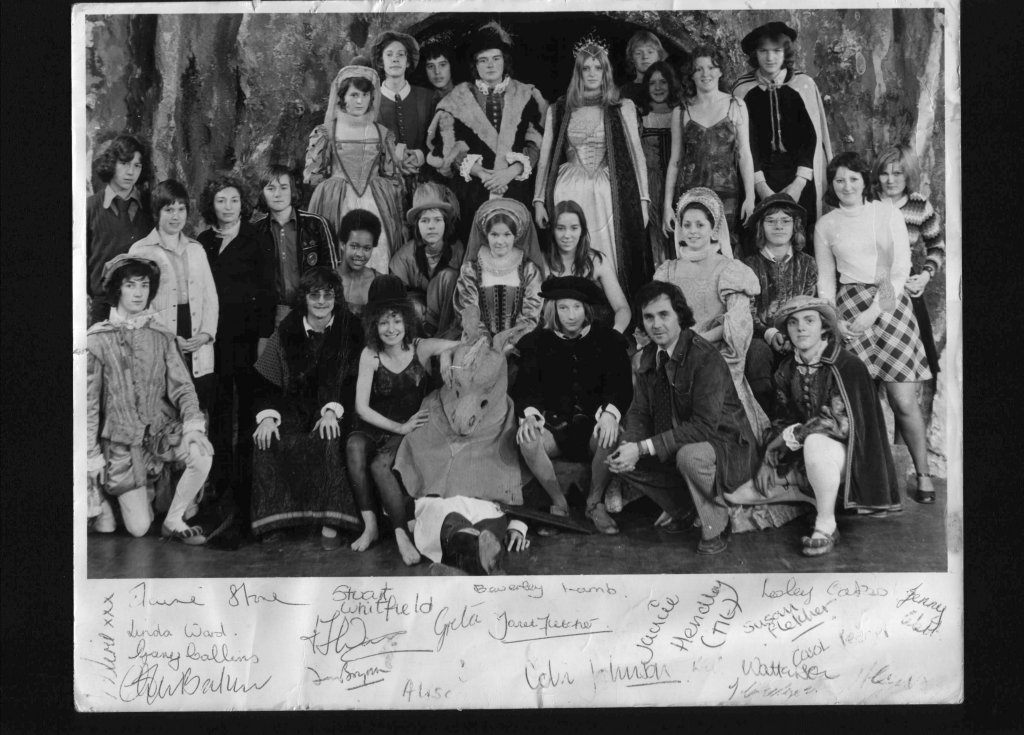
The start of the Shakespeare obsession. Yes, I am in there somewhere.
Fast approaching 50 and reflecting like mad. This production didn't only infect me with the Shakespeare bug, it introduced me to the music of Bartok: I now live in the part of the world he inhabited.

Theatre has been a major part of my life. Shakespeare fundamental to it.

This photograph captures almost the very moment all this happened. The people I now know little of but are echoing through my life.

Tuesday, January 17, 2006

Un Sex Me Here

or, 'Too much Freudship but not Jung enough'.

There seem to be a number of confused and confusing issues over the cross gender casting of characters in Shakespeare's plays. It is something of a Gordian knot - and I ain't no Alexander.
The first of these issues for me is a linguistic one, the second gender and the third, cultural.
A great deal of confused debate of the role of women comes, I believe (quite perversly some will say) from the misuse of the word sex.

Sex is a physical act, procreation/recreation.

To refer to a human being's sex, is going to reduce that being to a physical action: And define them by a very limited part of their activities (or their dangly bits).
Gender is the correct word for refering to a person's masculine or feminine identity. This is much more inclusive and incorperates aspects of personality which extend far beyond the physical.
Some of the people seem to be doing precisely that: Males are reduced to Homosexuals or Heterosexuals depending on the charater they are playing in a play. Those elements of themselves which they are using to illustrate female roles, which are held in common between male and female (after all, the word female contains male and there is a man in every woman - or a woman is 40% more extensive than a man) are ignored and the physical act of sex becomes the only issue.
It is worth remembering the Globe theatre wasn't a sex club in Amsterdam. One of the most famous scenes in Shakespere's works is the balcony scene in R and J: Have you ever thought why one of them is on a balcony and the other some distance away on the floor? I suspect it put a jolly good physical barrier between them which meant they could not do what a real pair of teenageers would do: You and me baby we ain't nothing but mammals.

Which brings me to Freud and Jung.

Freud smashed open the subconcious and ever since we have been stuck with it (Shakey didn't have to worry about all this). Essentially (short for over-simplification coming up) Freud saw sexuality in terms of suppression - of darkness of blindness. We repress and hide our physical urges (notice the focus) and this makes us all mad as hatters and in need of a very expensive analyst called Freud. It is interesting he uses Oedipus as his entry point: but that is all Greek to me.

Jung saw the subconcious heading on a journey to light: We ascend and try to comprehend; seek to see what life is for: To understand: This is the animus in all of us (male and female) and is a much stronger drive than the power drive or the sex drive (they do exist but are not dominant).

I find Freud useful some times, Jung most of the time in explaining why Shakespeare was so successful: he manages to hit patterns of behaviour which illustrate our basic drives.
Which brings me to the cultural dimension.

Shakey Baby lived in a world we can never know: No amount of reconstruction can return us to his world. Just think of the effect of now knowing Arabic numbers: We can never go back to a world where we do not know them, the world of Plato or Aristotle or St Paul (an aside, try turning 666 into Roman Numbers).
We are now living in a world of African States being run by elected women presidents. The USA might still be in the Dark Ages in this respect (executing blind old men sounds distinctly babarian to me) but much of the rest of the world recognises there is more to a woman than her sex.

Enough for now: Someone else wants to use the computer and I am getting off the point.

One last Question though: Shakespeare's acting troop is thought to consist of 16 males (12 "men" and 4 "boys"). Did the fact that he had an all male company to write for mean the roles he wrote for the female characters, by including the male elemnets, become fuller more rounded, greater than the sex? We shuld in fact be thankful the boys played the women.

Thursday, January 12, 2006

A Dreame.

Coming on the train to Romania yesterday I fell into a daydream.
I thought about the title of the play I have been spending so much time on. And had a very nasty thought.
So, I have just looked up the original printing of it: You can find it here:

http://prodigi.bl.uk/treasures/shakespeare/record.asp

That's the British Library for you - useful even on line.

What I notice is there is no punctuation. (Just what I suspected.)

Traditionally we add the apostrophe to night to make it look like it was one night and the dream belongs to that one night.
Why?

Why can't the s mean more than one night? A dream which takes place, not on Midsummer's Eve, but over several nights in midsummer.

Time has been causing me some problems recently so forgive the niggle I feel about this acceptance of a piece of additional punctuation which must be none sense.

At the start of the play Theseus talks about 4 nights - and his future missus repeats it.

When do we go into the forrest? The same day? Or does it take time for the lovers to sort out the escape?

And how long are they there?

The usual comment on all this is that Shakespeare didn't really take much notice of time: In which case, why did he mention it at all?
Or that he was careless: When we credit him with so much care in other areas?

There is a rather telling line in Henry 4, Part One (I think). Falstaff talks about being one of Dianne's servants: A thief of the night. This is just after Hal has asked about Falstaff's connection with time.
Could it be that, for Shakespeare, Time was only a phenomenon of the day light?

I shall be back on this one!

Friday, January 06, 2006

Forced Inertia

This seemingly throw away line has a whole lot of meaning behind it as far as I can see.
If you've lived on a farm in the more or less pre-industrialised, pre-enclosure world, one thing that happens each year is the re-walking of the paths you take. There are few fences or gates to get in the way and when people take a path, it is for a specific reason - and they go straight there, especially in the grazing areas.
The more elaborate the paths in an area, the greater the activity, the greater the movement.
If the paths have become indistinguishable, by early midsummer, then either there has been no growth of the vegetation, or no one has been moving. The word wanton would suggest the second of these - the green has run riot and overgrown. The green also suggest the village green where you would expect all sorts of comercial activity associated with the village.
When the weather is as bad as it was last summer in Romania, the paths were unworn. The feeling is one of tremendous imprisonment. Enforced inertia. Time stops, with the activity.
A note on the word quaint:

Friday, December 23, 2005

Want

To want something now seems a little selfish, to exercise a desire which is suggestive of action and force and demand.
In the line quoted above it is different: It is a lack of something - a thing needed, a thing not just expected but necessary.
The full effects of last winter on the farm are still emerging. It was an exceptionally long and cold one. The plum trees all lost their blossom to frost and the walnuts suffered equally.
So what?
Well, the year before we made well over 100 euros on the walnuts and were able to make over 30 litres of tuica (plum brandy to you).
100 euros is a whole lot of money in Romania - well over a month's income and more than enough to pay the annual taxes on the land. A signifficant amount of the walnuts are used to make cakes for Easter and Christmas - and add a lot to the local diet.
The tuica is what we drink to cheer us through the winter!
When Titania says this line - she knows its import.

Saturday, December 10, 2005

Rotten Corn

The ox hath therefore stretch'd his yoke in vain,
The ploughman lost his sweat, and the green corn
Hath rotted ere his youth attain'd a beard;

One result of the rains this summer in Romania has been the rotting of the corn - maize now, unlike the wheat of Shakespeare's day.
It is hard for all of those people who live in towns and cities to grasp the significance of this.
The corn is used for two purposes - feeding the chickens and livestock through the cold winter, and as a staple of the human diet. Bread is a luxury in many villages and there is nowhere to buy it anyway.
The traditonal wooden containers found in many farmyards, usually full at this time of year, are empty. The stalks of the maize plants are still standing - barren. Animals will have to be slaughtered, and chickens will go hungry, get smaller, lay fewer eggs.
People are going to go hungry, their diets will be limited and various degrees of malnutrition will set in.
This is the reality hidden in the words - a true horror to those who still live this life all over the world.

Thursday, December 01, 2005

Titania's Speech

Therefore the winds, piping to us in vain,

Perhaps the most interesting thing to come from my experience of the rain (previous post) is a realisation of just how physically real this speech is.

As we approach 2007 - the year when over half of the world's population will be classified as urban - connecting our personnel experiences with the natural elements of Shakespeare is becoming increasingly difficult.

I suspect, in Shakespeare's time, listening to Titania's speech was a much more powerful experience - it certainly is for me now - and physical/tactile rather than intellectual. There is an overwhelming sense of uncontrolled energy - an energy against which we are impotent.

My understanding of this is not now in terms of psychology - it is in terms of a concrete feeling based, as it must have been for the vast majority of Shakespeare's original audience, on being forced to endure a real storm.
Pelting rain is no longer just uncomfortable, it is a force to be reckoned with.
And this is not an extreme event (as it is sometimes suggested by people who have lived in the closed world of the ivory tower) - my experience was only on the edge of the really serious flooding that devestated parts of Romania.

Just as in the politic world of Theseus/Hippolyta, Egeus is being allowed to break the harmony and sends out the forces locked in the lovers; so in the natural world of Oberon and Titania, a dispute unleashes considerable natural forces, normally held in check.

Friday, November 25, 2005

Every Pelting River made Proud

The experience

We had our own Niagra Falls within seconds of it starting to rain: The guttering running the 20 meter length of barn roof was overflowing.

And I mean flowing - a solid, metalic sheet of water heaved itself off the roof and plunged onto the cobbles below. – I've lived on and off in the village for several years now and I'd never seen anything like it.

For well over half-an-hour the downpour hammered everything.

The yard was under several centemetres of water. Drainage was through the barn – soaking the bottom of the stored hay.

The tell-tale sound of flowing water signelled the road down the hill outside the main entrance had turned into a torrent – normally this only happenes in the worst of winter, when the ground is frozen – and rarely with such intensity; never for so long.

Plum and walnut trees seemed pressed down. Goodness knows where the birds had gone – they couldn't fly in this.

It was not dark exactly – the rain was light – but you only saw the rain – and how it was pushing against everything.

Inside, the chimney soon ran with water – the plaster was stained and I had to put down sponges and cloths to try to absorb some of the flow.

I moved the small icon I had bought in a flea market in Moscow, and the fine Chinese statue from Shanghai, off the mantle piece. A few old letters had already soaked through and were sticking.

I could only move things out of the way of the ever increasind drips and dribbles: The roof, not in the greatest of states, was incapable of holding out rain under this pressure: At one point, quite frankly, it seemed to me as if it had given up trying.

Back on the veranda the tiles were seaping. I saw one of the local house snakes glide up and into the summer kitchen – wether it was escaping the water or because it had scented a mouse escaping the water, I couldn’t tell – but at that moment any living thing I could attach an atom of sympathy to was a welcome sight.

There was nothing I could do: Whatever damage there was, there would be.

But damage was the wrong word – this was an unfocused, complete and all encompassing force – pressing squeezing, shifting – but not total. You knew it could do a lot more.

It was unmotivated, aimless, inpersonal.

One element – water – against … what?

Nature itself?