Showing posts with label Acting. Show all posts

Saturday, August 16, 2008

Now, I didn't know that ...

When the Globe burnt down in 1613, there was a ballad written (knew that): On the Pitiful Burning of the Globe Play-house (link and link)

What I didn't know was that it mentions in it:

Then with swoll'n eyes, like drunken Flemings,
Distressed stood old stuttering Hemings.
Oh sorrow, pitiful sorrow, and yet all this is true.


Now, cast your mind back to 'Shakespeare in Love' and the character who delivers the prologue at the start of Romeo and Juliet (video).


He stutters ... and I thought it was all a directors or writers idea - in fact it is based on a real actor (although the character in the film is not Hemings).

The real stutterer was' of course, behind the printing of the folio! He also seems to have apprenticed as a grocer, become a freeman of London and died wealthy ... acting was as profitable then as now.

(Sorry about the size of the video - not Geek enough to make it smaller!)

Technorati Tags: , ,

Sunday, June 08, 2008

I had a dream ...

... last night - very strange, flipping between seedy cellar flats in muddy London, Pet Shop Boys trying to pay me back for wood I'd bought on their behalf, a clamped delivery van and ever-lengthening queues to buy tickets for the London Underground whilst a woman I knew 'grilled' the ticket seller for information about times and place to for a Christian 'Timeout".

All irrelevant I hear you say, to the noble theme of Shakespeare - but from this melee of images and ideas I woke (the bloody Blackbird from Hades is back - 5.30 start this morning).

But I woke, once I'd shook the above from my head, with a thought - I bet the boy who played Speed in The Two Gentlemen of Verona, played Kate in 'Shrew'!

A bit of Brahms on the mp3, sink comfortably into the bed and work on it ...

It's the meeting of Kate and Petruccio ... the 'witty' exchange and battle of words: Speed does the same continuously in the earlier play.

But there is a difference - here, in The Shrew, it IS funny - or rather, is still funny.

In the former play, it is words words words - a bit of word-play, verbal fencing, wit for wit's sake; here there is something serious underneath.

In the former play it is intellectual; here it is emotional.

The former play needs a lot of support from the action to make the exchanges comprehensible - here most of the exchange is comprehensible as Kate attempts to bludgeon Petruccio - verbally and then physically.

But the comprehensibility comes not from understanding the words - it comes from understanding the intent.

The words really don't matter that much ... it is the play of emotion, the constant assault of Kate, the sidestepping, and deft pushing away of Petruccio, the resources and intellect shown by Kate, that matter.

Don't miss-take my meaning - if the words are understood, it is witty too - but the words are but a surface.

We've lost the full impact of the play on the word 'Kate' - we have to stretch our minds (or the audience's hearing) to make the pun work; we do not have to stretch anything to understand that 'teasing' a person about their name is a very, very irritating thing.

(Whilst we're at this point - does anyone else see the 'Hate-away' link?)

The exchange is earthy - intimations of sex (all but missing from Two Gentlemen) are here:

KATE.
Asses are made to beare, and so are you.
PET.
Women are made to beare, and so are you.

which is as clear as can be a reference to 'the getting of children'.

But there is also a great 'naturalism' in the exchange - they go on to talk of 'swaine' (don't forget the closeness of that word to swine - as in swine-herd); of buzzing bees and buzzards catching turtle doves that are too slow; of waspes with stings, wasps with tongues and tongues in "Taile' (which is too gross for the delicate sensibilities of this blog to explain).

To remind you:

PET.
Alas good Kate, I will not burthen thee,
For knowing thee to be but yong and light.
KATE.
Too light for such a swaine as you to catch,
And yet as heauie as my waight should be.
PET.
Shold be, should: buzze.
KATE.
Well tane, and like a buzzard.
PET.
Oh slow wing'd Turtle, shal a buzard take thee?
KAT.
I for a Turtle, as he takes a buzard.
PET.
Come, come you Waspe, y'faith you are too angrie.
KATE.
If I be waspish, best beware my sting.
PET.
My remedy is then to plucke it out.
KATE.
I, if the foole could finde it where it lies.
PET. Who knowes not where a Waspe does weare his sting? In his taile.
KATE.
In his tongue?
PET.
Whose tongue.
KATE.
Yours if you talke of tales, and so farewell.
PET.
What with my tongue in your taile. Nay, come againe,
good Kate, I am a Gentleman,

... and Petruccio claims no allegiance with courts, courtly love and such - he is a plain, honest Gentleman!

The speed of the movement of the images - sexual innuendo and the sheer energy needed to say these lines contrast remarkably from a similar early exchange in Two Gentlemen:

SP.
Twenty to one then, he is ship'd already,
And I haue plaid the Sheepe in loosing him.
PRO.
Indeede a Sheepe doth very often stray,
And if the Shepheard be awhile away.
SP. You conclude that my Master is a Shepheard then, and I Sheepe?
PRO. I doe.
SP. Why then my hornes are his hornes, whether I wake or sleepe.
PRO. A silly answere, and fitting well a Sheepe.
SP. This proues me still a Sheepe.
PRO. True: and thy Master a Shepheard.
SP. Nay, that I can deny by a circumstance.
PRO. It shall goe hard but ile proue it by another.
SP. The Shepheard seekes the Sheepe, and not the sheepe the Shepheard; but I seeke my Master, and my master seekes not me: therefore I am no Sheepe.
PRO. The Sheepe for fodder follow the Shepheard, the Shepheard for foode followes not the Sheepe: thou for wages followest thy Master, thy Master for wages followes not thee: therefore thou art a Sheepe.
SP. Such another proofe will make me cry baa.


The slowness of this, the teasing out of an intellectual thread, the silliness and the sound (all those s.s) suggest a very different approach ...

And yet ... if the same actor played Speed and Kate - do we get a deliberate contrast made, do we see Speed's wit behind Kate, and Kate as just another 'Act' on the World's Stage?

If she is - then it is the soldier she is playing rather than the lover. She is about to move on to the 'justice' - and that is where Petruccio is heading too. In the final act, Katerina does give judgement - on her sister and the widow ... but possibly on all mankind too.

But it flows both ways - Kate is in Speed too - he is the wild cat, who has been domesticated.

Speed is swinged into submission - in Shakespeare's Shrew, that doesn't happen to Kate; although the threat is there ... if she hits, he will hit back (so much for courtly love); Equal rights: Equal fights! I am not happy, by the way, with those productions where he does hit her - doesn't fit my view of him.

If the parts were played by the same 'boy', what a remarkable flexibility as an artist he must have had - and a strength in his personality, and an intellect?

Dare we suggest that Shakespeare was writing the part for the actor?

And, if Kate and Speed doubled - who did Petruccio double? Valentine or Proteus?

Technorati Tags: , , , ,

Powered by ScribeFire.

Thursday, June 05, 2008

Can you be induced ... ?

Neither of the two 'filmed' versions I watched of The Taming of the Shrew used the Induction. Few people know it, fewer regard it, some even claim it ain't Shakespeare ... and yet!

The induction does add to the play - if you think about it.

Not only that - if you follow the Oxford 'Complete Works' you are reminded of the framing plot in several places.

Most striking for me is the theatricality of it - if you add the induction (and rest) you never loose track of The Taming of the Shrew as a play - it is the play being performed for 'Sly' - he is (presumably) 'above' - or possibly in the curtained alcove at the back - he may be visible all through the play - maybe he is doubling a role (could he be Petruccio?).

Notice, you need to think of the staging techniques of the Elizabethan theatre to get part of the meaning out ... just as Peter Brook indicates - the platform stage is an active ingredient of the play.

As a play there is a sense of make-believe, of imitation rather than reality - a distancing - which allows the antics of Petruccio and Kate to be seen less as realistic than symbolic - as deliberate 'over the top' for amusement's sake. This is the stuff of farce ... no one is meant to take it seriously as 'serious' ... although farce does play on basic errors of humanity.

The induction starts with Sly being thrown out of an 'alehouse' by a 'baggage' - the Hostess. He falls into a drunken slumber ... this is all extremely extreme. We see excess - we start with lack of control and alcohol induced sleep - surely, when we see both Petruccio and Kate we see a further pair of examples of this extremity? Without the induction there is a danger of taking both male and female character as 'real'?

If played right the 'throwing out' is also funny - knock-about funny. I can't believe, in the spirit of 'Commedia', there was not improvisation - possibly even spoken dialogue improvised - at this point.
I wouldn't like to suggest a full 'Italian treatment' - alla the picture - but we should remember the first folio refers to 'Gremio a Pantelowne' - suggesting knowledge of the stock characters ... and also linking nicely with the induction.

A bit of rough and tumble at the beginning would also set quite a tone for what follows - very un-serious - but then, it is a comedy ... and maybe you should be very cautious when you read the scripts with 'comedy scenes' - especially as later in his writing Shakespeare has a character moan about comedians adding lines.

A word of warning over this one - everyone takes the words against comedians to be a reflection of Shakespeare's own thoughts ... strange, when for most of the rest of the time the very same people are cautioning us about taking the words of any one character as being Shakespeare's ... I have also seen the suggestion that Shakespeare himself, in his role as an actor, was not averse to taking on the 'lighter' roles ... and with his linguistic inventiveness and quick wit, I bet he was a great improviser!

Back to the induction.


A second (and third?) theme introduced in the induction is the 'correct order of things' - as reflected in 'the world turned upside down, of the lord serving the beggar and the male dressing up as female.

Very clearly the first is seen as a source of humour - firmly in the control of the 'Lord'. In the Taming itself, the role Kate takes on as Shrew can be seen in the light of this - both as an 'un-natural' and humorous manifestation ... it is absurd.
Is it also to be seen as role playing? Is she concious of the absurdity herself?

When you add to this the next factor - the play starts with a boy dressing as a woman ... the issue of illusion, of the reality of Kate being played by a boy .. and consequently reflecting a boyish spirit ... only leads to 'complexicate' the whole process.

How is it possible, without the induction, to raise these guidelines and issues?

Well, as I said at the start ... both the versions I watched left them out. The Zefferelli film did nod in the direction of drunkeness - the opening shots include a drunk being punished in a cage (which suspiciously looks like the opening of Othello in Orson Welles's film).

Can the induction work outside the theatre?

I don't think it can .. and I suspect you need a Globe-like theatre for it to really work ... one with a balcony above ...


Technorati Tags: , , ,

Tuesday, April 29, 2008

Original Pronunciation

Link for those interested:

Public Broadcast on Original Pronunciation at the Globe.

A lot of people seem unaware of the richness of resources available for reconstructing the sound - not the least being the glory of English Spelin - writ as proNounsed until some idiyuot invverntd dickshiooneries.

Too Bay, awe not to Bay!

Another link worth looking at is THIS: Jolly good fun for starters.

Finally - still to come over on the Music Review section of my blogomania is the piece on Elizabethan music being prepared as a response to all the cd and mp3 material I've been working through as a result of the 'Complete Works' project.


Technorati Tags: , ,


Saturday, October 20, 2007

In black and white 2:


2. Is this a question of Politics or Theatre?

I left off last time with a question – could Iago be played by a black actor?

It is a question with its origins in a debate that took place way back in the 70s when they were casting the first filmed version of ‘Jesus Christ Superstar’ – Norman Jewison the director, had cast a white Jesus and a black Judas . There was a bit of an outcry at the ‘negative image’ created by such a casting (remember, we are at a time when race issues were to the forefront of politics in a number of countries).

Quite rightly Mr Jewison pointed out that the ‘political correctness’ of those protesting was blinding them to the ‘unprejudiced’ nature of the casting – and that those objecting were, at best, misguided: What is trying to stop a black man from playing a major role in a major filmed musical on the grounds of the colour of a his skin if it is not prejudice?

I think this highlights the problem of political correctness and acting Othello – and also gives the best answer to the problem – to deny any actor the right to play any character in the play on the grounds of their race (and I’d add gender and culture) is just plane wrong – it is a denial of our common humanity and a clear example of prejudice.

It is also a common mistake ‘in understanding’ of the nature of theatre: Nothing on the stage is real – everything is illusion (and isn’t): All the World’s a Stage.

Shakespeare knew all about the illusions of life and the stage and one place he tackles it is in ‘A Midsummer Nights Dream”. His rude mechanicals hang on to the need to ‘bring moonlight’ into the hall they are to perform in – and they have to give the ‘lion’ a speech of denial – don’t be fooled, he’s really a man, not a man eater. Shakespeare is taking a quick kick at the literal minded (and dangerous) Puritans – but also exploiting what for many people at the time was an essential question – what is the nature of reality and the connection between the life we lead and what we really are?

No doubt exists in my mind that Othello is was meant to be looked on as a potential ‘everyman/everywoman’. (I also think the same of Shylock.)

There is a correction in the above paragraph is has been turned to was – as I have pointed out elsewhere, the text we have inherited is incomplete: The director, actors and audience do not miraculously shed the contemporary when they enter the theatre – despite the illusions of costumes and design, the obscuring quaintness of some of the language and tedious programme briefs, today is ever present.

I live in a country, Romania, where once performances of Shakespeare could carry a revolutionary message – when Ian McKellen brought his Richard III to Bucharest, the audience knew it was about dictatorship and corrupt political government – just like that of Ceausescu’s.

Whilst not wishing to limit theatre to this potential political dimension, it is a legitimate concern at times and a legitimate function of ‘theatre’. Brecht, after all, did exist. The casting of a white man as Othello can be symptomatic of political and social oppression. How Brecht would have challenged such oppression in the theatre I cannot say – but I can be certain he would have challenged it.

But Stanislavski also existed. And Eisenstein. Russia, during iconoclastic, revolutionary times producing icons for the future of almost the oldest profession in its newest manifestation.

How we got to modern Hollywood from such noble ancestors beggars belief, but we did (sorry – I actually enjoy a lot of the output of Hollywood, but I’ve got my low-grade-intellectual hat on at the moment).

Film, as it appears in Western popular entertainment, promotes a deceptive realism. If a character is meant to be ‘Afro-American’ he has to be played by ‘a person of colour’. The only exception I can think of to this in recent cinema is Antony Hopkins – who played (excellently) an ‘interesting’ part in a ‘worthy’ film about a ‘black’ man whose skin colour was light enough for him to pass as ‘white’ and who eventually gets accused of racism against black students.

Mr Hopkins, of course, also did a brilliant job as Othello in the BBC Shakespeare.

With the majority of people’s exposure to acting and storytelling (and, I suspect, Shakespeare) being essentially ‘filmic’, it is not surprising that a recent conversation I had with one young man, to whom I had lent Orson Welles’ film version of the play, started with the question – “Why didn’t they cast a black actor as Othello?” He went on to say you could tell Othello was wearing makeup.

I wonder if he would ask the same question about a stage performance?

If he lived in the USA most likely – combine the political realities with the deceptive film reality and expectations would be casting to ‘type’.

Over in Britain there has been a tradition of black actors playing Othello (from Paul Robeson onwards) at the same time as more traditional castings such as Laurence Olivier (in a controversial blacked-up performance).

But then again, British theatre productions owe a much stronger debt to Brecht than to almost any other practical theatre theoretician. It is one of those delicious ironies that an approach to theatre designed to focus the audience on social and political issues can result in magnificent musical dross like ‘Cats’ – which, in case you didn’t realise it, employed some of the greatest of Britain’s Shakespearean talent in its original production.

So, to return to my question, is this issue one of Politics, or Theatre?

Yes.

You have to make a choice – Politics or Theatre: Power or Imagination.

They are not the only choices available nor, necessarily, the most important; neither are they mutually exclusive, but they are certainly potent and polarising.

But what about the acting?


Thursday, September 06, 2007

Me at work!

Results of Shakey and You!

Click on the above or see me here too:

All the World's a Stage:


To Be:


Romeo and Juliet:


Voice of an Angel


(Well, maybe not!)

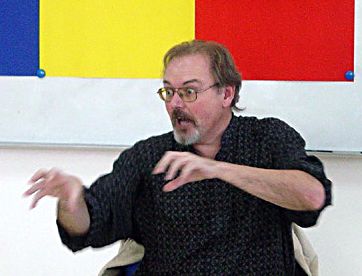
That's me to the right on stage leading the recent international workshop on texts held in Timisoara.

Click on the link to the name and you can hear me hamming my way through a couple of Shakespeare texts for Librivox.

Can't excuse myself really, but very limited equipment and somewhat rushed - still authentic Farrar.

(Willy Russel did say once that I was a, "King Actor - just like Orsen Welles: Maybe not good, but loud enought to do the BIG parts!"

Friday, August 31, 2007

Right Royal for Free!

You just drop into a site and find things.

The RSC has video to watch - interviews, extracts, bits and bobs.

Why didn't I know that?

http://www.rsc.org.uk/explore/

Tuesday, August 21, 2007

Ambience and Accident


I'm just coming out of a week of workshop and performance with a mixed group of enthusiastic amateurs and (what I like to refer to as) proto-professionals.

What started off as a performance of a cut down Shakespeare, ended as a most interesting experiment in the application of 'ambience' and 'accident' to a variety of text extracts. The basis remained Shakespeare - as reflected in the 'All the World's a Stage' speech which both started and ended the performance.

On Friday evening, as the sun set, we promenaded the texts in front of an invited audience - in the local botanical garden, a public place which hadn't been closed to 'the public'. Most definitely intended as (as one participant phrased it) a work in progress, resonance and echo, bright bombs of ideas and dud squibs have been infecting my waking thoughts since.

The strongest image I come up with is that of Seurat's, 'La Grande Jatte'.

In that remarkable work, individuals, pairs and small groups are placed in a man adapted landscape: So too with our texts.

Monologue, dialogue and more extended extracts from scenes were placed in a landscape which evolved out of the mixture of human decision and selection, and the more powerful vagaries of natural growth working on a genetic ‘text’.

This is a rational/real-isation ‘After the fact’, but so much of what happens in theatre is precisely thus - no excuse needed.

Environment and text interacted far more powerfully than I anticipated (or hoped for). Indeed, I am not sure I was consciously aware of the potential when I started on the workshops.

What the gardens were originally chosen for – backdrop and oddness, colour and outdoorness, time and light - soon transformed the scenes.

The strongest effect, in performance, was to unify. Under the green wood, along the paths, confined in the fenced space; but much stronger in feeling was the awareness of people – the park was full of humans – like La Grande Jatte on a Sunday morning.

These people were sitting, talking, walking, playing guitar, watching the children – and the ‘actors’ were no different – they too were in the playground, a natural part of the park: Truly, all the world had become the stage.

Each text was given a relevance – and the extracts became caught moments of other people’s conversations.

Caesar was just walking along the footpath amongst a group of friends and between the park people when from another path, across the formality of a flowered bed, the soothsayer shouted her warning – a moment only, then passed on – not time to catch more than an awareness of other people’s lives.

Later, on a zigzag Chinese bridge, over a dry pond, Oberon has just parted from Titania – and calls for Puck to fetch the magic flower – a dog barks as he mentions the singing of the mermaid, children are noisily playing, a family, pushing a child in a buggy stop and watch, then move on – a man with his children had watched the actors ‘rehearsing’ a previous scene – time looped.

Sunday, July 15, 2007

Performing Again

Not often I have the chance - but a couple of weeks ago I did my best to drag some willing Romanians into Shakey's world.

Striking thing was where and when I performed.

Outdoors, in a courtyard (about the size of a typical pub courtyard), in daylight on a slight platform.

It was impossible not to 'talk' to the audience - when I did the 'monologues' they became multi-logues.

'To be or not,' is dialectic!

We assume Shakspere was being Rhetorical - but he isn't.

More work and thought needed on this one.

Friday, July 13, 2007

For the Actors:

Some notes on Elizabethan character

There are 3 key aspects to understanding the Shakespearean construction of character:

1. The belief in types;
2. The idea of reality;
3. The didactic purpose of art.


1. Types

In the ‘All the World’s a Stage’ speech, Jacques, ‘provides us with a series of little character sketches, all self-contained, each stage apparently deriving nothing from the age before.’ ([Greer) There are ‘rites of passage’ between roles – but the human being is seen as playing stock roles.

An important thing to understand at this point is that these ‘roles’ are not caricatures – Jacques might pencil-in some small details as illustration – but he does use the words ‘Acts’ to describe each period of time – the theatre is aiming to show a complete, not a partial, view. There will appear ‘several’ versions of a type on stage, and frequently one man in one play will act several parts.

If we look at the ‘act’, Soldier in Jacques speech, some interesting detail comes out – applicable to all the soldier roles in Shakespeare’s plays. He is expected to be bearded ‘like the pard’ – marking his masculinity in contrast to the earlier, almost effeminate lover, and marking his rough wildness in contrast with the ‘formal cut’ magistrate.

We might choose to believe ‘you can’t judge a book by its cover’ – but, ‘clothes maketh the man!’ – very much so in Elizabethan England where rules on how you dressed could determine your right to move through the country. ( I am tempted to suggest modern airport security checks are not much different.)

A beard, is a beard, is a beard – but can you grow one, how thick is it and do you cut it ? The talliban understand that quite clearly.

‘Jealous in honour’ – your soldier has to measure himself against others – he is seeking an almost Mafia-like purity of honour: Whether it is Pistol or Hotspur.

Sudden and quick in quarrel – how else can you be ‘macho’? There is a tiresome stream of quarrelling youth in Shakespeare’s History plays – frequently indulged by their elder relatives – it is, after all, an aspect expected in this role. It is an aspect disrespectful of rank and nationality; both the French Court and the English campfire display it.

What is genius in Shakespeare is not the ‘breaking out’ of the constraints of these characteristics, but the variation he manages to display within the boundaries – and the consequent depth he is able to take our capacity to reflect.

It is a concept of character that is also very useful in displaying sudden change – the change that so frustrates the method actor: Hal becomes, through the ‘rite of passage’ of coronation a new character type – King.

Falstaff, at the same time, possibly as a consequence of the realisation of his true role, turns to the final act – second childishness and mere oblivion, sans teeth, etc.

This concept of character role extends into real life.


2. Reality

The comparison of ‘The World’ to ‘A Stage’ is a very common idea in the Renaissance – way back in the 15th Century, Pico Dello Mirandola, said at the very beginning of his ‘Oration of the Dignity of Man’,

Quote:
I have read in the ancient writings of the Arabians that Abdala the Saracen on being asked what, on this stage, so to say, of the world, seemed to him most evocative of wonder, replied that there was nothing to be seen more marvellous than man.

(An alternative translation renders the phrase, ‘on this stage, so to say, of the world,’ as ‘in this theatre of the world.’)


And in Shakespeare’s time:

Quote:
What is our life? A play of passion
Our Mirth the music of division;
Our mother’s wombs the tiring houses be,
Where we are dressed for this short comedy;

(Sir Walter Ralegh)


Shakespeare himself constantly reminded his audience of this idea –

Quote:
Antonio: I hold the world but as the world … a stage where every man must play his part, and mine a sad one.

Macbeth: Life’s but a walking shadow; a poor player, that struts and frets his hour upon the stage . . .


So what, in Ralegh’s terms, is dressed in the tiring house of the womb? What is it that, actor like, plays its part?

The Human Soul.

To quote Greer again:

The soul was not simply a static entity, like an invisible identity card, but a dynamic principle, the fire breathed by God into the clay. Just as the actor animated different trappings in different situations in the same play, and in different plays at different times, the soul animated the protean body through all its changes.

The body and all it goes through – whether it be ‘the slings and arrows of outrageous fortune’, or ‘a little time to monarchise’ – is just the costume and action of a brief play – the reality, the living soul, endures before and after the illusion of performance.

But the soul is not accessible – you cannot cut it out, you cannot ask it directly – ‘there’s the rub’.

Like some Elizabethan cult of celebrity, the question was constantly asked – what is the actor really like? What does he use when he acts on the stage that truly reflects the real he?

In other words, what is illusion and what truth?

Method acting tends to look for the ‘true’ person within the uniqueness and isolation of individuality and personality – what actions and history have shaped and moulded this character.

To the Elizabethan this is to deny the fundamental principal of ‘free will’ – how could an outside force ‘shape’ and determine the free soul?

To the Elizabethan the question is, ‘What choices have been made?’

Because, to quote Ralegh further:

Quote:
Heaven the judicious sharp spectator is,
That sits and marks who doth act amiss;


The theatre can be seen as not just a metaphor, but a real ‘acting out’ of the human situation. Shakespeare never lets go of the play between reality and illusion – and never lets his audience forget the freedom of choice being made – Hamlet’s ‘Thus conscience does make cowards (of us all)’ comes at the end of a question, ‘To Be or ….?’

Conscience is a product of the soul – which was believed to reside in the head - it is a ‘dynamic’ force that interacted with our thoughts giving humans the power to choose, always, between right and wrong.

And like in tennis, where the game is never lost until the last ball, the soul is able to reach god, is free to repent, even up to death.

One of the jobs of the theatre was to illuminate the constant choices being made in daily life and to illustrate the consequences: Art was needed to cut away the detritus of confusion, and the bare stage was a good place to do it.


3. Didactic Purpose

To suggest that Shakespeare and his team were only writing ‘entertainments’ is to miss the significance of the regular, constant and quite widespread attacks that were made on ‘the theatre’ at the time.

The Puritan attacked because acting was seen as lying – imitating speech and actions taught people to be untruthful. Also attacked by the Puritan was the acting of female parts by males (still, and perhaps more, ‘mis-taken’ nowadays), which was seen as just plain evil.

The good councillors of the city of London – and a sizeable proportion of its citizens of worth – disapproved of the theatre not only because of the disease, lewdness and distraction from work engendered by the performances, but also because it raised questions of authority and power.

The need for companies to be ‘under the protection’ of some great Dignity was not only ‘protection’ from prosecution for vagabondage, but also a great way to secure self-censorship from the companies and keep them not ‘off’ the hot topics of the day (Politics and Religion), but within the right, state approved, view.

Plays were used in school to teach boys –serving both as a delight and an instruction. Pupils were taught to ‘read’ pagan classic texts, like Terence, as sources of insight into Christian morality – line by line.

Finally, Sir Philip Sidney’s ‘Apologie for Poetry’ makes the didactic claim, as does Hamlet in his ‘mirror up to nature’ speech – which must surely be a typical Shakespearean ‘quote’ of Donatus on Comedy: ‘imitatio vitae, speculum consuetudinis, imago veritatis’ (an imitation of life, a mirror of manners, an image of truth).

What all of these things have in common is the belief that a public performance of a play, not only could, but would with certainty, instruct. It would present ‘a truth’, which the audience would believe and possibly act on. It would thus be a force – whether for good or evil depending on the content and the audience’s point of view.

Shakespeare wrote knowing he had a responsibility to portray ‘… the relation between God and man, of ways of behaviour both ideal and reprehensible, and the demonstration of ethical issues’ (Greer, pg. 28 ).

Another thing that is very special about Shakespeare is that he not only took this duty seriously – but seems to relish the role of teacher – and teacher of the groundlings: He focuses on the ‘uneducated’ on the un-schooled – but he never compromises or writes ‘down’.

In Henry V, the didactic responsibility (as outlined by Greer) gives an extra dimension to both the action and the actors’ performances. (I’m using Henry V as an example – but I think the idea is applicable to all of Shakespeare’s plays.)

The prologue makes a claim for the King – he is Godlike – the god happens to be ‘Mars’, but that would be seen by the Elizabethan’s as a metaphor for an aspect of the ‘True God’: Look at Michaelangelo’s portrayal of Christ in ‘The Last Judgement‘ in the Sistine Chapel, and you have your Mars/Henry. But also look at the portrait of Elizabeth in armour at Tilbury – that also is Henry.

The actor is playing the ‘role’ of King – but so too is the real King – he has also ‘assumed’ the God-given Role. When the prologue points out the stage is just a show – the audience know that the ‘theatre of the World’ is also just a show.

The prologue goes on to point out that the actors are ‘but ciphers’ - one person represents many – a very clear statement of the representative nature of the characters. Pistol is not the portrayal of a real human, but the distillation of many – his characteristics have been selected not on the basis of psychological truth, but verisimilitude. His purpose is to represent and illustrate.

Just as Shakespeare frequently uses blank verse to heighten the language, so he heightens characters – truth can only been seen through art. The real is to be found not in the slavish reproduction of the illusion of the world, but in the artistic recreation of the hidden truth.

Hamlet’s advice to the actors should not be read as a proto-Stanislavskian manifesto – it is an appeal against excess and illusion – but that illusion is as much the illusion of the world as of the stage.


Quotes from Greer: http://www.oup.com/uk/catalogue/?ci=9780192802491